How Often to Clean, Inspect and Service Your System, and What It Should Cost
Most Arizona solar owners never schedule solar panel cleaning and inspection until the electric bill climbs. By then, a loose connector, a dead monitor or months of caked-on dust has been quietly costing them output for a long time. Solar has no moving parts, so it is easy to assume it needs no attention. In the desert, that assumption is the most expensive one an owner can make.
The reason is simple: nothing about a struggling system announces itself. There is no warning light on the wall, no noise from the roof and no letter from the utility until the numbers have already slipped. Arizona makes it worse. Summer heat expands and contracts connectors every single day. Dust storms and monsoon grit settle on the glass, and light rain tends to smear that grit rather than rinse it away. Birds and rodents nest under arrays and chew wiring. Meanwhile, the solar monitoring system that was supposed to keep watch may have gone offline months ago, or may belong to an installer that shut down in Arizona.
This guide gives that attention a name: the system health check. It combines solar panel cleaning and inspection with production verification into one routine, so you stop treating them as three unrelated chores. Cleaning restores the light reaching your panels. Inspection checks the wiring, the inverter and the monitoring. Verification compares what your system actually produces with what it should, so you know the work made a difference.
Below, you will find how often to do each part, what it should include, what it should cost, and what to do when something has already gone wrong. Whether your system is two years old or fifteen, whether you installed it yourself or inherited it with a house, and whether your installer is still around or long gone, there is a section here for your situation.
Start with the situation map that follows, find the row that sounds like you, and jump straight to it. If you only do one thing this week, compare your production now with the same month last year. That single number tells you whether you have a quiet problem worth fixing.
Do these three things this week:
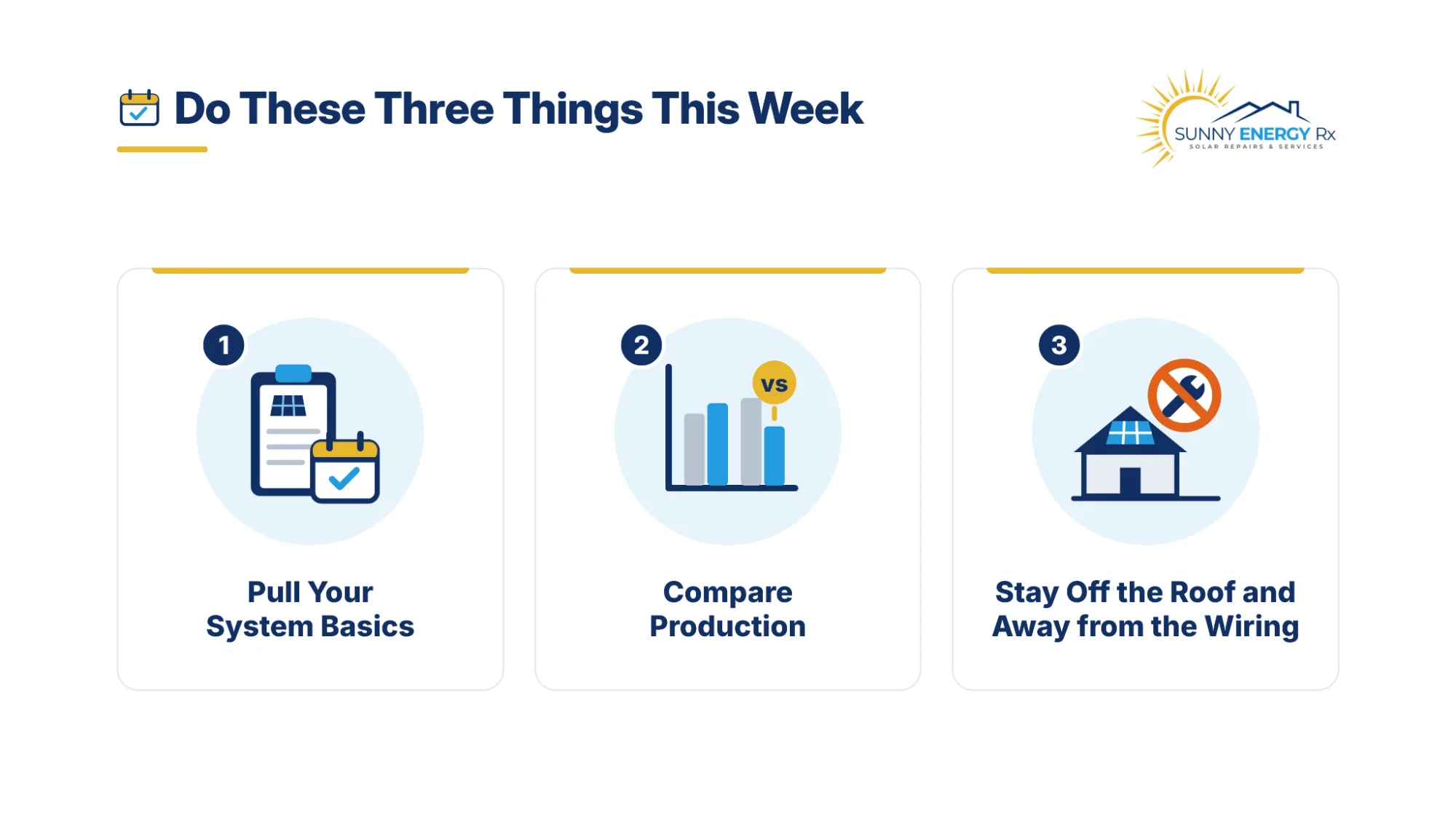
Pull your system basics. Write down the install date, the panel and inverter brands, and the date of the last service or cleaning, if there ever was one.
Compare production. Look at output now against the same month last year, using the app, the inverter display or your utility bill.
Stay off the roof and away from the wiring. Hosing hot panels and DIY electrical checks can damage equipment and put your warranties at risk.
The next step involves understanding which problem you are in.
Situation Map: Find Your Starting Point
# | What you're facing | What it usually means | First move this week | Jump link |
1 | Not sure how often solar panel cleaning and inspection should happen, or yours is overdue | Arizona dust and haboob seasons build up on panels, and rain rarely rinses them | Compare production to the same month last year | Section 1 |
2 | Panels are dirty, or you're wondering about solar panel cleaning yourself | Dust and hard-water spots are cutting output | Check the panels from the ground and compare production | Section 2 |
3 | Annual solar panel inspection is due | Routine check of wiring, inverter and monitoring | Gather your system basics | Section 3 |
4 | System has never been serviced (5 to 15 years old) | Hidden faults are likely after years without a check | Book a full first inspection | Section 4 |
5 | SunPower, Tesla or SMA system | Brand-specific tools and checks apply | Note your model and serial numbers | Section 5 |
6 | Buying or selling a home with solar, or your installer is gone | You need a documented system condition, and service and warranty questions need a new owner | Collect the contract, permits and equipment details | Section 6 |
7 | You want a maintenance plan | You want routine care without remembering it | List what you want covered | Section 7 |
8 | You need to know what diagnosis, inspection or repair costs | Prices vary by system size and fault | Ask about the diagnostic fee first | Section 8 |
9 | Monitoring is offline or comms are disconnected | A reporting fault, not always a production fault | Check the inverter display | Section 9 |
10 | Bill is high, or the utility says solar isn't producing | Output has dropped or stopped | Compare production to the bill | Section 10 |
11 | Panels damaged, or disconnected after roof work | Physical damage or an incomplete reinstall | Photograph it and stay off the roof | Section 11 |
12 | Failed installation inspection, or permit question | A correction and re-inspection are pending | Find the inspection notice | Section 12 |
Ready to stop guessing? Book solar panel cleaning and inspection as a Solar System Health Check, or ask about a Maintenance Plan with Sunny Energy RX: 480-470-1023.
Explainer: Cleaning vs. Inspection vs. Maintance: What Each One Is and Isn't
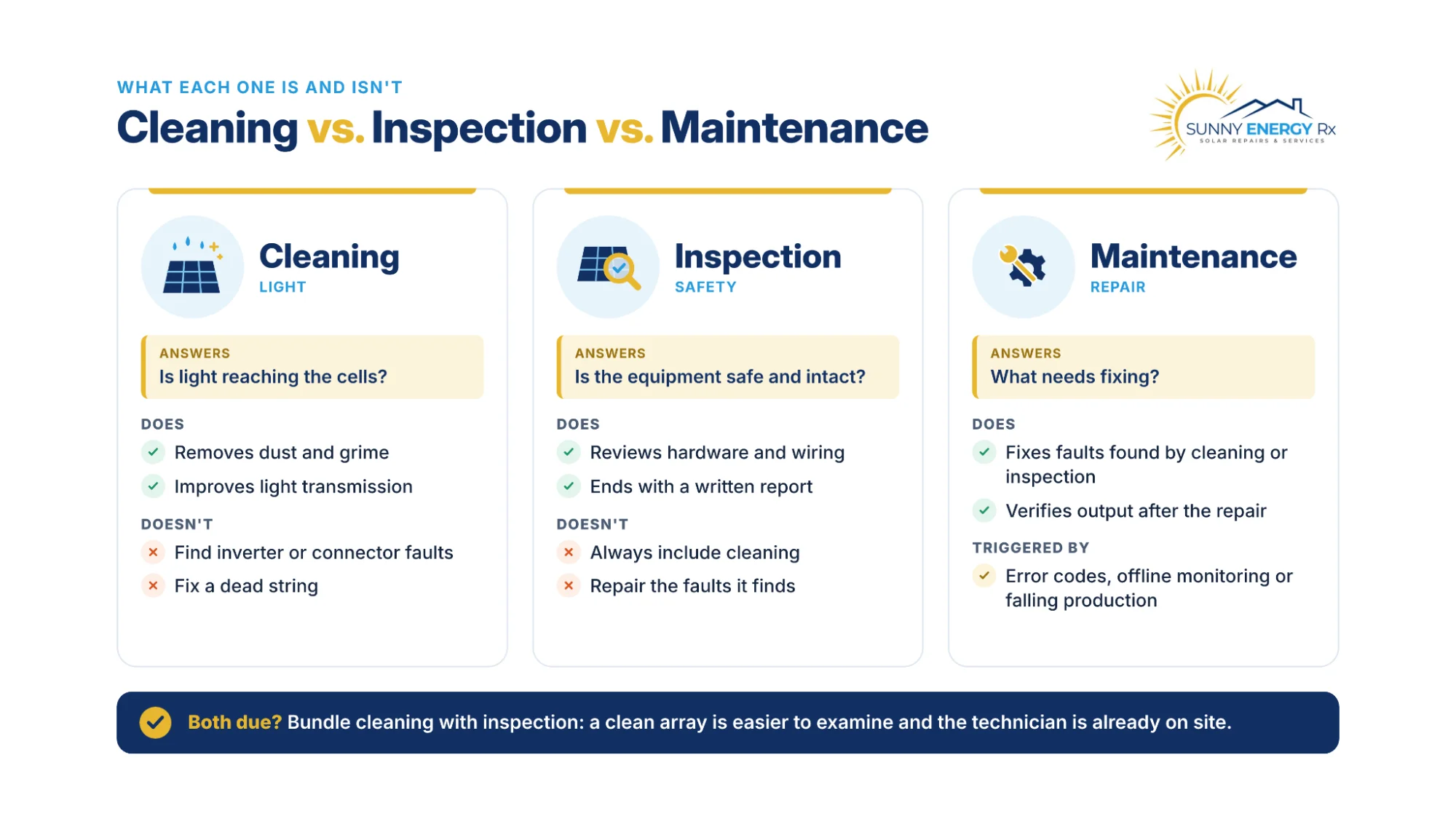
Solar panel cleaning and inspection, plus maintenance, sound similar, but they answer different questions. Cleaning asks whether light is reaching the cells. Inspection asks whether the equipment is safe and intact. Maintance fixes what the first two find.
Cleaning alone will not find a failing inverter or a loose connector. A clean panel can still sit on a dead string. An inspection does not always include cleaning either, so ask before you book. Bundling solar panel cleaning and inspection into one visit usually makes sense, because a clean array is easier to examine and a technician is already on site.
What You're Seeing
"I got it cleaned but my production is still low." "They inspected it but never washed it."
What's Actually Happening
Each service has a different scope. Cleaning improves light transmission only. Inspection reviews hardware and wiring. A repair visit for solar system repair is triggered when either one, or the production data, reveals a fault.
The Fix
Ask any provider exactly what is included before booking.
Request a written report for inspections.
Bundle solar panel cleaning and inspection when both are due, and ask any solar inspection company exactly what the visit covers.
Treat error codes, offline monitoring or a falling production trend as repair triggers.
Verify output again after any repair.
With the three services defined, the most common question is the practical one: how often each of them should actually happen in Arizona.
1. HOW OFTEN TO CLEAN AND INSPECT
"How Often Should You Schedule Solar Panel Cleaning and Inspection "
Quick Answer: Most Arizona systems need solar panel cleaning and inspection on a set schedule: an inspection once a year and cleaning one to two times a year, depending on dust and rainfall. Cleaning restores lost output, while an inspection checks wiring, the inverter and monitoring. If your system has never been serviced, start with a full health check, then set a schedule. |
What You're Seeing
"Due for yearly inspection and cleaning." "The panels look dusty." "I haven't had it checked in five years."
What's Actually Happening
Arizona's dust, monsoon and haboob seasons deposit fine grit on glass. Light desert rain often leaves mud spots instead of rinsing panels clean. That is why "do solar panels need cleaning in Arizona?" has a different answer here than in rainy climates, where regular rain does much of the work.
Once you have a rough rhythm in mind, here is how to put it on your calendar and keep it there.
The Fix
Schedule one solar panel inspection a year, ideally before summer peak demand.
Plan solar panel cleaning once or twice a year, and after major dust storms.
Check production monthly against the same month last year.
Log every cleaning and inspection date in one place.
If a gap has passed with no service, book a full health check through our solar panel inspection services first.
Field note: A homeowner who bought a house in 2020 with owned solar never had it inspected or cleaned. A first visit found heavy dust and one failed comms device.
Yes, usually. Arizona's dust, pollen and monsoon grit build up on panels, and light rain often smears rather than rinses. Most systems benefit from cleaning once or twice a year, more after major dust storms.
Yes. Even if nothing looks wrong, years without service allow loose connections, pest damage and failing communications to develop unnoticed. A first inspection establishes a baseline and catches hidden faults before they become expensive.
Yes. An inspection before a warranty expires can document defects while claims are still possible. Keep the written report with your warranty paperwork. Check each manufacturer's terms, because coverage periods differ by equipment type.
Many owners clean before the hottest, highest-demand months and again after monsoon season. Clean when panels are cool, early morning or evening, to avoid thermal stress and streaking. Your technician can recommend timing for your location.
How Sunny Energy RX handles this: with 17+ years in Arizona solar, we time our solar panel cleaning and inspection visits around how dust and monsoon seasons affect real systems.
Knowing the schedule is half the job. The other half is knowing how to do the cleaning part safely, and when to hand it to a professional.
2. CLEANING IN ARIZONA
"Can I Clean My Solar Panels Myself, and What Does Professional Cleaning Cost?"
Quick Answer: You can rinse ground-accessible panels yourself if they are cool, the water is gentle and you never climb onto the roof. Roof arrays, hard-water spotting and stubborn grime are better left to professionals. Professional cleaning prices vary by panel count and access, so request a written quote for your system. |
What You're Seeing
"Panel needs cleaning and maintenance." "Looking for a panel wash and then a service contract." "Can I just use a hose?"
What's Actually Happening
Phoenix-area tap water is often hard, and hard water dries into white mineral spots that scatter light and are tough to remove. Spraying hot glass with cold water also stresses it. Pressure washers can force water into seals and void warranties. Dust itself, rinsed gently, usually comes off easily.
If cleaning is worth doing, the next step is knowing what is safe to try yourself and when to hand it off.
The Fix
Clean early morning or evening, when panels are cool to the touch.
Work from the ground only. Never walk on or lean a ladder against the array.
Use a soft brush or sponge with plain water, or a mild non-abrasive solution. Avoid pressure washers and harsh chemicals.
Prefer soft or purified water where possible to limit mineral spotting.
Hire a professional solar panel cleaning service for roof arrays, two-story homes or stubborn residue. See the best way to clean solar panels on the roof for details.
Field note: A Chandler owner with about three dozen panels rinsed them with a hose in the afternoon and left white mineral streaks that reduced the benefit of the wash. A professional soft-water cleaning removed the spotting.
Yes, if you can reach them safely from the ground. Use cool panels, gentle water and a soft brush. Never climb onto the roof, and avoid pressure washers, which can damage seals and risk your warranty coverage.
Often, yes. Dust and grime block sunlight, so removing them can restore lost output. The gain depends on how dirty the panels were. If production stays low after cleaning, another fault likely exists, which is why solar panel cleaning and inspection work best together.
Soft or purified water is generally the better choice here. Phoenix tap water is hard, and as it dries it leaves mineral deposits that dull glass. Professionals commonly use filtered water to avoid that spotting.
A typical home array takes a few hours to clean professionally, depending on panel count, roof pitch and access. Ground-mount arrays can be quicker to reach but larger. Ask your provider for a time estimate when you book.
Cost depends on panel count, roof access, water method and how dirty the system is. Many companies quote per panel or per visit. Request a written quote from a licensed provider rather than relying on generic national averages. Our solar panel cleaning cost guide explains what affects the price, and solar panel cleaning and bird proofing can be bundled in one visit.
How Sunny Energy RX handles this: our warranty support experience means we know which cleaning methods protect your manufacturer coverage.
A clean array is only part of the picture. Next, here is what an annual inspection checks beyond the glass.
3. WHAT AN ANNUAL INSPECTION INCLUDES
"What Does an Annual Solar Panel Inspection Include?"
Quick Answer: An annual inspection checks panels for damage, racking and mounts for looseness, conduit and wiring for wear, the inverter and breakers for faults, and monitoring for reporting. It ends with a production check and, ideally, a written report. It does not always include cleaning, so confirm that when you book. |
What You're Seeing
"Just need basic maintenance and inspection to ensure everything is running properly." "Check and maintenance on system." "Installed 2019, just want an inspection."
What's Actually Happening
Most owners cannot see problems from the ground. Loose connectors, chafed wiring, pest nesting and failing inverter components hide under and behind the array. A professional solar system inspection turns those invisible risks into a written list. Regular solar panel checks are far easier to act on than a vague sense that something is off.
Here is the checklist an owner should expect, so you can compare solar inspection companies on equal terms.
The Fix
A solid annual inspection covers:
Panels: cracks, discoloration, hot spots, loose edges.
Racking and mounts: tightness, corrosion, roof sealing around attachments.
Conduit and wiring: wear, exposed conductors, rodent damage.
Inverter: error codes, status, ventilation, firmware.
Breakers and disconnects: condition, labeling, secure connections.
Monitoring: online status and accurate reporting.
Production check: actual output against expected output.
Written report: findings, photos and recommended fixes.
A thorough inspection reviews panels, racking, wiring, the inverter, breakers and monitoring, then compares production to expectations. It should end with a written report that lists findings, photos and recommended repairs, so you have documentation.
Most residential inspections take a couple of hours, depending on array size, access and whether electrical testing is included. Larger or ground-mount systems take longer. Ask for an estimate when scheduling so you can plan access.
Routine inspection and cleaning typically do not need a permit. Repairs or equipment replacement may, depending on your city or utility. Your technician can tell you whether the planned work triggers a permit or utility sign-off.
A useful report lists system details, condition findings by component, photos, production data, safety concerns and recommended repairs in priority order. Keep it with your warranty documents and records, because it helps with claims and home sales.
How Sunny Energy RX handles this: inspections are performed by NABCEP certified technicians who document findings in writing.
An annual inspection assumes a system with some history. If yours has gone years without a single visit, the first inspection deserves a closer look.
4. FIRST INSPECTION ON A SYSTEM THAT'S NEVER BEEN SERVICED
"My System Has Never Been Serviced. What Should a First Inspection Cover?"
Quick Answer: A first solar panel inspection on a never-serviced system should cover everything an annual check does, plus a baseline review of wiring condition, inverter health, communications and production history. Expect to look for loose connections, pest damage, failed monitoring and aging inverters. The goal is a complete picture, then a prioritized repair list. |
What You're Seeing
"Fifteen-year-old ground mount, never been serviced, needs a full evaluation." "A ten-year-old system that needs repair and continuous maintenance." "The original monitoring device died."
What's Actually Happening
Years without service let small problems stack up. Connectors loosen with heat cycles, rodents chew insulation, comms devices fail and inverters age. Because monitoring often dies first, owners lose visibility just when it matters, and the only warning is a higher bill.
Because a never-serviced system has so much to check, here is how to approach the first visit.
The Fix
Gather every record you have: contract, equipment list, permits and warranty papers.
Book a full solar system inspection rather than a quick visual check, and combine it with solar panel cleaning and inspection of the whole array.
Ask for a baseline production comparison and a written report.
Have a technician inspect wiring, connectors, inverters and comms hardware.
Review a prioritized repair list and decide what to fix now and what to monitor.
Is it worth repairing a system this old? Often, yes. Panels commonly outlast other components, so replacing a failed inverter or comms device can be cheaper than replacing the system. Compare repair cost to the output you would regain, and get a written assessment first.
Field note: A large ground-mount system with several inverters lost its wireless inverter communications after years without service. A first inspection restored visibility and found additional issues that had gone unnoticed.
Common findings include loose or corroded connectors, rodent or bird damage, failed monitoring or communications, degraded inverters, cracked panels and disconnected strings. Many are invisible from the ground, which is why a first inspection often reveals more than owners expect.
Compare current production to the same month in earlier years, check the inverter display for faults and confirm monitoring is reporting. If numbers have dropped or data is missing, a technician should test the system directly.
It is a combined routine of cleaning, inspection and production verification. For a first visit it also sets a baseline, so future checks can compare against a known condition and spot gradual decline before it hits your bill.
Yes. An inspection while coverage is active can document defects while claims are still possible. Keep the written report with your warranty documents, and review each manufacturer's terms, since equipment coverage periods differ.
How Sunny Energy RX handles this: with 17+ years in solar, we have seen what a decade of Arizona heat does to a system nobody has checked.
A first inspection looks at equipment generically, but some brands have quirks of their own. Here is what changes when your system is a SunPower, Tesla or SMA installation.
5. BRAND-SPECIFIC INSPECTIONS
"What Should an Inspection of a SunPower, Tesla or SMA System Include?"
Quick Answer: Every brand gets the same core checks: panels, wiring, inverter, monitoring and production. What differs is the tooling, the monitoring platform and the certification a technician needs. SunPower, Tesla and SMA systems each have unique components, so choose a company experienced with your specific equipment. |
What You're Seeing
"Eight-kilowatt SunPower system installed in two phases, a few damaged panels, disconnected comms. Need an audit." "Need to clean and inspect 32 Tesla panels."
What's Actually Happening
Different brands use different inverters, monitoring platforms and warranty rules. A technician who knows one ecosystem well may struggle with another. Systems installed in phases can also mix equipment, which makes a brand-aware audit more important.
With those brand differences in mind, here is how to prepare and what to ask when you book.
The Fix
Note the brand and model of your panels, inverter and any battery.
Ask the provider whether they have worked on that specific equipment.
Request a written report covering production and communications.
Confirm whether manufacturer warranty terms require certified servicing.
Keep serial numbers and registration details in your records file.
SunPower: Often multi-phase or mixed-equipment installs. Focus on panel condition, comms, damaged modules and production auditing. Company status changes may affect who handles claims.
Tesla: Check panels, the inverter and, where present, the Powerwall battery and its connection. The Powerwall inspection scope needs confirming before publication.
SMA: Typically string inverters such as the Sunny Boy. Check the display, fault logs, ventilation and communications, including Bluetooth links.
It should cover panel condition, damaged modules, wiring, inverters, communications and a production audit against expected output. Multi-phase systems deserve extra attention, since mixed equipment can create mismatches. Verify brand-specific details before relying on them.
Not always. Some manufacturers require certified technicians for warranty work, and some equipment needs specific tools. Ask whether the company has handled your exact brand before, and request proof of relevant certification.
It should check the battery's status, connections, communications and how it interacts with the rest of the system.
It can, because specialized tools or certification may be involved. Costs vary by system size and scope, so request a written quote. Pricing needs business approval before being published on the page.
It can if the manufacturer requires certified technicians and the work was not done by one. Check your warranty terms first, and hire a technician with the credentials your manufacturer specifies.
How Sunny Energy RX handles this: we service all major brands, so your SunPower, Tesla or SMA system gets a technician who knows it.
Brand matters even more when a home changes hands, because a buyer inherits equipment they may know nothing about.
6. BUYING OR SELLING A HOME WITH SOLAR
"How Much Is a Solar Inspection Before Buying or Selling a House?"
Quick Answer: Pre-purchase and pre-sale solar inspection prices depend on system size, access and report depth, so ask for a written quote. The inspection checks panel and inverter condition, wiring, monitoring and production, then delivers a report. A standard home inspector typically does not assess solar in depth. |
What You're Seeing
"How much is an inspection on a house I'm buying, and how fast can someone come?" "Buying in Peoria, owned solar, the company is no longer in business." "Solar inspection as part of the purchase agreement."
What's Actually Happening
Buyers inherit the system, but not always the paperwork, monitoring login or warranty rights. Sellers want proof the system works. A documented inspection protects both sides, and an installer that has closed makes records harder to track down.
Whether you are buying or selling, the same orderly steps keep the process on track.
The Fix
Ask the seller for the contract, permits, equipment list and monitoring access.
Book a solar-specific inspection early in the purchase timeline.
Request a written report with findings and production data.
Identify the equipment and installer so warranty transfer can be checked.
If the installer is gone, see our troubleshooting guide for orphaned solar systems.
It checks panel condition, mounts, wiring, the inverter and monitoring, then compares production to expectations. A written report summarizes findings, so buyers know the system's condition before committing to the purchase.
It is not always required, but it is wise. A general home inspector typically does not test solar performance, so a dedicated inspection reveals hidden faults and records you may need for warranties and financing.
Many can do a visual review, but fewer are equipped to test production, inverter health or communications. A solar-specific technician gives a deeper answer. Ask your inspector what they cover.
Gather the contract, permits, equipment serial numbers, warranty registrations and monitoring login. Transfer requirements vary by manufacturer and utility, so confirm the forms needed and any fees before closing.
How Sunny Energy RX handles this: our warranty support experience helps new owners work out what coverage still applies to the system they inherited.
Once a system is inspected and documented, many owners ask how to keep it that way without remembering to book every visit, which is where maintenance plans come in.
7. MAINTENANCE PLANS
"Do You Offer a Solar Maintenance Plan, and What's Included?"
Quick Answer: Yes. Sunny Energy RX offers ongoing Solar Panel Monitoring & Maintenance for Arizona homeowners, including systems we did not install. The service combines Monitoring Assurance, where we watch your production data and contact you when something looks wrong, with scheduled cleaning and inspection visits. Call 480-470-1023 to set up a visit schedule for your system. |
What You're Seeing
"Just looking into a maintenance program." "Looking for a panel wash and then a service contract." "I need continuous maintenance."
What's Actually Happening
Most Arizona owners want service to happen on a schedule so they don't have to remember it. That matters more here than almost anywhere else. Haboobs coat panels in dust, rooftops pass 130°F in summer, monsoon winds put stress on mounts, and pigeons nest under arrays to escape the heat. Many systems in the state are now 10 to 15 years old. A lot of them lost their installer along the way, so nobody is checking the data anymore. Sunny Energy RX built its maintenance service to fill that gap. It has three parts:
Part of the service | What we do | Why it matters in Arizona |
Monitoring Assurance | Review your system's data throughout the year, check that performance looks reasonable, and contact you if something looks off. If your monitoring is offline, we fix it. | A fault shows up in the data weeks before it shows up on your APS, SRP or TEP bill. |
Scheduled cleaning | Remove dust, debris and bird droppings from the panels. | Desert dust and haboobs cut output between rain events. |
Inspection and performance check | Check the panels, inverter, visible wiring and roof mounts, and look for signs of nesting. | Heat and monsoon weather wear components down quietly. |
When a visit or an alert turns up a fault, we explain it and give you an estimate before any repair work starts. You decide what happens next.
The Fix
Open your monitoring app and note whether it shows current data. If it shows nothing, see our Monitoring Offline guide
Gather your records: panel and inverter brands, the install year, past service dates and your warranty documents.
Call 480-470-1023 and tell us your equipment brands and system age. We service SolarEdge, Enphase, SMA, Fronius, Tesla, SunPower and legacy string inverter systems.
Start with Solar System Diagnostics and a cleaning so we have a record of your system's current condition. This step matters most if the system hasn't been serviced since it was installed.
Choose a visit frequency. Most Arizona homes do well with one visit a year. Homes near desert lots, construction or heavy traffic, or homes with birds, usually need cleaning twice a year or more.
Ask us to put the inclusions, visit frequency and anything excluded in writing before your first scheduled visit.
Warranty Considerations
Manufacturer warranties typically cover equipment defects, and the terms vary by brand. Work by an unqualified technician can void a warranty, and a dated service history can help support a future claim. Our Warranty Claim Assistance handles the paperwork. The manufacturer makes the final decision on every claim.
Field note: A Surprise owner of a system more than a decade old moved from occasional visits to a scheduled plan after finding out that monitoring had been down for months without anyone noticing.
It includes Monitoring Assurance, scheduled panel cleaning, and an inspection and performance check. When we find a fault, we explain it and give you an estimate before any repair. We put the inclusions and visit frequency in writing.
Plan on at least one full service visit a year. Homes in dusty areas, near construction, or with pigeon activity usually need cleaning twice a year or more. A check after monsoon season catches storm-related problems early.
Yes. Sunny Energy RX services systems no matter who installed them, including orphaned systems whose installer has closed. We work on nearly every major brand and start with a diagnostic visit to set a baseline.
How Sunny Energy RX handles this: Our NABCEP-certified technicians, backed by 17+ years in solar, handle your Solar Panel Monitoring & Maintenance. The team that cleans your panels is the same team watching your data. We are the solar service company you can still call years later.
A schedule keeps routine costs predictable. When something breaks, owners want to know what diagnosis and repair will cost, and that's the next question.
8. WHAT DIAGNOSIS, INSPECTION AND REPAIR COST
"How Much Does a Solar Diagnosis, Inspection or Repair Cost?"
Quick Answer: Costs vary by system size, the fault and how much time a diagnosis takes. For ongoing upkeep, see solar panel maintenance cost. Many solar panel inspection companies charge a diagnostic or service-call fee, and some credit it toward the repair. Request a written estimate that separates the diagnostic fee from parts and labor, so you can compare providers fairly. |
What You're Seeing
"How much do you charge for a diagnosis?" "Is solar maintenance expensive?" "What does it cost to repair a cracked panel?"
What's Actually Happening
Solar faults are hard to price over the phone. A single symptom, like low production, can come from dust, a loose connector, a failed inverter or a disconnected string. A technician usually needs to test the system before quoting a repair, which is why diagnostic fees exist.
Since the unknowns are what worry people, here are the questions to ask before anyone comes out.
The Fix
Ask whether there is a diagnostic or service-call fee, and what it covers.
Ask whether the diagnostic fee is applied toward the repair.
Request a written estimate that itemizes parts, labor and fees.
Ask whether estimates for repairs are free.
Keep the estimate with your records, and compare at least two providers.
Many companies charge a diagnostic or service-call fee because the technician must test equipment on site. Ask up front what the fee covers, how long the visit takes and whether it counts toward the repair.
There is no single average, because repairs range from a reconnected wire to an inverter replacement. Cost depends on the fault, the equipment and the labor involved. A written estimate after diagnosis is more reliable than any average.
Some do, and some bundle the estimate into a diagnostic fee. Ask whether an estimate is free once the problem is identified, and whether it is binding. Get it in writing either way.
Generally, upkeep is modest compared with the system's value. Routine cleaning and inspection are the main costs, and prompt repairs prevent bigger ones. Costs rise when problems go unnoticed for years, so regular checks tend to save money.
How Sunny Energy RX handles this: with 17+ years in the industry, we explain what a diagnosis involves before the visit, so there are no surprises.
Many repair calls begin with the same symptom: an app that says the system is offline. Here is what that message really means.
9. MONITORING OFFLINE
"Does 'Monitoring Offline' Mean My Solar Panels Stopped Producing?"
Quick Answer: Not necessarily. "Offline" usually means your monitoring device has lost its connection, so data is not reaching the app. Your panels may still be producing. Check the inverter display, your router and your utility bill before calling, because those tell you whether the fault is reporting or production. |
What You're Seeing
"Monitoring says offline." "The original monitoring device died." "Disconnected comms." "Need a firmware update or new comms hardware."
What's Actually Happening
Monitoring runs on its own communications hardware and your home Wi-Fi, separate from the panels. A changed router password, a failed gateway or outdated firmware can break reporting while the system still generates power. The risk is that a real production fault can hide behind that silence.
Before you call anyone, a few owner-safe checks can tell you which kind of problem you have.
The Fix
Check the inverter display for error codes or a stopped status.
Restart your Wi-Fi router and confirm the internet is working.
Open the monitoring app and look at the last reported date.
Compare your utility bill or meter data to earlier months.
If data is still missing, book a technician to test the communications hardware.
If your installer has closed, the monitoring account may be tied to a company that no longer exists. See the companion orphaned-systems guide, and the monitoring guide for deeper troubleshooting. Our professional solar monitoring system services can replace failed hardware.
Field note: A system showed as offline for months. The panels were producing, but the failed gateway meant no one noticed a separate string fault until the bill rose.
It usually means the monitoring device cannot send data to the app. The cause may be Wi-Fi, a failed gateway or a firmware issue. It does not by itself prove the panels stopped producing.
No, not on its own. Panels can keep producing while reporting fails. Confirm with the inverter display and your utility bill, because a hidden production fault can mask itself behind missing data.
Often yes. Failed gateways and communications devices can usually be replaced or updated by a qualified technician. Compatibility depends on your inverter and brand, so have them confirm what your equipment supports.
Firmware updates typically need manufacturer tools or app access, and sometimes a certified technician. Do not attempt electrical work yourself. Ask a qualified provider whether an update or new communications hardware is needed.
Monitoring devices remember your old Wi-Fi details. When the network name or password changes, they cannot reconnect until reconfigured. Re-pairing the device to your new network often restores reporting.
How Sunny Energy RX handles this: we work with all major brands' monitoring platforms, so we can restore reporting whichever system you have.
Offline monitoring is one cause of a mystery. The other common clue is the electric bill itself, which is where we turn next.
10. HIGH BILL, SOLAR NOT PRODUCING
"Why Is My Electric Bill High Even Though I Have Solar Panels?"
Quick Answer: A high bill with solar usually means the system is producing less than expected, or your usage or rate plan changed. Common causes are dirty panels, an offline inverter, disconnected strings or a new rate structure. Compare your production data to your bill to find out which one it is. |
What You're Seeing
"Higher electric bill than average." "APS says my solar isn't producing." "SRP bill is high, and I don't know why."
What's Actually Happening
Your bill reflects both what your panels produce and how you use power. If production has dropped, you buy more from the utility. Rate plan changes can also raise bills even when the system works well. Looking at production alone, or the bill alone, hides the real cause.
Once you know the possible causes, comparing your numbers will rule them in or out.
The Fix
Check the inverter display for faults or a stopped status.
Compare this month's production to the same month last year.
Review your utility bill for solar credits and any rate plan changes.
Look at the panels from the ground for obvious dirt or damage.
Book a solar panel inspection if production is down or the utility says solar is not producing.
For deeper analysis, see our guide on solar panels not producing.
The system may be producing less because of dirt, an offline inverter or disconnected strings. Your usage or rate plan may also have changed. Comparing production data to your bill shows which cause applies.
Treat it seriously. Check the inverter display, compare production to earlier months and look at the panels from the ground. Then book a technician for diagnosis, because the utility's data can reveal a fault you cannot see.
Yes. Heavy dust reduces output, and in Arizona that can accumulate quickly. Professional solar panel cleaning may restore production, but if the bill stays high afterward, another fault such as an inverter issue is likely.
Yes. Time-of-use schedules, demand charges and credit changes can raise bills even when panels perform normally. Review your plan with your utility, and compare production to expected output to separate the two causes.
How Sunny Energy RX handles this: our warranty support experience helps when the cause turns out to be a faulty component still under coverage.
Sometimes the explanation for lost production is physical: a broken panel, or one disturbed by other work on the roof.
11. DAMAGED OR DISCONNECTED PANELS
“Can One Broken Solar Panel Be Replaced, and What About After Roof Work?”
Quick Answer: Yes. A single damaged panel can usually be handled through solar panel replacement, and panels removed or disconnected during roof work can be reinstalled through solar panel removal and reinstallation and tested. The technician should match the replacement to your system, check every electrical connection and verify output afterward. Who pays depends on the cause, so document everything first. |
What You’re Seeing
“I need damaged panels replaced or re-attached.” “I can see cables slung over one of the panels.” “I think my roofing guy disconnected some of them.”
What’s Actually Happening
A cracked or damaged panel can pull down the whole string it belongs to. After roof work, loose cables often mean part of the array was never reconnected. Because the rest of the system still produces, owners usually notice only when the bill rises. Responsibility depends on the cause: a roofer who disturbed the array may owe the repair, while a manufacturing defect may fall under an equipment warranty.
Damage and disconnection are physical and electrical problems, so the safest first move is to document, not to touch.
The Fix
Photograph the damage and any loose cables from the ground, without climbing or touching anything.
Write down when the roof or other work happened and who did it.
Book a solar panel inspection to confirm which panels and strings are affected.
Ask the technician to check connections, replace what is damaged and confirm output afterward.
Ask whether a warranty claim applies, and keep every report and invoice.
For next steps on leaks and coverage, see the solar panel roof repair guide and the warranty guide. Also read our guide on solar panel damage
Yes, in most cases. A technician can swap a single panel, but the replacement must be compatible with your system, and the connections must be tested afterward. Older panel models can be harder to match, so identify yours first.
Cracked glass generally cannot be reliably repaired and may let moisture in, so replacement is usually the answer. A technician can assess the damage and recommend the safest option for your equipment and your warranty situation.
The technician should confirm every panel and string is reconnected, inspect wiring and connectors, verify the inverter reads all strings and compare output to expectations. A written report documents the result for your records.
It is possible, especially if panels were removed or disconnected. Responsibility depends on who did the work and what was agreed. Document the timeline and damage, then speak with the roofer and your service provider.
It depends on the cause and the coverage that remains. Manufacturer warranties often cover defects but not damage from outside work. Check your documents, and ask your provider to help determine whether a claim applies.
How Sunny Energy RX handles this: we work on all major brands, so panel replacement and reinstallation are matched to your specific equipment.
Physical repairs often bring paperwork with them, which leads to the last situation on the map: inspections and permits.
12. FAILED INSPECTION OR PERMIT QUESTIONS
“My System Failed Its Installation Inspection. What Now?”
Quick Answer: A failed installation inspection means the inspector found items that don’t meet code or approval requirements. The installing contractor is normally responsible for corrections and for requesting the re-inspection. If your installer is gone, a licensed company can review the report and complete the corrections. |
What You’re Seeing
“Failed installation inspection.” “Does this work need a permit or inspection?” “Who fixes it, and what happens next?”
What’s Actually Happening
A failed inspection is a list of items to correct, not a verdict on the whole system. Typical issues involve labeling, wiring, mounting or documentation. Until the corrections are made and the re-inspection passes, approval to operate can be delayed. Responsibility usually follows the contractor who did the work, and permit rules vary by city and utility.
With the cause understood, the way forward is a short, orderly sequence.
The Fix
Get a copy of the inspection notice and the list of items to correct.
Contact the original installer first and ask for a timeline.
If the installer is unavailable, hire a licensed contractor to review the notice.
Have the corrections completed and documented in writing.
Ask the contractor to schedule the re-inspection and confirm any utility steps.
Field note: A system failed its inspection over a labeling and documentation issue. After a licensed contractor made the corrections and booked the re-inspection, it passed.
You receive a list of corrections. Once they are completed, a re-inspection is scheduled. The system generally cannot be approved to operate until it passes, so working through the list promptly keeps the delay short.
Usually the contractor who installed the system. If that company is out of business or unresponsive, you may need another licensed contractor to take over. Ask for a written scope so you know exactly what is being corrected.
New installations and some repairs or equipment changes typically require permits and inspections, while routine cleaning and basic maintenance usually do not. Requirements vary by city and utility, so confirm with your contractor.
Timelines depend on your local jurisdiction and its scheduling. Once corrections are finished, your contractor requests the re-inspection and the inspector sets the date. Ask your contractor for an estimate based on current local availability.
Yes, a licensed contractor can usually take over the corrections. Share the inspection notice and your system documents, and confirm the company can pull any required permits and arrange the re-inspection.
How Sunny Energy RX handles this: with 17+ years in the industry, we know how to read an inspection notice and get corrections completed.
With all twelve situations covered, one question remains: how to choose a right company?
How to Choose a Company for Inspection and Maintenance
Not every provider is set up to service a system it didn't install, so ask a few questions of any solar service professionals first.
NABCEP certification. Ask whether technicians hold it, since it signals recognized solar training.
Arizona ROC license. Confirm the company is licensed for solar and electrical work in Arizona.
Brand certifications. Ask which equipment brands the company is certified or experienced to work on.
Experience with systems it didn’t install. Ask how they handle missing records, orphaned monitoring accounts and mixed equipment.
A written scope. Ask for a report that lists what was checked, what was found and what to do next.
Ready for a licensed, NABCEP-certified team to run a full health check on your system? Call Sunny Energy RX at 480-470-1023.
Most Arizona systems should be inspected once a year and cleaned one to two times a year. Heavy dust, nearby construction or long dry spells can justify more frequent cleaning. Your production data is the best guide.
Yes, in most cases. Arizona’s dust, dry climate and hard water leave residue that rain rarely removes. Regular cleaning helps panels produce closer to their potential.
Cost depends on panel count, roof access and how soiled the panels are. Request a written quote that lists what is included.
It covers panels, racking, conduit and wiring, the inverter, breakers and monitoring, plus a production check and a written report. Some providers add thermal imaging.
Costs depend on the fault, system size and access. Many companies charge a diagnostic fee, and some credit it toward the repair. Ask for the policy and a written estimate first.
Costs depend on the fault, system size and access. Many companies charge a diagnostic fee, and some credit it toward the repair. Ask for the policy and a written estimate first.
Not necessarily. It usually means the system stopped reporting data. Check the inverter display and your utility bill, and have a technician diagnose the communication fault.
About the author
Joseph Cunningham
Published · Updated