
What Happens to Your Solar System Now, and How to Keep It Producing
Arizona’s solar industry has seen installer closures, mergers, and bankruptcies. When solar companies went out of business, many homeowners were left unsure who would service their systems. These systems are known as orphaned solar systems, and their owners are often called solar orphans.
The good news is that an orphaned solar system does not automatically stop working when its installer disappears. However, without regular performance checks, working app access or routine maintenance, problems such as declining production or inverter faults can go unnoticed. In Arizona, these issues tend to develop faster. Extreme heat strains inverters, dust reduces output, and monsoon storms can damage panels and wiring.
To help you take over where your installer left off, this guide covers how to assess your system’s condition and spot common problems. It also shows you how to locate essential records, understand your warranty options, and find qualified help. Solar should be easy to own for the long run, even when your installer disappears.
Before troubleshooting your system, put safety first. Read below and follow the instructions to remain protected when dealing with solar panels.
Safety First: Read This Before You Touch Anything
Solar equipment carries high-voltage DC electricity, and roofs can become dangerously hot. Even if your system appears to have stopped working, avoid investigating electrical components or climbing onto the roof yourself.
Never open inverter, combiner box, or DC disconnect enclosures as internal components may remain hazardous.
Stay off the roof during extreme heat or monsoon weather. Leave rooftop inspections and repairs to qualified professionals.
Know where your rapid shutdown switch and AC/DC disconnects are located. Photograph their locations from a safe position without opening any enclosures.
Treat burning smells, smoke, arcing, buzzing, melted components, swollen batteries, or exposed wiring as potential emergencies. Keep your distance and call 911 or the fire department when there is immediate danger. Contact the utility or a qualified electrical professional as appropriate.
With safety covered, you can move on to the recovery plan.
Orphaned Solar System Recovery: Document, Diagnose, Restore, Protect
If your solar company went out of business, these steps are best completed in the first week. This protects your system and warranties while you figure out who will service it.
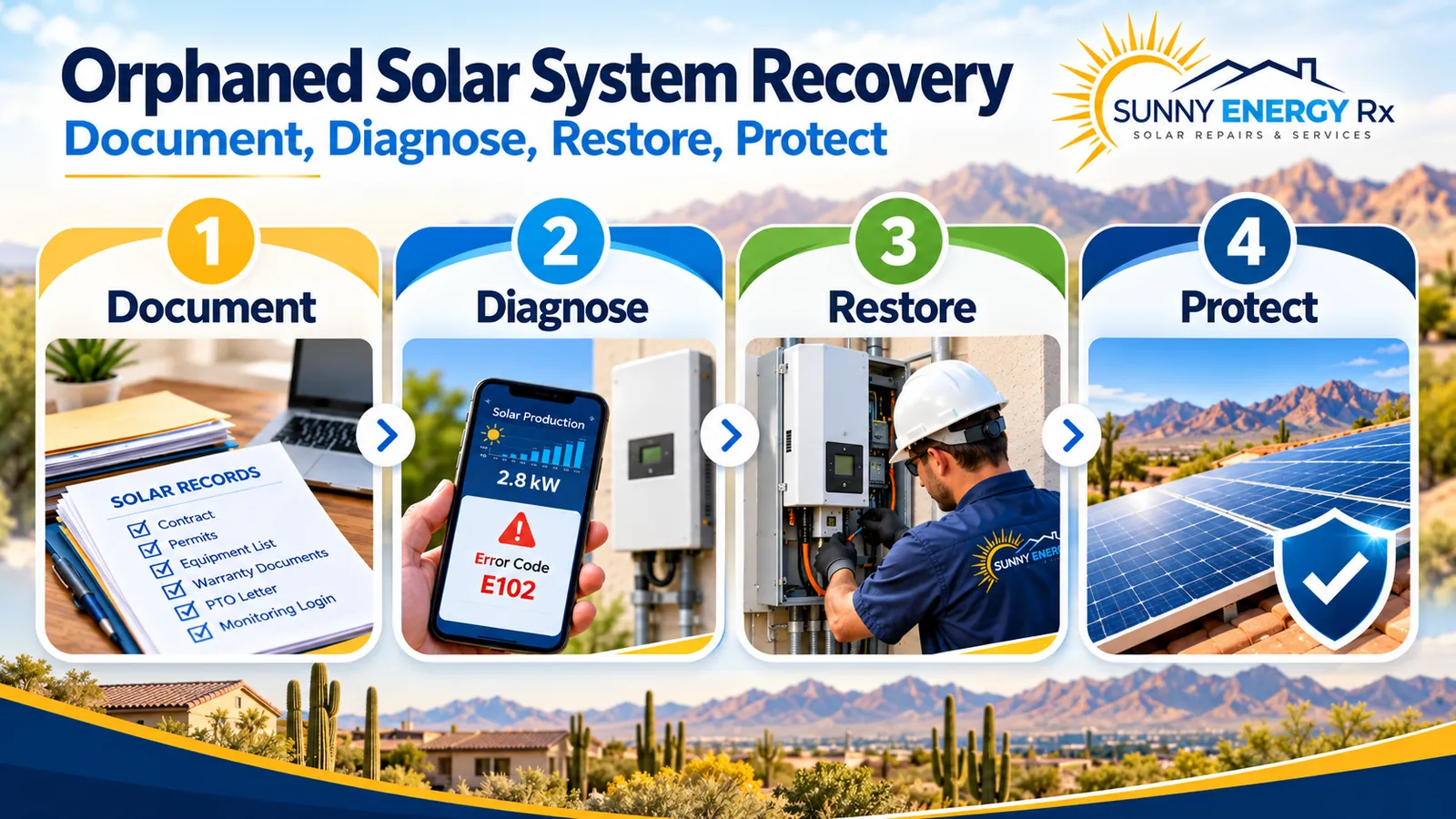
Note: This is just a quick overview, and we will discuss each step in detail later in this guide.
1. Document
Start here this week: Save your records before they disappear. A closed installer’s website, customer portal, and monitoring login can go offline without warning. Download or photograph your contract, permit, equipment list, warranty documents, PTO letter, and monitoring login details. Search your email for the installer’s name to find invoices and warranty registrations.
Then: Request permit and inspection records from your city or county and build a complete Solar Records File.(discussed in the section “Your Solar Records File: Essential Documents for Solar Orphans in Arizona”)
2. Diagnose
Start here this week: Check production now. Look at your inverter display or monitoring app for a reading or error code, and photograph any code. With no app access, compare this month’s utility bill with the same month last year.
Then: Book a professional inspection and get the findings in writing.
3. Restore
Choose a licensed service company, approve repairs, and replace failed parts or monitoring equipment.
4. Protect
Start here this week: Keep untrained hands off the equipment. Manufacturer warranties often require qualified technicians, so don’t let a handyman or a door-to-door “free inspection” open the inverter or move panels until you have checked their ROC license and brand experience.
Then: Add a maintenance plan or workmanship coverage, and confirm it doesn’t conflict with manufacturer warranties. (discussed in the section Can I Buy a New Warranty for an Existing Solar System?)
Once these steps are done, use the Situation Map to find the section that matches your problem. The sections below explain how to approach common problems, from lost monitoring access and reduced production to warranty claims, roof leaks, and missing installation records.
Solar Orphan Situation Map: Find Your Problem Fast
Before we move, let us understand: not every solar orphan in Arizona faces the same problem. Some are simply left without an installer, while others are dealing with warranties, equipment failures, monitoring issues, or billing concerns.
This map is designed to help you quickly identify your situation, whether you’re dealing with offline monitoring, dropped production, missing documentation, or a closed installer. From there, it points you to the right section and the first steps you can take this week.
# | What you're facing | What it usually means | First move this week |
1 | Installer closed, nobody to call | Your service contact is gone, but the equipment usually keeps running | Gather records and find a certified service company |
2 | Your installer was Titan, Freedom Forever, SunPower or similar | Status varies by company | Verify the company's current status from official notices |
3 | Equipment failed and no installer to file the warranty claim | Manufacturer coverage often still applies | Collect serial numbers and contact the manufacturer |
4 | You want a replacement or third-party warranty | Installer workmanship coverage may have ended | Ask about a service plan from a qualified company |
5 | Production dropped or stopped | Could be a fault, soiling, heat or a tripped breaker | Check the inverter display and compare to past bills |
6 | Monitoring offline or you lost app access | The account may belong to the closed company | Note whether the gateway lights are on (without opening any box), check Wi-Fi, and confirm account ownership |
7 | Warranty part arrived, nobody certified to install it | Many brands require certified installers. | Find a technician certified for your brand |
8 | You got PTO (permission to operate), but the installer closed | Handoff paperwork may be incomplete | Verify commissioning and keep the PTO letter |
9 | APS or SRP bill still high, no credits | Rate plan, meter or paperwork issue | Review your rate plan and bill |
10 | Roof leak at a solar mount | Installer’s roof-penetration warranty may have ended with them | Photograph, protect the area, call a qualified pro |
11 | You need your contract, permits, or system specs | Records live in several places | Request them from the city, utility, and manufacturers |
Need help right now? Sunny Energy RX offers Warranty Claim and Repair Assistance in addition to Monitoring Assurance for solar orphans. Call 480-470-1023.
Now that you’ve identified your situation, let’s take a closer look at each problem, who can help, and the steps you can take to get your solar system back on track.
1. Installer Closed, Nobody to Call
What Happens If My Solar Company Goes Out of Business?
Quick Answer: When a solar installer closes, your panels and inverter usually keep working, and manufacturer warranties often stay valid. What may disappear is the installer’s workmanship and roof-penetration coverage, your monitoring access and your service contact. Check production now and gather your records. Then call the equipment manufacturer for warranty support and a licensed Arizona solar service company for repairs. |
If your solar company went out of business or filed for bankruptcy, or stopped responding, you may be unsure who to contact about your system. In a situation like this, your next steps depend on which part of your solar arrangement needs attention.
Three parts of your solar arrangement are affected differently when an installer closes.
Equipment: Manufacturer warranties for panels, inverters, and batteries usually stay in effect after your installer closes, because the manufacturer, not the installer, backs the equipment.
Workmanship: Your installer’s workmanship and roof-penetration warranties may no longer be honored if the company has shut down, unless another company took over its obligations or a third-party insurer backs the coverage.
Financing: Your solar loan, lease, or power purchase agreement (PPA) generally remains a separate contract with your lender or financing provider.
These distinctions help you determine where to turn for equipment problems, installation disputes, and payment questions. The sections below cover each one in detail.
What You're Seeing
"My installer's phone is disconnected." "The website is gone." "I don't know if my panels are even working."
What's Actually Happening
Installer closures can leave homeowners without a clear service contact. Customer portals and monitoring accounts may also become difficult to access, particularly when they were managed through the installer. Additionally, a small production or equipment problem can therefore go unnoticed when nobody is checking the system regularly.
The Fix
The good news is that an installer’s closure does not leave you without options. You can work through the situation by confirming your system’s status, securing the information you need, and establishing who can provide service going forward. Read on to understand how.
Check production. Use your monitoring app, inverter display, or recent utility bills to see whether the system is still producing.
Secure your records. Download or photograph your contract, permits, and monitoring information. Also record the serial numbers for your panels, inverter, and batteries, and keep your purchase records and warranties handy. Check each warranty’s terms and conditions.
Check the installer. Use the Arizona Registrar of Contractors (ROC) to review the company's license status and look for official closure, bankruptcy, or acquisition information.
Find out who is responsible now. If another company acquired the installer or its service obligations, determine whether it is actually providing support.
Arrange professional service. If no successor is available, find a licensed and qualified solar service company in Arizona that can inspect, diagnose, and maintain your system.
Explore formal complaint options if needed. Contact the Arizona ROC about workmanship disputes and potential Recovery Fund eligibility, the Arizona Attorney General for suspected deceptive practices, or review bankruptcy notices for claim deadlines. Consider legal advice for significant losses or contract disputes. (We have discussed this in detail in the section: Arizona Solar Consumer Rights and Where to Get Help )
Was Your Equipment Ever Registered?
Some manufacturers ask for proof that the equipment was registered and installed by a licensed contractor. If your installer never registered your panels or inverter, contact the manufacturer now, because registration rules vary by brand.
People Also Ask
What happens to my solar panels if the company goes bankrupt?
The panels usually keep producing. Warranties from manufacturers usually continue; installer warranties often do not. Check which warranties you hold and who issued each one.
Do I still have to pay if my solar company went out of business?
Contact your lender or lease provider to confirm what applies to your contract. A solar loan, lease, or power purchase agreement is usually a separate agreement from your installer’s work, so the installer’s closure does not automatically change your payment obligations.
Can I still use my solar monitoring app?
Sometimes. If the account belongs to the closed company or a cellular plan has expired, access may stop. Ask the equipment manufacturer whether you can move the account to your own login.
Is my solar system safe without service?
Usually yes, if left alone and not showing fault signs. Follow the safety rules above, and call a qualified technician if you see error codes, unusual noises, or burning smells.
How Sunny Energy RX handles this:
Our NABCEP-certified technicians service solar systems across Arizona, even if we didn’t install them. We start with system diagnostics to find out why your system is underperforming, and monitoring to keep watch on its production afterward. If something is wrong, we explain what we found and let you decide the next step.
Once you know who to contact when your solar company is out of business, it helps to look at how the situation differs for customers of specific solar companies.
2. Installer Was Titan, Freedom Forever or SunPower
Titan, Freedom Forever, SunPower: What Happens to Their Customers?
Quick Answer: Titan Solar Power filed Chapter 7 and ceased operations in June 2024. SunPower filed Chapter 11 in August 2024. Freedom Forever filed Chapter 11 in April 2026. Sunrun is still operating. Confirm your installer’s current status from court records or official notices, then contact your equipment manufacturers about warranty coverage. |
Owners of Titan Solar, SunPower, Freedom Forever, and Sunrun systems face real questions about service and support. Here’s what you need to know about company updates, warranty support, and getting your solar system serviced.
What You’re Seeing
“My Titan Solar installer is gone. Where do I get service?” “SunPower filed for bankruptcy. Is my equipment warranty still valid?” “Freedom Forever or Sunrun isn’t responding. Does that mean the company has closed?”
What’s Actually Happening
Each company has a different situation, so a lack of support doesn’t always mean the business has closed. Below is an overview of where each company stands and how homeowners can find the support they need.
SunPower: Filed for Chapter 11 bankruptcy in August 2024. Check official updates to find out where to seek current service and warranty support.
Titan Solar: Filed for Chapter 7 bankruptcy on 20 June 2024 and ceased operations. Contact your equipment manufacturers about warranty coverage and service options.
Freedom Forever: Filed for Chapter 11 in April 2026. Chapter 11 is a reorganization, not a closure, so contact the company through official channels to ask about service.
Sunrun: Slow responses do not necessarily mean the company has closed. Contact Sunrun directly and document unresolved service requests in writing.
The Fix
First, don't panic. Once you get the news about your solar installer, do this instead:
Verify the company’s status. Check official company announcements, relevant court records, and Arizona Registrar of Contractors (ROC) records before relying on reports of closure or bankruptcy.
Gather your records. Keep your installation contract, permits, equipment details, warranty documents, monitoring access information, and any company notices together.
Check your equipment warranties. Contact the panel, inverter, or battery manufacturer to ask about warranty coverage and the correct process for requesting service.
Identify who handles ongoing service. Check the original installer’s website and official closure or acquisition announcements, then review the acquiring company’s website for customer support updates. Contact the company directly to confirm whether it services your system and has assumed any contractual or workmanship obligations.
Escalate unresolved issues. Keep written records of your attempts to obtain support. Depending on the problem, contact the Arizona ROC or seek legal advice about potential contractual remedies.
Arrange professional inspection if needed. If your system has stopped producing, shows fault codes, or appears damaged, contact a qualified solar service company to diagnose the issue.
Did the New Owner Take On Your Warranty?
A company that buys part of a closed installer’s business does not always take on its workmanship warranties. Ask that company to confirm in writing whether your warranty still applies.
People Also Ask
Can I get my Titan Solar or SunPower system repaired?
Yes. A qualified solar service company can usually inspect and repair systems another installer put in, depending on your equipment and the problem. Have your serial numbers, contract and any error codes ready so the technician can identify your system quickly.
Does Sunrun or Freedom Forever going quiet mean the company has closed?
Not necessarily. Freedom Forever filed Chapter 11 in April 2026, which is a reorganization, and Sunrun is still operating. Contact the company in writing, keep a record of every request, and call your equipment manufacturer if service stalls.
Is my SunPower warranty still valid?
It depends on who issued each warranty. Check your documents to see whether coverage comes from the equipment manufacturer or from SunPower itself, then contact the issuer to confirm what still applies after the August 2024 bankruptcy.
How do I check whether my installer filed for bankruptcy?
Search federal court records through PACER using the company’s legal name, and check its license status with the Arizona Registrar of Contractors. News reports can point you in the right direction, but court filings and official notices confirm whether a case exists.
How Sunny Energy RX handles this
We offer services and repairs for existing solar systems across Arizona, even if another company installed them. Additionally, our solar experts can help diagnose issues and restore system performance.
Worried about losing your warranty now that your installer is gone? The next step is understanding how to claim any remaining warranty coverage.
3. Equipment Failed, No Installer to File the Claim
How Do I File a Solar Warranty Claim When My Installer Is Gone?
Quick Answer: You may be able to file a solar equipment warranty claim without your original installer because manufacturer warranties often remain valid after an installer closes. Gather the equipment model and serial numbers, installation records, and photos of any error messages, then contact the manufacturer to confirm coverage and claim requirements. |
Your solar equipment warranty may remain valid after your solar company went out of business. However, the coverage depends on the warranty terms and who issued it. The key is to identify the responsible provider, understand what the warranty covers, and follow the correct claims process.
What You're Seeing
"My inverter has an error code, and the installer is gone." "My panels are damaged, but I don't know who to contact." "I need a warranty replacement, but no one is handling the claim."
What's Actually Happening
When a solar installer closes, homeowners may assume their equipment warranties disappear with it. However, that is not the case. The table below shows the main types of solar warranties, who stands behind each one, and whether it usually survives an installer closure.
Warranty Type | Who Stands Behind It | Usually Survives Installer Closure? |
Equipment (panels, inverters, batteries) | Manufacturer | Often yes, subject to the warranty terms |
Workmanship | Installer | Usually difficult to enforce if the installer has closed |
Roof Penetration | Installer or another provider named in the agreement | Depends on the warranty and available coverage |
Production or Performance Guarantee | Installer or financing company | Depends on the contract |
The Fix
You can begin the warranty claim process without handling any electrical equipment yourself.
Document the problem. Photograph visible damage, equipment labels, inverter displays, and error messages. Never open electrical enclosures or attempt electrical repairs.
Record the equipment details. Note the manufacturer, model, and serial number of the affected panels, inverter, or battery.
Gather proof of installation. Locate your purchase contract, installation date, permit records, Permission to Operate (PTO) letter, and any warranty documents you have.
Contact the manufacturer. Use its official support channel to ask how to submit a claim. Some manufacturers accept claims directly from homeowners, while others require an authorized installer or technician.
Confirm coverage and costs. Ask whether the warranty covers the replacement part, shipping, diagnostic fees, labor, and installation. Do not assume that a replacement component means the entire repair is free.
Arrange qualified service. If the manufacturer requires professional diagnosis or installation, hire a contractor appropriately licensed in Arizona for the work. Confirm whether the manufacturer requires brand-specific authorization.
Keep the claim records. Save claim numbers, emails, invoices, service reports, and replacement details for future warranty claims or repairs.
Three Things to Know Before Filing
Who pays for warranty labor?
Manufacturers may replace a defective component without covering the labor needed to install it. Unless your warranty, service plan, or another agreement provides labor coverage, you may have to pay for diagnosis and installation.
Why do certified technicians matter?
Manufacturers may require authorized technicians for certain warranty repairs. Work by an unqualified person can create electrical and fire hazards and may affect coverage. Check the manufacturer's requirements before authorizing work. NABCEP certification can demonstrate solar expertise, but it does not replace applicable Arizona contractor licensing or manufacturer-specific authorization.
What if your claim is denied?
Request a written explanation and review the warranty's exclusions, conditions, and appeal process. For disputes involving contractor work, the Arizona Registrar of Contractors (ROC) may be able to help with matters within its jurisdiction. Manufacturer warranty disputes may require a different route.
Before hiring a solar service company, verify its Arizona ROC license and confirm that its license classification covers the proposed work. Ask about experience with your equipment brand and request a written estimate separating diagnostic fees, parts, labor, and additional work.
Field Note: A homeowner in Tucson contacted us after their monitoring software showed one panel that didn’t appear to be working. Their system was installed by SunPower, which filed for bankruptcy in 2024, and their panel warranty is administered by Maxeon. They couldn’t tell whether the panel had failed or the problem was in the inverter, and they wanted a service company to maintain the system long term. A diagnostic visit answers that first question, because the fault’s location decides which warranty applies and what the claim needs.
People Also Ask
Does the manufacturer warranty still apply if my installer went bankrupt?
Usually yes, unless the equipment was damaged or tampered with. The installer’s closure doesn’t cancel equipment coverage, but confirm your warranty terms and registration are still on file.
Who pays warranty labor?
Often the owner, unless a service plan or other agreement covers it. Ask the manufacturer in writing whether any labor allowance applies before you book a technician.
What documents do I need for a solar warranty claim?
Serial numbers, proof of purchase or install date, photos, and error data. Gather them in your Solar Records File before you contact the manufacturer.
Will using a new contractor void my warranty?
Using a licensed contractor certified for your brand is less likely to affect your coverage. Check the manufacturer’s warranty terms before any work starts, and keep a record of the technician and install date.
Can I file an Enphase or SolarEdge warranty claim myself?
Check each brand’s current policy. Some accept owner claims; others require a certified installer. Policies change, so confirm on the manufacturer’s website or support line before you file.
How Sunny Energy RX handles this:
Our Warranty Claim Assistance helps homeowners gather the documentation and equipment details the manufacturer needs, then submit the claim. If the claim is approved, our technicians install the replacement panel or inverter and get your system producing again.
If your existing warranty leaves gaps in labor or workmanship coverage, you may be wondering whether you can get new protection for your system.
4. You Want a Replacement Warranty
Can I Buy a New Warranty for an Existing Solar System?
Quick Answer: If your original solar installer's workmanship warranty is no longer available, some solar service companies offer maintenance plans or repair agreements for existing systems. Compare written coverage, labor costs, exclusions, and claim procedures before choosing a plan, as a service agreement is not necessarily equivalent to your original warranty. |
Your solar company went out of business, but your system still needs someone accountable for it. Knowing which parts of your coverage survive, and which gaps remain, is the foundation for protecting your investment.
What You're Seeing
"I want coverage again." "Is there a solar warranty company I can use?" "What will it cover?"
What's Actually Happening
Manufacturer warranties cover equipment defects, but they generally don't replace the workmanship, roof penetration, or labor coverage you may have lost. Some Arizona solar service companies offer maintenance plans or repair agreements for existing systems, but these aren't the same as your original warranty. Coverage varies; therefore, check which repairs, labor costs, and exclusions apply before signing up.
The Fix
Before choosing a solar maintenance plan or repair agreement, identify the coverage gaps you need to fill and compare providers carefully. These steps can help you find suitable protection for your existing solar system without risking your remaining manufacturer warranties.
List what you want covered: labor, monitoring, annual inspection, roof penetrations.
Ask any provider for the plan in writing, including exclusions and claim steps.
Check the provider's Arizona ROC license, insurance, and NABCEP certification.
Confirm the plan does not conflict with manufacturer warranty terms.
Keep a copy with your records file.
Does the Plan Cover Warranty Labor?
Ask whether the plan covers labor on manufacturer-warranty replacements. That is the gap most orphaned-system owners need filled, and many plans leave it out.
Field Note: An Arizona homeowner contacted us looking to buy a third-party solar warranty after their installer, Titan Solar Power, went out of business. Titan’s closure ended its workmanship coverage, but manufacturer equipment warranties typically continue on their own. Before buying a new plan, the first step is confirming which manufacturer warranties still apply, so any new coverage fills the real gap, usually labor and roof penetrations, instead of paying twice for protection you already have.
People Also Ask
Can I get my Titan Solar or SunPower system repaired?
Yes. A qualified solar service company can usually inspect and repair systems another installer put in, depending on your equipment and the problem. Have your serial numbers, contract and any error codes ready so the technician can identify your system quickly.
Does Sunrun or Freedom Forever going quiet mean the company has closed?
Not necessarily. Freedom Forever filed Chapter 11 in April 2026, which is a reorganization, and Sunrun is still operating. Contact the company in writing, keep a record of every request, and call your equipment manufacturer if service stalls.
Is my SunPower warranty still valid?
It depends on who issued each warranty. Check your documents to see whether coverage comes from the equipment manufacturer or from SunPower itself, then contact the issuer to confirm what still applies after the August 2024 bankruptcy.
How do I check whether my installer filed for bankruptcy?
Search federal court records through PACER using the company’s legal name, and check its license status with the Arizona Registrar of Contractors. News reports can point you in the right direction, but court filings and official notices confirm whether a case exists.
How Sunny Energy RX handles this:
Monitoring Assurance gives our team a year-round view of your system’s production, so we catch problems before they cost you months of output. If a failed part is still under manufacturer warranty, our Warranty Claim Assistance helps you prepare and submit the claim. Visit sunnyenergyrx.com to learn more.
Whether or not you can get additional coverage, identifying performance problems early can help prevent a small issue from becoming a costly repair.
5. Production Dropped or Stopped
Why Is My Solar System Producing Less Than It Used To?
Quick Answer: Lower output usually comes from an inverter fault, a tripped breaker, dust buildup, shading, or a failed component. Arizona heat also trims output every summer. Compare this month’s production with the same month last year, photograph any inverter error code, and book a diagnostic if the shortfall lasts beyond one billing cycle. |
Many Arizona homeowners notice their solar panels are not producing enough power over time and wonder whether their system is aging or needs attention. Understanding what’s causing the drop can help you determine when professional solar service may be necessary.
What You're Seeing
"My bill went up." "The inverter light is red or blinking." "Production is a fraction of what it was."
What's Actually Happening
In Arizona, several causes show up again and again. A qualified solar technician in Arizona can diagnose the issue and recommend the right repair.
Full outage: a tripped breaker or AC disconnect, a grid outage, an inverter fault, a triggered rapid shutdown, or a blown fuse or failed combiner.
Underproduction: Dust, bird droppings, heat, shading, degraded panels, faulty microinverters or optimizers, and hot spots.
Wiring and connectors: corroded MC4 connectors or rodent damage.
Intermittent output: loose connections, grid voltage excursions, or sensor failures.
Battery-related performance issues: battery settings, system configuration, communication faults, or component failures preventing charging or backup power.
The Fix
If your solar system is producing less electricity than usual, compare its recent output with previous months and check your monitoring app for alerts. A higher utility bill or a sudden drop in solar production may indicate a problem that needs attention. Be sure to do the following:
Check the inverter display and note any error code. Photograph it.
Look at your solar breaker from a safe position without opening any enclosure. If the solar breaker is tripped and your inverter manual allows it, reset it once. If it trips again, leave it off and call a technician.
Compare this month's utility export or production with the same month last year.
If panels look dusty from the ground, ask a professional about cleaning. Do not climb on the roof.
Book a qualified solar technician for a diagnostic if the shortfall persists beyond a billing cycle.
Note: When an installer closes, nobody may be watching your production, so a failed component can go unnoticed for a long time. Whether your system is in Tempe or elsewhere in Arizona, compare your output with the same month last year and book a diagnostic if the shortfall continues.
Keep Proof for a Performance Claim
Panel performance warranties typically set a minimum output level over time, and manufacturers usually ask for production records with a claim. Keep monthly readings and photos of any error codes in your Solar Records File (discussed under “Your Solar Records File: Essential Documents for Solar Orphans in Arizona”)
People Also Ask
Why did my solar production suddenly drop?
Check for tripped breakers, fault codes, soiling, and shade first. A drop to zero often points to a breaker or inverter fault. Photograph any codes for a technician.
Does heat reduce solar output?
Yes. High module temperatures cause derating, so panels produce somewhat less power in hot weather. This is normal in Arizona summers.
How do I know if a panel has failed?
Production drops, and monitoring data shows it, often as one panel producing less than the others. A technician is needed to confirm the cause and warranty status.
Can dust make my solar production drop?
Yes. Dust buildup can lower output, especially in Arizona, but it is only one possible cause. If panels look dusty from the ground, ask a professional about cleaning. Do not climb on the roof.
How Sunny Energy RX handles this:
Our technicians look into why your system is producing less than it should, whether the cause is an inverter fault, a failed component, or something else. We work on systems from all major brands, even if another company installed them.
If you can't determine how much electricity your system is producing, the next step is to check whether your monitoring access is working.
6. Monitoring Offline or App Access Lost
Why Is My Solar Monitoring App Offline?
Quick Answer: If your solar monitoring app is offline after your installer closes, the account may still be controlled by the installer, or the system may have a connectivity or gateway issue. Contact the monitoring equipment manufacturer about transferring account access, note whether the gateway’s lights are on without opening any box, and verify production through another available source. |
When your solar monitoring app stops working, you lose a convenient way to track your home's energy system. For Arizona homeowners with an orphaned solar system, restoring monitoring access helps identify production problems and equipment faults before they go unnoticed.
What You're Seeing
"The app shows no data." "I can't log in." "My installer's monitoring app stopped working."
What's Actually Happening
Many systems were set up with the installer owning the monitoring account. When the company shuts down, the account may lock, vanish, or become unmanageable. Other common causes are a new Wi-Fi router, an unplugged gateway, or a cellular gateway whose service plan ended.
If your system has a battery, a monitoring outage can also hide battery warnings, so a charging or communication fault may go unnoticed.
The Fix
Restoring reliable monitoring access helps solar orphans in Arizona keep track of your system’s performance and spot potential problems before they go unnoticed. The following steps can help you regain visibility into your solar system.
For now:
Confirm that the inverter display is active and note any available production readings or error messages.
If the gateway is visible without opening any box, note whether its lights are on. Tell the technician if your router or Wi-Fi password has changed.
Contact the monitoring manufacturer to ask whether the account can be transferred to you.
Verify production another way, such as through the inverter display, a production meter, or your utility bill.
Ask a qualified solar service company about restoring monitoring access or setting up an account you control.
If your system has a battery, tell the technician about it when you book a diagnostic so they know your full system.
Protect Your Claim While Monitoring Is Down
Lost monitoring access does not usually cancel your equipment warranty, but missing production data can make a claim harder to support. Restore access through the manufacturer’s official process, since unofficial firmware or hardware changes can affect coverage.
People Also Ask
Can I transfer my monitoring account to myself?
Often yes. The monitoring manufacturer decides the process. Contact their support with your system’s serial numbers and proof of ownership, and ask whether the account can be moved to your own login.
What does a monitoring service cost per year?
It varies by provider and plan. Many basic monitoring features are free, while cellular plans or advanced features may carry a fee, so ask for current pricing in writing.
How can I check production without an app?
Use the inverter display, a production meter, or your utility bill. Photograph any readings or error codes for a technician, and compare this month’s bill with the same month last year.
What if my cellular gateway has no service?
Ask the manufacturer or a service company about a new plan or a Wi-Fi alternative. Confirm compatibility before you buy anything, since some older gateways rely on discontinued carrier networks.
How Sunny Energy RX handles this:
With Monitoring Assurance, we first make sure your monitoring connection is working and restore it if it has dropped. Our team then reviews your system’s production data throughout the year. If something looks off, we contact you, explain what we found, and let you decide the next step.
Once you've identified the fault and arranged a replacement through the manufacturer, you'll need to know who can install the new equipment.

7. Warranty Part Arrived, Nobody to Install It
The Manufacturer Sent a Replacement. Who Installs It?
Quick Answer: A licensed technician certified for your equipment brand should install it. Many manufacturers require authorized installation to keep the warranty valid, and the replacement part often excludes labor. Keep the part boxed, confirm it matches your model, and get a written labor quote from an Arizona ROC-licensed solar service company before work starts. |
Getting a replacement part from the manufacturer is good news, but it doesn’t end the process. Having the part in hand is one thing; getting the repair completed is another, and that’s where many homeowners wonder what comes next.
What You're Seeing
"A box showed up on my porch." "The part is here, but no one will install it."
What's Actually Happening
Manufacturers such as Enphase, SolarEdge, APsystems, and Tesla may have specific requirements for replacing inverters, microinverters, gateways, batteries, and other components. Requirements vary by equipment and warranty terms.
If your original installer has closed, you may need to find a qualified solar service company in Arizona that can confirm compatibility, complete the installation, and meet the manufacturer's requirements.
The Fix
Once the replacement arrives, a little preparation can help you avoid delays and make the installation process smoother. Here’s how to get started.
Keep the box and packing slip. Do not open or install anything.
Confirm the part is correct for your model.
Find a technician certified for that brand and licensed in Arizona.
Get a written quote for labor and scope.
Keep records of the install date and technician.
Do not install the part yourself. A qualified technician handles all installation.
Does the Manufacturer Want the Old Part Back?
Keep the packaging and ask the manufacturer whether it wants the failed unit returned. Some warranty programs require a return and may charge you if the old part never arrives.
People Also Ask
Can any electrician install my replacement inverter?
Many manufacturers require a brand-certified technician. Check your warranty terms before booking the work.
What if the part is obsolete or discontinued?
A qualified technician can check whether the manufacturer has issued a compatible replacement model and whether it works with your existing panels, monitoring, and battery equipment. Ask for the recommendation in writing so you have a record for any warranty claim.
Will installing a replacement part affect my remaining warranty?
It can if the work is done by an unqualified installer or doesn’t meet the manufacturer’s requirements. Use a certified, Arizona-licensed technician and keep records of the install date and technician.
How do I know the replacement part is the right one?
Compare the model and part number on the packing slip with your equipment records, and ask the manufacturer to confirm compatibility. Do not open or install it yourself. Have a qualified technician verify it before work starts.
How Sunny Energy RX handles this:
Our Solar Inverter Replacement and Solar Panel Replacement services cover warranty parts from SolarEdge, Enphase, SMA, Fronius and other major brands, even if another company installed your system. We confirm the part matches your equipment, install it to manufacturer specifications, then restart the system and check its production. You get a written record of the install date, technician and new serial numbers for your warranty file.
Even after a repair is completed, it's worth checking that your system's installation and commissioning records are in order.
8. PTO Received, Installer Closed
I Got Permission to Operate. Is My System Properly Commissioned?
Quick Answer: Receiving Permission to Operate (PTO) from your utility does not necessarily confirm that every solar installation and commissioning task is complete. Keep your PTO letter, check with your city or county that the permit and final inspection are complete, and ask a qualified technician to review any outstanding commissioning or monitoring issues. |
You’ve received your Permission to Operate (PTO) email, so you might assume everything is finished. But getting utility approval doesn't necessarily mean every part of your solar installation has been completed. Here's what Arizona homeowners should know about PTO and solar system commissioning.
What You're Seeing
"I got the PTO email, and then the installer vanished." "I don't know if everything was finished."
What's Actually Happening
PTO means your utility approved the system to run. If permit sign-off, final inspection, or monitoring setup was left incomplete, small gaps can cause problems later. Incomplete interconnection or permit paperwork can also affect billing and sales of your home.
The Fix
Keep your PTO letter, permit, and final inspection sign-off.
Confirm with your city or county that the permit is closed out.
Check that the monitoring account is set up in your name.
Ask a certified technician for a commissioning check.
When Did Your Warranty Clock Start?
Some manufacturer warranties start at the installation or commissioning date and may require product registration. Check that your equipment was registered, and keep your PTO letter as proof of the in-service date.
People Also Ask
What is PTO in solar?
Permission to Operate (PTO) is your utility’s approval to run your system. It shows the utility has approved the connection, but it doesn’t necessarily mean every installation and commissioning task is finished.
Can I run my system without PTO?
No. Your utility must grant Permission to Operate before a grid-tied system runs. If your installer closed before PTO arrived, contact APS, SRP or TEP to check the application status and ask what paperwork is still missing.
Where can I find my PTO letter?
Check your email for a message from your utility or installer, your monitoring or customer portal, or your original paperwork. If you can’t find it, ask your utility to confirm your system’s interconnection approval.
Do I need a new PTO if I change my inverter or add panels?
Often yes. Utilities may require a new application or notification when you replace major equipment or change your system’s size, so check with your utility before making changes.
How Sunny Energy RX handles this:
Our NABCEP-certified team brings 17+ years of Arizona solar experience to every solar system diagnostics visit. We check that your system is set up and running as designed, and we review whatever installation records you have, even if your original installer is gone.
If your system has permission to operate but your electricity costs still seem unusually high, your utility billing and interconnection records may need attention.
9. High APS or SRP Bill, No Solar Credits
Why Is My APS or SRP Bill Still High With Solar?
Quick Answer: High APS or SRP bills despite having solar may result from low system production, utility rate plans, meter errors, or incomplete interconnection records. Check your solar production, request a bill and meter review, and verify that your PTO and interconnection paperwork are on file. |
You may have noticed that your electric bill is still high despite having solar. The cause could be a system problem, an unsuitable rate plan, time-of-use charges, a meter issue, or incomplete interconnection paperwork. Understanding which factor is driving your bill can help you identify the right next step.
What You're Seeing
"I have solar, but my bill didn't drop." "No solar credits show up." "My bill is higher than before."
What's Actually Happening
Arizona utilities such as Arizona Public Service (APS), Salt River Project (SRP), Tucson Electric Power (TEP), and UNS Electric have different billing rules. Export rates, solar plans, and existing rate terms may vary.
High bills can also result from time-of-use charges, demand fees, meter issues, incomplete interconnection records, or a solar system that has stopped producing electricity.
The Fix
To get to the bottom of a high solar bill, follow these steps to identify the issue and find the right solution.
Confirm the system is producing.
Verify you are on the correct solar rate plan with your utility.
Ask the utility's solar or interconnection department to review your bill and meter.
Confirm your PTO and interconnection paperwork are on file.
If a complaint is not resolved with an ACC-regulated utility such as APS or TEP, you can contact the Arizona Corporation Commission. SRP customers use SRP’s own dispute process instead.
Keep copies of utility bills, meter information, emails, and complaint reference numbers in your Solar Records File.
Billing Problem or Warranty Problem?
A rate-plan or billing issue is a utility matter, not a warranty matter. If the high bill traces back to low production, the failed component may fall under manufacturer terms, so have it diagnosed before you pay for parts.
People Also Ask
Why am I not getting solar credits?
Several things can cause this: low or stopped production, your utility rate plan, a meter issue, or incomplete interconnection records.
What happens to my solar credits if the system is down?
Reduced production can mean fewer credits or less energy available to offset consumption, depending on your utility plan.
Who do I contact about my interconnection records?
Start with your utility’s solar or interconnection department. Ask for your interconnection agreement and your Permission to Operate (PTO) letter, and keep copies with your Solar Records File. If you can’t find them, ask the utility to confirm your system’s interconnection approval.
Can I complain to the Arizona Corporation Commission about SRP?
No. SRP sets its prices through its own elected Board of Directors, not the ACC. Start with SRP’s customer service and dispute-resolution process, and keep copies of your bills and reference numbers in your Solar Records File.
How Sunny Energy RX handles this:
Our team checks whether low production is driving your high APS or SRP bill. If it is, we find the cause, from dust and shading to loose connectors, and recommend the repair.
Beyond equipment and billing issues, an orphaned solar system can also create challenges when your roof needs attention.
10. Roof Leak at a Solar Mount
My Roof Is Leaking Where the Solar Panels Are Mounted. Who Fixes It?
Quick Answer: A roof leak near solar panel mounts may result from deteriorated flashing, failed seals, or damaged roofing materials. Photograph the damage from a safe location, protect the affected area, and coordinate a qualified roofer with a licensed solar contractor if the panels need to be removed and reinstalled for repairs. |
A roof leak near your solar panels can be stressful, especially when you're unsure who should handle the repair. The right approach depends on where the leak starts and whether you need to remove the panels to access the damaged area.
What You're Seeing
"Water stains on my ceiling." "Leak near the roof penetrations." "The installer who did the mounts is gone."
What's Actually Happening
Leaks around solar panel mounts can develop when flashing, seals, or roof materials deteriorate or fail. Arizona's intense sun and monsoon storms can accelerate wear on roofing materials and mounting components.
Because mounting hardware penetrates or attaches to the roof, water can enter through compromised seals or damaged roofing beneath the panels. If the affected area is covered by the array, accessing it may require temporarily removing the panels.
The Fix
If you suspect a roof leak near your solar panels, take these steps to limit damage and arrange the right repairs safely.
Move belongings away from the leak and contain water safely.
Photograph damage inside and from the ground outside.
Do not climb onto the roof, especially in heat or storms.
Contact a qualified roofer and a certified solar company together if panels must come off.
Notify your homeowner's insurer if there is damage.
Check your HOA and permit requirements before work.
Agree on responsibilities in writing, including roof repairs, panel removal and reinstallation, and inspections.
Verify the solar contractor’s Arizona ROC license and experience with your roof type.
Clear responsibilities help prevent gaps between roofing work and solar repairs, reducing the risk of damage during reinstallation.
Protect Both Your Roof and Solar Warranties
Disturbing mounts or flashing without a qualified technician may affect both your roof warranty and any remaining solar coverage. Check both sets of warranty terms before work starts, and keep photos and written records of who did what.
People Also Ask
Who is responsible for a leak caused by solar?
It depends on the cause and the warranties in place. Documentation helps, so photograph the leak, note the date, and check whether the roofer’s or installer’s workmanship warranty still applies.
Will a roofer remove my panels?
Usually a certified solar technician does that. Roofers often won’t handle electrical disconnection, so plan for a solar technician to detach and reinstall the panels, and ask for the scope and cost in writing.
Can I fix a roof leak near my solar mounts myself?
It’s best not to. Sealing or moving mounts can affect your roof warranty and any remaining solar coverage, so have a qualified solar or roofing professional assess the leak first.
Who reinstalls the panels after a roof repair?
A licensed, brand-certified solar technician should do it, since the system must be reconnected and tested. Keep a record of the technician, the date, and the post-repair production check.
How Sunny Energy RX handles this:
When your roof needs repair or replacement, we safely remove your solar panels, protect the wiring, and reinstall them to manufacturer specs. After the roof work, we restart your system, reconnect monitoring, and verify it’s producing as it should.
Whether you're arranging roof repairs, pursuing a warranty claim, or booking a service visit, having the right system records makes the process easier.
11. Missing Contract, Permits or System Specs
Where Do I Find My Solar Contract, Permits and Equipment Details?
Quick Answer: If your solar installer has closed and you cannot find your contract, permits, or equipment details, request available installation and inspection records from your city or county and interconnection documents from your utility. You can also contact equipment manufacturers for warranty information and your financing provider for copies of loan, lease, or power purchase agreement documents. |
Now that your solar installer is no longer around, tracking down your system’s paperwork can feel like a puzzle. These records are important for understanding your equipment, maintaining warranty coverage, and arranging future repairs.
What You're Seeing
"I can't find my contract." "I don't know my panel or inverter model." "I need my permit."
What's Actually Happening
Installers typically maintain records of system design, permits, inspections, equipment, and installation details. When a company closes, its internal records may become inaccessible, leaving gaps in the documentation associated with your solar system.
The Fix
Start with these sources to track down the information you need.
City or county permit office: Request your permits, system plans, and final inspection records.
Your utility: Request your interconnection documents and Permission to Operate (PTO) letter.
Manufacturers: Ask about equipment identification and warranty registration using the available model and serial numbers.
Your equipment: Photograph accessible labels without opening electrical enclosures or removing covers.
Your email: Search for the installer's name, contracts, invoices, warranty registrations, and PTO notices.
Your financing provider: If you financed, leased, or entered a power purchase agreement for the system, request copies of relevant agreements and account records.
Build Your Solar Records File
Once you've located your documents, use our Solar Records File checklist (next section) to organize your contracts, permits, equipment details, warranties, and service records in one place. Keeping these records together can make future warranty claims and repairs easier to manage.
Records That Keep a Claim Moving
Most manufacturer claims ask for serial numbers and proof of the purchase or installation date. Missing records do not automatically void a warranty, but they can slow a claim, so rebuild your file before you need it.
People Also Ask
How do I find out who installed my solar?
Check your city or county permit record first, because it names the contractor who pulled the permit. Your utility interconnection file, installation contract and old emails can also confirm it. Equipment labels usually name only the manufacturer, not the installer.
What records should every solar owner keep?
Keep your installation contract, permits, PTO letter, equipment model and serial numbers, warranty documents, monitoring login details and service invoices. Store them in one digital folder with printed backups, so a new service company can identify your system and support a warranty claim quickly.
What if I cannot find my solar contract?
Ask your financing or lease provider first, since they often keep a copy of the signed agreement. If you paid cash, check your email and any old customer portal downloads. Your city permit file and utility records can fill in many of the system details.
Why do technicians need my equipment serial numbers?
Serial numbers identify the exact unit and model of your panels, inverter or battery. Manufacturers use them to confirm warranty coverage and process claims, and technicians use them to check compatibility before ordering a replacement part.
Do I need my original contract to get my system serviced?
No. A qualified technician can usually identify your equipment from its labels and serial numbers and inspect the system without the contract. The contract still helps with warranty claims and roof-penetration questions, so keep looking for it while service goes ahead.
How Sunny Energy RX handles this:
Our Solar System Diagnostics visit records the make and model of your panels, inverter, and monitoring equipment. That gives you a solid starting point for warranty claims and rebuilding missing paperwork.
Your Solar Records File: Essential Documents for Solar Orphans in Arizona
When your solar installer in Arizona goes out of business, having your system's paperwork organized can make solar warranty claims, repairs, inspections, and utility reviews easier to manage. For solar orphans in Arizona, these records are especially important because a replacement service company may not have access to the original installer's files.
Create a digital folder and, if practical, keep printed copies of your most important documents. Organize them into the following categories.
Solar Contracts and Installation Records
These documents establish how your solar system was designed, installed, and approved for operation.
Signed solar installation contract and any change orders
Original system design and equipment specifications
Electrical drawings, including the single-line diagram if available
City or county permits and final inspection records
Permission to Operate (PTO) confirmation and utility interconnection documents
Solar Equipment and Warranty Information
Equipment details help technicians identify compatible replacement parts and determine which manufacturer warranties may apply to your orphaned solar system.
Solar panel manufacturer, model, and serial numbers, where available
Inverter, microinverter, optimizer, gateway, and battery details
Manufacturer warranty documents and registration confirmations
Workmanship, roof-penetration, and production-guarantee documents
Solar loan, lease, or power purchase agreement documents, if applicable
Solar Monitoring and Maintenance Records
Your system's operating history can help a solar service technician identify performance changes and diagnose recurring faults.
Solar monitoring account details and account-recovery instructions
Photos of equipment labels and visible disconnect locations
Utility bills and solar production records
Inspection reports, solar repair invoices, warranty claim references, and cleaning records
Where to Find Missing Solar Records
If your solar documentation is incomplete, your city or county building department may have permit and inspection records, while your utility may hold interconnection and PTO documents. Equipment manufacturers may be able to provide available warranty information, and your financing provider may hold copies of your loan, lease, or power purchase agreement.
Search your old emails for installation contracts, invoices, warranty registrations, and project notices as well.
A complete Solar Records File cannot replace a closed installer, but it gives technicians a clearer starting point for solar repairs, warranty support, and ongoing maintenance in Arizona.
With your records organized, it also helps to know your options if your installer closed, failed to honor its obligations, or left service issues unresolved.
Arizona Solar Consumer Rights and Where to Get Help
If your solar installer has closed, you may need more than a repair technician to resolve the issue. Depending on your circumstances, Arizona contractor regulations, consumer protection laws, utility procedures, or bankruptcy proceedings may affect your options.
The following resources can help solar homeowners identify the appropriate authority for their situation.
Arizona Registrar of Contractors (ROC)
Use the Arizona ROC to check a solar contractor's license status and complaint history. You can also ask about filing a complaint and potential eligibility for the Residential Contractors' Recovery Fund. Eligibility requirements, deadlines, and compensation limits apply.
Arizona Attorney General
If you believe your solar installer engaged in deceptive practices or other conduct covered by Arizona consumer protection laws, consider submitting a consumer complaint to the Attorney General's office.
Arizona Corporation Commission (ACC)
The ACC handles matters involving utilities under its jurisdiction, including Arizona Public Service (APS) and Tucson Electric Power (TEP). Salt River Project (SRP) sets its prices through its own publicly elected Board of Directors, not the ACC.
Identify your utility before escalating a solar billing, service, or interconnection dispute, and if you are an SRP customer, start with SRP’s own dispute process.
Bankruptcy Court or Trustee
If your former solar company filed for bankruptcy, review official notices for creditor claim procedures and deadlines. Bankruptcy proceedings may restrict collection actions against the company, so understand the applicable process before pursuing a claim.
Local Building and Permit Department
Contact your city or county building department about outstanding solar permits, missing inspection records, or installation work that was never formally finalized. These records may also help establish your system's original configuration.
Homeowners Association (HOA)
Under A.R.S. §33-1816, an HOA in a planned community cannot prohibit the installation or use of a solar energy device, even if its community documents say otherwise. It may adopt reasonable rules about placement, as long as those rules do not prevent installation, impair the device’s functioning, restrict its use, or adversely affect its cost or efficiency. Check your community’s rules before arranging solar equipment changes, roof repairs, or other work that may require HOA review.
An Attorney
Consider consulting an attorney if you face substantial financial losses, a disputed solar contract, a complex warranty dispute, or a bankruptcy claim with significant implications. Legal advice can help clarify your options and applicable deadlines.
This guide provides general information, not legal or financial advice. Your options depend on the facts of your situation, applicable agreements, and current Arizona law.
With the right agencies identified, you can turn to the practical side: choosing a service company you can trust with your orphaned system.
How to Choose a Solar Service Company in Arizona
As discussed earlier, choosing a qualified solar service company involves more than finding someone who can repair your equipment. The checklist below brings together the key requirements to consider when evaluating a provider for your orphaned solar system in Arizona.
Before hiring a solar service company, check these three areas.
NABCEP certification: Look for relevant credentials held by the professionals who will inspect or service your solar system.
Arizona ROC license: Verify the contractor's license status and classification through the Arizona Registrar of Contractors.
Solar equipment experience: Ask whether the company services your specific inverter, microinverter, optimizer, battery, and monitoring equipment. Relevant manufacturer certifications can be useful where applicable.
What Else to Check Before Hiring a Solar Contractor
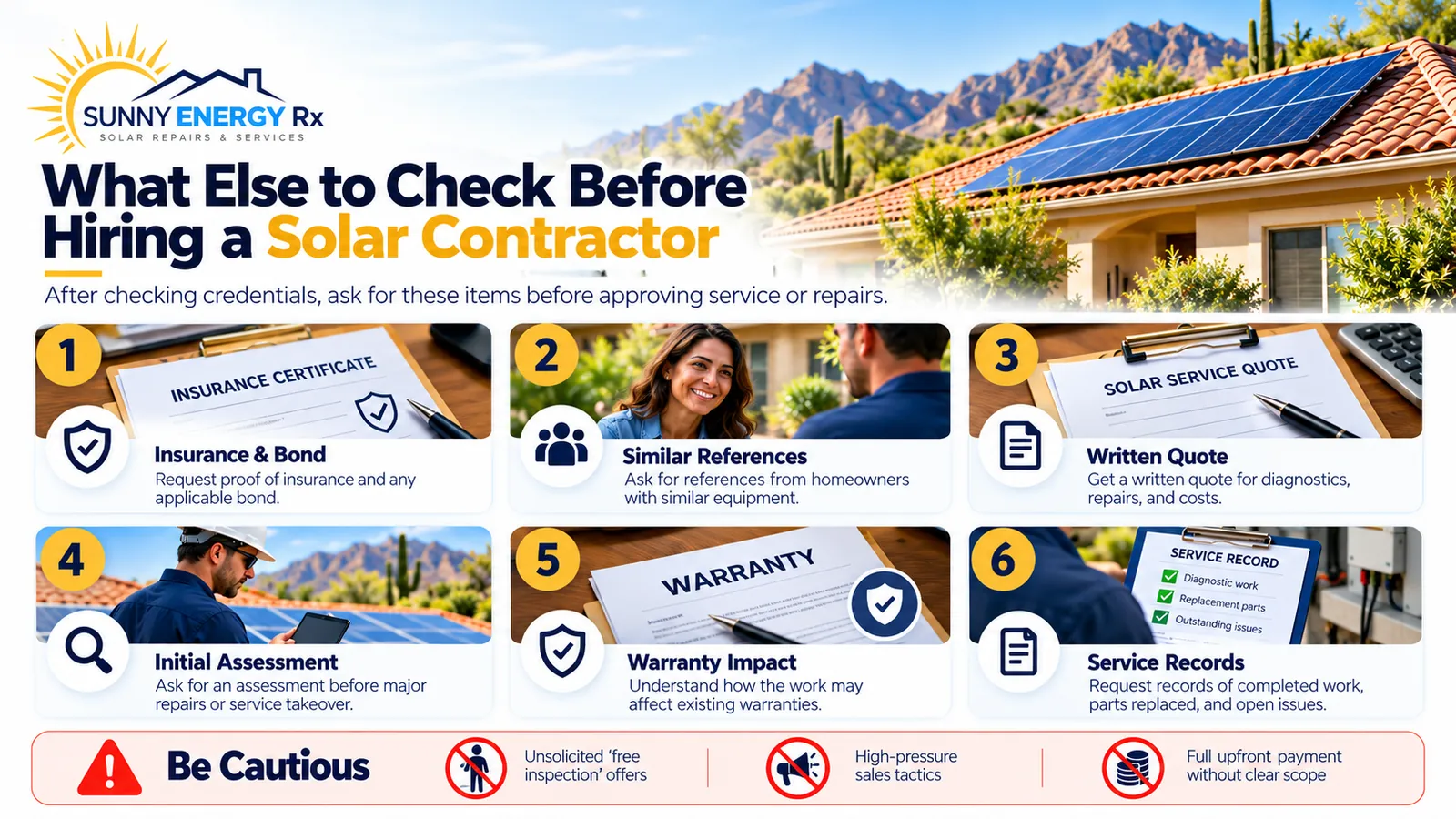
Now that you have checked the credentials, don't forget to ask for the following before approving a solar repair or service agreement:
Proof of insurance and any applicable bond
References from homeowners with similar solar equipment
A written quote outlining the diagnostic work, repairs, and costs
An initial assessment before major repairs or a service takeover
A clear explanation of how the proposed work could affect existing warranties
Written records of completed work, replacement parts, and outstanding issues
Note: Be cautious of unsolicited door-to-door offers for a "free solar inspection," high-pressure sales tactics, or demands for full payment upfront without a clearly defined scope of work.
Need Solar Service in Arizona? Reach out to Sunny Energy RX
Once you’ve checked a contractor’s credentials, experience, and service terms, look for a team that can take over servicing your existing system, even if your original installer is no longer in business.
Sunny Energy RX is one option for Arizona homeowners in this situation. We provide solar service and repair for systems installed by different companies, with NABCEP-certified technicians, 17+ years of experience, and support for major solar equipment brands. Our team can also help diagnose equipment issues and navigate solar warranty claims.
Call 480-470-1023 to discuss your existing solar system or visit us https://sunnyenergyrx.com/
Yes. Many qualified solar service companies can inspect, diagnose, repair, and maintain systems installed by other providers. Having your original installation contract, equipment details, warranty documents, and monitoring information available can help the new company identify the system and determine what service it needs.
Usually not. A workmanship warranty comes from the company that did the installation, so a new service company generally isn’t bound by it. The exception is a company that formally took over the installer’s obligations, or a third-party insurer that backs the coverage. Check your warranty documents to see who issued it, and ask any company in writing before you assume it applies.
A first diagnostic visit typically includes a review of your inverter and monitoring data, any error codes, and a visual inspection of the equipment by a qualified technician. Ask for the findings in writing, along with a quote that separates diagnostic fees, parts, and labor. Findings from this visit help show which manufacturer warranties may apply.
An installer closing doesn’t usually change your utility agreement by itself, but your utility can confirm whether anything needs updating. Contact it if you need your interconnection records or PTO letter, have billing questions, or plan to replace major equipment or change your system size, since a new application may be required.
Start by checking your inverter display or monitoring app for production data and any fault alerts. Compare your current output with the same month in previous years, accounting for seasonal changes, weather, shading, and equipment issues. You can also compare your actual production with your original system estimate or use the NREL PVWatts Calculator to estimate expected solar production for your location. If the difference seems unusually large, arrange a professional inspection.
Get it checked within the first few months, even if nothing seems wrong. Orphaned systems often lose their monitoring oversight, so a fault can run for a full Arizona summer before anyone notices. A professional inspection gives you a written baseline of how the system performs today, records your equipment details for future warranty claims, and catches heat, dust or monsoon wear early.
About the author

Sunny Energy RX Team
The Sunny Energy RX Team is a group of NABCEP-certified Arizona solar technicians with 17+ years of experience. The team specializes in repairing, maintaining and monitoring residential systems from nearly all major brands, including orphaned systems.
Published · Updated