What to Do First After Hail, Monsoon Wind, Lightning or a Haboob, and Who Handles the Repair
Arizona storms do not all hit a solar system the same way, and each type of severe weather can cause different forms of solar panel damage, leaving behind very different clues. Violent monsoon microbursts and high winds can generate enough aerodynamic lift to pull mounts loose and lift an entire array off a roof. Severe hailstorms, on the other hand, can shatter visible glass or create hidden micro-cracks inside the silicon cells that quietly degrade performance over time. Meanwhile, nearby lightning strikes and the electrical surges they send through wiring tend to knock out sensitive electronics like inverters, optimizers, and gateways rather than breaking the panels themselves. Even a fast-moving haboob can coat the glass in a thick layer of desert dust, temporarily cutting power output and making a completely healthy system look broken in your monitoring app.
The homeowners who contact us after severe weather almost always describe the same stressful situations involving solar panel damage and uncertainty about what to do next. One owner sees two panels pulled up after a windstorm, while another wakes up to find five of fourteen panels ripped off the roof overnight. Others discover hailstones cracked two modules and damaged the underlying roof at the same time, or notice their entire system went dead right after a dust storm rolled through. Almost every one of them asks the exact same question first: who do I call right now?
This guide breaks solar storm damage into three key questions: What failed, who is responsible for covering the repair, and who can safely fix it? Whether the damage involves homeowners insurance, an equipment warranty, or an installer that has gone out of business, the sections below walk you through the process, starting with what to do in the first hour.
After a storm, stay off the roof, photograph the damage from the ground, and shut the system down only if it's safe. Then call your insurer and a certified solar technician. Hail, wind, lightning and dust damage different parts of a system, so an inspection should separate what failed, who pays and who can fix it.
Do these three things today
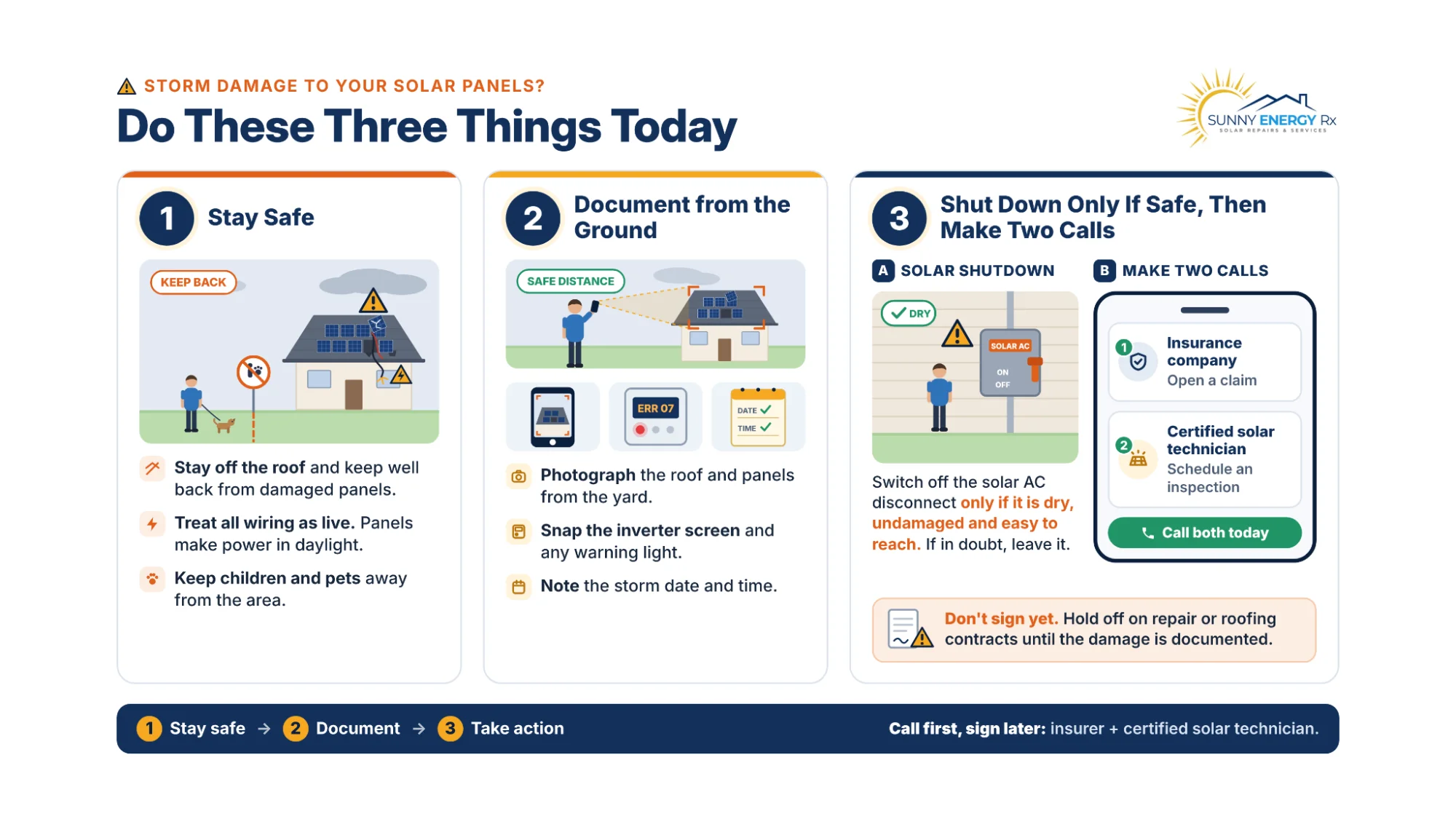
Stay safe. Stay off the roof and away from any panel that is loose, cracked or hanging. Cracked panels can still produce voltage in daylight. Keep people and pets clear of downed or exposed wiring.
Document from the ground. Take dated photos and video of the panels, roof, gutters and yard. Photograph the inverter screen and its lights, and note any error code. Write down the storm date and time.
Shut down only if it's safe, then make two calls. Turn off the solar AC disconnect or breaker only if you can reach it safely. Then call your insurer to open a claim, and a certified solar technician for an inspection. Don't sign a roofing or repair contract before the damage is documented.
Once you have handled those immediate priorities, use the map below to match what you see on your property or app with the most likely cause and the right section of this guide.
Situation Map
Match what you're seeing after the storm to the most likely cause and jump straight to the matching guide section.
What you're seeing | What it may indicate | Section |
You see debris, damaged panels, or hanging wires after a storm | Immediate safety concerns and the need to document the damage | 1 |
Panels have cracked or shattered glass after hail | Impact damage or possible micro-cracks | 2 |
Panels look fine, but production has dropped after hail | Hidden micro-cracks or hot spots | 2 |
Panels are lifted, shifted, or missing after high winds | Mount or attachment failure, or roof-side damage | 3 |
Banging or rattling sounds are coming from the roof | Loose panels, wind movement, or loose flashing | 3 |
The system stopped working after lightning or a power surge | Possible inverter, surge, or grounding damage | 4 |
Production dropped after a haboob or dust storm | Dust buildup or possible physical damage from debris | 5 |
The system stopped producing after a storm or power outage | Grid event, inverter lockout, or tripped breaker | 6 |
The solar app shows the system as offline after the storm | Router or gateway issue, not necessarily a production problem | 7 |
You need a professional inspection and written damage estimate | Assessment of panels, mounting, wiring, inverter, and grounding | 8 |
You're unsure whether insurance, a manufacturer warranty, or the installer will cover the damage | Coverage depends on the cause of damage and the applicable policy or warranty | 9 |
Your original installer has gone out of business and the system needs attention | An orphaned system with possible warranty or service complications | 10 |
Roof tiles or shingles are damaged near the solar panels | Roof repairs may require solar panel removal and reinstallation | 11 |
Panels or other system components need repair or replacement | Repair options, replacement considerations, and post-repair checks | 12 |
If your situation looks like more than one row, that's normal. Storms rarely do just one thing.
Need someone to look at it? Our Post-Storm Solar Inspection and Damage Assessment covers panels, mounting, wiring, inverter and grounding in one visit. Call 480-470-1023.
Now that you know what broke on your roof or inverter, the next step is figuring out whose coverage applies when it comes time to pay for the work.
Who Pays? Insurance, Warranty or Installer
This is the question that stresses people most, so here's the overview. We can't tell you what your policy or warranty will cover, because it depends on the exact language, and we are not your insurer. What we can do is show you where to look.
Homeowners insurance | Manufacturer warranty | Installer or workmanship warranty | |
What it's generally for | Sudden storm and hail events, depending on the policy | Defects in the equipment itself | Defects in the installation work |
What to find | Your policy and declarations page, your deductible | Each manufacturer's current warranty document, including exclusions | Your original contract and warranty paperwork |
Common catch | Deductibles, and how your policy treats roof-mounted equipment | Many warranties exclude weather events and acts of nature | Only useful if the installer still exists |
In plain terms: storm and hail damage is the kind of thing homeowners insurance claims are usually about, while manufacturer warranties usually cover defects rather than weather. Installer warranties matter only if the installer is still in business. Coverage varies by policy and by manufacturer, so confirm your own policy and warranty language and ask your insurer directly.
Section 9 goes deeper on this, and Section 10 covers what happens when the installer has closed.
1. What to Do First After a Storm
Quick Answer: Focus on safety and documentation first, stay off the roof, photograph the array and surrounding clues from the ground, shut down the system only if safe to reach, and call your insurer and a certified solar technician promptly. |
What You’re Seeing
“A storm damaged my solar panels, and I’m not sure what to do first.”
“I see debris, hanging wiring, or a cracked panel and want to act fast.”
“I’m getting calls or door-to-door offers from contractors right after the storm.”
What’s Actually Happening
The first hour after a storm matters more than the first week when dealing with potential solar panel damage. Even a cracked or displaced panel can still generate voltage in daylight, and a hanging panel can energize metal parts it shouldn't touch.
Meanwhile, ground-level clues, like dents on cars, gutters, or patio furniture, plus inverter status lights and app production history, help establish what happened and support your claim. Waiting too long can also mean longer lead times during peak storm weeks.
The Fix
Prioritize safety first. Keep everyone off the roof and away from ground debris or wiring. If you smell burning, see smoke, or see exposed wires, step back and call emergency services.
Document from the ground. Take photos and video of the full array and close-ups with zoom, capture dents on nearby surfaces, photograph the inverter screen and error codes, note the storm date and time, and save before-and-after monitoring screenshots.
Isolate only if safe. Turn off the solar AC disconnect or breaker only if it is easily reachable without standing in water or approaching damaged wiring; otherwise leave it alone.
Make two calls early. Make two calls early. Open a claim with your homeowners insurer and schedule a solar panel inspection with a certified solar technician, you don't need to wait for the adjuster to book the assessment.
Follow the do-not list. Do not climb on the roof, pressure-wash or hose panels (especially cracked ones), reattach panels yourself, or sign a rushed tear-off/roofing contract before inspection and documentation.
Contact a certified solar technician experienced with systems installed by other companies to check modules, racking, roof penetrations, wiring, and inverter performance, and request a written report with photos for your insurer.
Yes, it may keep generating power with little immediate drop, but damaged glass lets moisture in, accelerates cell deterioration, and creates electrical hazards, so have a technician inspect it rather than assuming it is safe.
Shut it down via the designated AC disconnect or breaker only if you can reach it safely away from damaged wiring or standing water; otherwise leave it untouched.
Many policies cover sudden storm damage from hail, wind, or falling debris, subject to policy terms, exclusions, and deductibles, document damage promptly and ask your carrier about requirements.
Once you have handled immediate safety and documentation, the next question is whether the storm's impact, such as hail actually damaged your panels.
2. Hail Damage
Quick Answer: Usually yes, if hailstones are large, fast, wind-driven, or hitting older or weakened modules. Even though standard panels are tested against roughly one-inch hail impacts, severe storms can still crack glass, create hidden micro-cracks, and damage surrounding roofing materials. |
What You’re Seeing
“Can hail damage solar panels, and what size hail actually causes harm?”
“My panels look fine from the ground, or only a couple cracked, while the roof also took a hit.”
“I’m wondering how hail affects different setups, including Tesla solar.”
What’s Actually Happening
Modern modules are tested to standards like IEC 61215 and UL 61730 using roughly one-inch ice balls at high speed, so typical panels handle ordinary hail well. Risk rises sharply with larger stones (such as golf-ball size and up), higher speeds, angled wind-driven impacts, and older or already weakened equipment.
Beyond obvious cracked or shattered glass, hidden micro-cracks in silicon cells and hot spots from resistive heating can degrade output and let moisture in even when glass looks intact.
Solar panel damage from hail is not always visible immediately. Even when the glass remains intact, impacts can create internal cell damage that affects performance over time. Hail strong enough to crack panels often damages the roof underneath as well.
The Fix
Treat car or roof dents as a trigger. If hail was big enough to dent vehicles or damage roofing, assume the solar array warrants a professional inspection.
Look for visible and hidden clues. Check from the ground for cracked glass, and compare post-storm output against your baseline using thermal imaging and production checks to spot micro-cracks or hot spots.
Review warranty exclusions. Check your manufacturer warranty text carefully, as warranties cover defects and workmanship and routinely exclude severe weather or acts of nature.
Check homeowners insurance. Confirm wind and hail coverage, deductibles, and mounting rules with your insurance carrier.
Apply the same rules to Tesla solar. For Tesla solar panels or Solar Roof tiles, review the specific product warranty and your homeowners policy just like any other system.
There is no single threshold because impact energy depends on size, speed, wind angle, and panel condition. While most panels handle standard 1-inch hail, larger, faster, wind-driven hail especially golf-ball size and up raises the risk of cracked glass and micro-cracks.
It depends on the exact warranty language, and many manufacturer warranties exclude severe weather events; always read the exclusions and see Section 9.
Often this is handled under homeowners insurance rather than a warranty, depending on policy terms, deductibles, and mounting. Confirm with your carrier and see Section 9.
Hail isn't the only severe weather threat strong gusts can test how securely your array is anchored to the roof.
3. Monsoon Wind and Panels Lifted Off the Roof
Quick Answer: Yes, violent gusts, especially microbursts, can lift or loosen solar panels, depending on the weakest link in your system. Whether mounts hold comes down to roof attachment, flashing seals, aging or brittle roofing materials, and gradual wear on hardware over time. |
What You’re Seeing
“Can wind lift solar panels off the roof?”
“I heard banging or rattling during or after a windstorm, or panels shifted or came loose.”
“Panels were pulled up and look intact can they just be reattached?”
What’s Actually Happening
Wind can generate aerodynamic lift over an array, pulling upward on the panels and potentially causing solar panel damage when mounting hardware or roof attachments fail. Understanding how solar panels and the roof work together is important because damage to mounting points, flashing, or roofing materials can affect both parts of the property.
Whether they hold depends on the weakest link in your setup. Key factors include how well mounts attach to rafters, the integrity of flashing and penetration seals, overall roof condition (such as brittle or aging roofing), and normal hardware wear over time.
Loose clamps, shifting panels, flapping wires, or lifted flashing can cause banging or rattling. Even panels that look intact after being pulled up may have twisted frames, micro-cracks, or damaged wiring/connectors, and uplift frequently affects the roof beneath.
The Fix
Keep clear of loose or hanging panels. Never stand beneath or try to hold/move a displaced or hanging panel due to fall and electrical hazards.
Shut down if safe to reach. If you can safely reach the disconnect away from hazards, turning the system off is a sensible first step.
Report banging or rattling. Treat unusual noise during or after wind as a sign of loosened hardware or lifted parts that needs inspection.
Require electrical and mechanical checks before reuse. Have a qualified technician inspect lifted panels for frame twist, micro-cracks, and wiring/connector damage before deciding whether to reattach or replace.
Coordinate roof repairs if damaged. When uplift affects the roof underneath, handle the roof and solar in the proper sequence.
Gusts can create lift forces that test mount attachment to structural framing, flashing seals, roof deck/material strength, and aging hardware.
It can indicate a loosened panel, shifted clamp, flapping wire, or lifted flashing and should be reported for inspection.
Not without electrical and mechanical testing frames can twist, cells can have micro-cracks, and wiring can be damaged even when glass looks intact.
Wind and hail are physical forces, whereas electrical storms bring a very different kind of risk to your equipment.
4. Lightning Strikes and Surges
Quick Answer: Solar panels do not attract lightning, but nearby strikes or grid surges can still damage solar electronics. Most often affected are inverters, optimizers or microinverters, monitoring gateways, and wiring, even when the glass panels look completely untouched. |
What You’re Seeing
“Can lightning damage a solar system, and do solar panels attract it?”
“My whole system stopped right after a storm, even though the panels look untouched.”
“A strike hit nearby on the property or garage, and I’m worried about hidden damage.”
What’s Actually Happening
Solar panels are not lightning magnets. Structure height, location, and surrounding terrain drive strike likelihood far more than having panels. However, a nearby strike can induce surges in wiring, or surges can enter through the grid.
These surges frequently cause solar panel damage to connected system electronics while leaving the glass intact, affecting inverters, optimizers or microinverters, monitoring gateways, and wiring or connectors. Direct strikes are rarer, though they can damage panels, wiring, and inverters, or occasionally cause a fire. Proper grounding, bonding, and surge protective devices reduce surge risk, even though no system is completely immune to lightning.
The Fix
Keep away if there is strike or fire risk. Keep people away from damaged equipment or wiring and call professionals if there is any hazard.
Inspect the whole system, not just one spot. After a nearby strike, have a technician inspect the inverter, grounding/bonding, and overall system, not only the nearest panel.
Verify grounding and surge protection. Have a licensed professional check grounding/bonding and appropriate surge protective devices (never relying on a household plug-in strip for PV surge protection).
Avoid "lightning-proof" claims. Treat any guarantee of complete lightning immunity with skepticism.
Follow dead-system checks if offline. If the system is completely dead after a thunderstorm, check basic indicators safely before calling a pro. For a closer look at common inverter faults, error codes, and troubleshooting steps, see our solar inverter troubleshooting guide.
No, building height, location, and surrounding terrain matter far more than whether panels are present.
They are not immune; while direct strikes are rare, surges induced by nearby strikes or grid events commonly damage inverters and other electronics.
Rely on proper grounding and bonding, appropriate surge protective devices, and qualified installation/inspection knowing nothing makes a system completely lightning-proof.
Properly rated surge protective devices can reduce surge risk to electronics, but they cannot stop a direct strike, and household power strips are not suitable for PV systems.
While thunderstorms bring surge risks, dry-climate storms often coat panels in dust and debris instead.
5. Haboob and Dust Storm
Quick Answer: Usually, a haboob just coats solar panels in a thick layer of dust and temporarily lowers power output rather than breaking them. However, physical damage from heavy windblown debris or sand abrasion is occasionally possible during severe storms. |
What You’re Seeing
“Can a haboob or dust storm damage solar panels?”
“My production dropped right after a dust storm, is it dust or a real fault?”
“Should I get on a ladder and hose my panels off?”
What’s Actually Happening
A haboob usually leaves a layer of dust, sand, or debris on the glass, temporarily reducing output until rinsed. Physical solar panel damage from abrasion or flying debris is uncommon during ordinary dust storms. To tell dust apart from a fault, look at your output: an even drop with visible dust means soiling, while zero output, error codes, or a tripped breaker points to a fault. Uneven output across specific panels suggests shading, trapped debris, or an optimizer issue. Because haboobs often come with high winds, outages, or lightning, timing alone does not prove dust caused the drop.
The Fix
Compare symptoms to separate soiling from faults. Check whether the drop is an even dust-related dip across the whole array, localized shading/debris, or a full shutdown/error code/tripped breaker.
Report storm-timed issues accurately. Let a technician know if a fault appeared right after a haboob while keeping in mind that wind, grid outages, or lightning may have played a role.
Stay off ladders and avoid hosing from them. Do not climb a ladder or spray panels from one due to fall and electrical hazards.
Clean or inspect according to conditions. Address dust buildup as local conditions warrant and maintain regular system inspections.
Yes, dust accumulates during dry periods and reduces output, with cleaning frequency depending on your specific location and site conditions.
There is no single schedule for everyone, though an annual inspection is a solid baseline and cleaning should match local dust and debris conditions.
When a storm leaves your system completely offline, sorting out whether it's an outage, a fault, or physical damage comes next.
6. System Down After a Storm
Quick Answer: A dead or offline solar system after a storm usually stems from a grid outage lockout, a tripped breaker, an inverter or surge failure, or physical damage. Start with safe, ground-level read-and-report checks rather than attempting any DIY electrical repairs. |
What You’re Seeing
“My solar stopped working after a storm, what could have failed?”
“The grid went out during the storm, or the inverter shows an error code or no lights.”
“The solar breaker tripped or I see visible damage from the ground.”
What’s Actually Happening
Standard grid-tied solar systems shut down automatically during a grid outage so power isn't fed into lines crews may be working on, and often restart after a wait once grid power stabilizes.
Other times a breaker trips, an inverter or surge-sensitive component fails, or physical damage (cracked/missing/shifted panels or damaged wiring) stops production and a single storm can trigger more than one issue at once.
The Fix
Check grid power first. See whether the home lost grid power, which causes a grid-tied system to shut down by design until stable grid power returns.
Read and photograph the inverter. Check the inverter display and status lights, take a photo, and record any exact error codes.
Check the solar breaker carefully. If the breaker tripped, you may reset it once if your inverter manual permits stop and call a technician if it trips a second time.
Scan for visible damage from the ground. Scan for visible damage from the ground. Look safely from the ground for missing or shifted panels, hanging wires, or scorch marks. If you find cracked or displaced modules, damaged wiring or other signs of physical impact, arrange a professional inspection before considering solar panel damage repair.
Stop and call a professional. Do not open the inverter, touch wiring, or climb onto the roof.
A grid-tied inverter shuts down automatically when grid power drops; if it stays off after grid power returns, check the display and breaker and call a technician if it doesn't restart.
Check grid power, the inverter display and lights, the solar breaker, and ground-level visible damage, then call a professional.
Standard grid-tied systems do not power the home during an outage unless paired with a battery backup setup.
Our guide to troubleshooting a solar system that is not producing explains what these symptoms can indicate and when to call a technician.
Sometimes the system isn't actually down at all only the app or reporting link is out of sync.
7. Monitoring Shows Offline After the Storm
Quick Answer: Not necessarily. A "monitoring offline" message usually means your home internet connection, router, or solar gateway lost its cloud reporting link after a storm outage, while your solar panels and inverter continue producing electricity normally in the background. |
What You’re Seeing
“Does ‘monitoring offline’ mean my panels stopped producing?”
“My app says offline after a storm, even though the weather cleared up.”
“I want to know whether I have a reporting glitch or a real production loss.”
What’s Actually Happening
Storms can knock out your home router, modem, or solar gateway that transmits data to the cloud, leaving the app showing "offline" even while the system generates power. Conversely, an app can occasionally display stale or misleading data while the inverter actually has a fault. Monitoring data can also help identify unusual production patterns that warrant further investigation. However, an offline app alone cannot confirm solar panel cell damage or establish whether the system has stopped generating electricity.
The Fix
Compare three sources. Cross-check your monitoring app, the inverter display/status lights, and your utility meter or bill.
Distinguish reporting from production. If the inverter shows normal operation while the app is offline, you likely have a communications/reporting issue; if the inverter shows a fault or no production, you likely have a real system fault.
Follow up with troubleshooting. Use monitoring and production checks to pinpoint whether the gateway/network or the solar equipment needs attention.
A storm outage or brief power blip can knock your home router, modem, or solar gateway offline without stopping your panels from generating electricity. Always check the physical inverter status lights before assuming your system stopped producing power.
Compare your monitoring app against the physical inverter screen or status lights and your utility meter readings. If the inverter shows normal operation and active power generation, the problem is usually your network or gateway reporting link rather than the panels.
Start by checking whether your home internet and Wi-Fi router came back online after the storm. If your internet works normally, inspect the solar gateway or communications hub
A monitoring app showing “offline” does not automatically mean your panels have stopped producing power. Understanding how a solar monitoring system tracks inverter data can help you distinguish a communication problem from an actual production issue.
Once you know you need a real checkup or repair claim, the next step is getting a qualified inspection and written estimate.
8. Who Inspects and Writes the Estimate
Quick Answer: A certified solar technician performs the post-storm inspection and provides written findings, while a qualified solar contractor typically writes the itemized repair estimate for your insurance adjuster to review. |
What You’re Seeing
“How do I get a solar damage inspection after a storm?”
“What should a post-storm inspection cover, and what does my insurer need?”
“How do I pick a trustworthy technician especially if my original installer is gone and what about diagnostic fees?”
What’s Actually Happening
You do not have to wait for an insurance adjuster before scheduling an independent technical inspection. Having written findings and photos of solar panel damage on hand often helps support your insurance claim. A thorough post-storm inspection checks several key areas, including modules, racking, mounts, and wiring.
The technician will also evaluate inverters, optimizers or microinverters, grounding, roof penetrations, and flashing, then compare actual production against expected output. To process your claim, insurers generally look for clear photos, the date of loss, a damage description, and a written repair estimate.
The Fix
Book a certified solar technician early. Schedule a full post-storm inspection and request a written report with photos and itemized findings.
Confirm what your insurer requires. Ask your carrier about formatting requirements and how repair estimates are submitted and reviewed by the adjuster.
Vet credentials and third-party willingness. Look for NABCEP certification, an Arizona ROC license, manufacturer brand certifications, and willingness to service systems installed by other companies.
Ask about diagnostic fees upfront. Confirm whether there is a diagnostic fee, what it covers, and whether it is credited toward repairs (or call 480-470-1023 to ask).
A thorough post-storm inspection should evaluate solar modules, racking, mounts, and wiring for physical damage. It should also check inverters, optimizers or microinverters, system grounding, roof penetrations, and flashing, followed by a production test comparing actual output against expected baseline performance.
A qualified solar contractor typically inspects the array and prepares the written, itemized repair estimate with supporting photographs. Your insurance carrier's adjuster then reviews those findings and documentation under the company's standard claims process to determine payout and coverage terms.
Inspection costs vary depending on your system size, roof access, inspection scope, and whether physical repairs are needed. Always ask a solar service company upfront if they charge a diagnostic fee, what it covers, and whether it credits toward repairs.
No, you do not have to wait for your insurance adjuster to arrive before booking an independent solar technician. Scheduling an inspection early lets you document damage quickly and hand the adjuster a professional written report and photo evidence.
Look for a technician with NABCEP certification, an active Arizona ROC license, and brand certifications for your specific panel or inverter manufacturer. Also confirm they regularly service third-party systems, especially if your original solar installer has gone out of business.
With a written inspection report and estimate in hand, you will also need to sort out who pays insurance or warranty.
Storm hit your system? Schedule a Post-Storm Solar Inspection and Damage Assessment. Call 480-470-1023.
9. Insurance or Warranty? Who Pays
Quick Answer: It depends on your exact policy and warranty wording. Homeowners insurance commonly covers sudden storm, hail, or wind damage, subject to deductibles and policy terms. Meanwhile, manufacturer warranties cover equipment defects and workmanship, meaning they routinely exclude severe weather events. |
What You’re Seeing
“Is storm damage to my solar covered by insurance or warranty?”
“How does my homeowners policy treat solar, and what deductibles apply?”
“Does my equipment or installer warranty cover storm or hail damage?”
What’s Actually Happening
Coverage for solar panel damage cannot be assumed without reading the actual insurance and warranty documents. Homeowners policies often address sudden storm, hail, or wind damage, but coverage details, mounting rules, and separate wind/hail deductibles vary. Manufacturer warranties generally cover product defects and workmanship and frequently exclude hail, lightning, or acts of nature, while workmanship warranties cover installation errors only if the installer still exists.
The Fix
Contact your insurer early. Ask how your homeowners policy covers solar equipment, what deductibles (including wind/hail) apply, and how to open a claim.
Read current manufacturer warranty text. Check the exact terms and exclusions in your panel, inverter, and battery warranties (such as SolarEdge or REC documentation) rather than relying on summaries.
Check workmanship coverage. Verify whether an installer workmanship warranty applies and remains active.
Gather your claim and warranty packet. Collect your declarations page/policy, equipment warranties, original contract/paperwork, storm photos/video/date, and inspection reports/estimates.
Confirm directly before assuming. Verify coverage in writing with your carrier and manufacturers rather than guessing whether a claim will be paid.
Many homeowners policies cover sudden storm damage from hail, wind, or falling debris. However, payout eligibility depends on your exact policy wording, coverage limits, mounting rules, and applicable deductibles. Always confirm specific wind and hail terms directly with your carrier.
Manufacturer warranties generally cover equipment defects and factory workmanship, meaning they routinely exclude severe weather events like hail, lightning, or other acts of nature. Always review your panel, inverter, or battery warranty text for exact exclusions before filing a claim.
Gather your homeowners policy declarations page, equipment warranty documents, original solar purchase contract, and the exact storm date. You should also include clear before-and-after photos or videos, inverter error screenshots, and a written inspection report with itemized repair estimates.
An installer workmanship warranty covers installation errors, such as mounts that failed because they were improperly fastened, rather than severe weather itself. Additionally, workmanship coverage only applies if your original solar installation company is still active and operating.
If you go to check your installer warranty or call for service and find your original installer is out of business, you still have paths forward.
10. The Installer Is Gone
Quick Answer: Your system still belongs to you and keeps ipment warranties generally still stand subject to their terms, and third-party solar service companies can inspect and repair systems they didn't install. |
What You’re Seeing
“My solar installer went out of business who services my system and honors the warranty?”
“What happens to my panels and monitoring if the installer closed?”
“Who took over customers or can work on an orphaned system?”
What’s Actually Happening
When an installer shuts down, you still own your system and it continues operating, though you may lose the installer's direct service and workmanship warranty unless another entity assumed those obligations. Equipment warranties for panels, inverters, and batteries typically belong to the manufacturer rather than the installer, though exclusions still apply.
The solar panel damage repair cost will depend on the components affected, equipment availability, roof access and whether the work requires panel removal and reinstallation.
Read more about what Arizona homeowners can do when their solar company shuts down.
The Fix
Review your purchase paperwork. Identify your panel, inverter, and battery brands and models so you know which manufacturers to contact.
Check warranty status and customer notices. Contact the equipment manufacturers and look for any notices about another company taking over service or obligations.
Hire a qualified third-party service provider. Look for NABCEP certification, an Arizona ROC license, brand certifications, and a stated willingness to service systems installed by other companies.
You still own your solar system outright, and it continues generating power as normal unless a fault occurs. However, you typically lose direct installer maintenance and workmanship coverage unless another company formally assumed those customer obligations.
Equipment warranties for solar panels, inverters, and batteries usually stay with the hardware manufacturer rather than the installer. Those manufacturer warranties remain valid under their stated terms and exclusions, even when installer workmanship coverage disappears.
Qualified third-party solar service companies can inspect, troubleshoot, and repair systems they did not originally install. Look for providers with NABCEP certification, an active Arizona ROC license, manufacturer brand credentials, and clear experience with orphaned systems.
Check your original purchase paperwork to identify your panel, inverter, and battery brands, then contact those manufacturers directly. You should also search for official customer notices, bankruptcy updates, or transfer announcements from the original company.
Our troubleshooting guide for orphaned solar systems explains how homeowners can approach service, equipment warranties, and monitoring after an installer closes.
Often, storm or age-related damage involves the roof underneath too, which means coordinating both trades in the right order.
Storm hit your system? Schedule a Post-Storm Solar Inspection and Damage Assessment. Call 480-470-1023.
11. Roof Damage and Remove-and-Reinstall
Quick Answer: Usually yes, if the work happens under or around the array, which is why roofers often call it a solar detach and reset. Re-roofing, tile replacement, and repairs beneath the panels need the panels and racking detached first. Small repairs away from the array may not. A licensed solar contractor should confirm in writing which applies. |
What You’re Seeing
“My roofer gave me a quote and said the solar has to come off first.”
“The roof is 18 years old, and the panels are only 9.”
“I have a leak, but I don’t know whether it’s the roof or the solar.”
What’s Actually Happening
Roofing materials go under the panels. Shingles, underlayment, tile, and flashing cannot be replaced while rails and panels are bolted over them, so the array has to be detached, set aside, and reattached afterward. If only a section of the roof is being repaired, the panels over that section come off, or the panels may stay if the repair is far enough away. That decision belongs to a qualified solar contractor, not a guess.
In Arizona, the pressure is usually timing. Sun-baked shingles go brittle and roofs often age out before the solar system does. Summer is peak re-roof season, and monsoon storms can compress the schedule and open the roof to rain. A system left uncovered or half-removed during a storm is a bigger risk than one that is scheduled well.
Homeowners searching for solar panel water damage are often dealing with leaks around roof penetrations or flashing, which can affect the roof structure and nearby electrical components. A professional inspection can help identify the source.
Time off the roof varies with the roof size, the type of roofing, and how many trades are involved. A well-coordinated job can take days, while a poorly coordinated one can take months, which is where owners lose production without realizing it. Ask for a target date for restart, not just a date for removal.
The Fix
Owner-safe steps first. Photograph the array, the roof, the inverter display, and every equipment label. Save a production baseline from your monitoring app.
Ask your roofer for their scope in writing, including whether they expect the panels to be removed.
Ask a licensed solar contractor for a removal and reinstallation scope and quote, including who seals penetrations and who tests the system afterward.
Confirm who pulls permits and notifies the utility (see Section 9).
Technician hand-off. The solar contractor shuts down the system, disconnects the wiring, removes the panels and racking, and later reinstalls and tests. No owner DIY electrical work.
Read more on our Solar Panel removal and reinstallation guide.
The downtime depends on your roof size, roofing material, repair complexity, and coordination between the roofer and solar contractor. Straightforward projects may take only a few days, while scheduling delays can extend the process to weeks. Ask both contractors for a written timeline and target restart date.
Solar panel removal for roof repair is not always required. You may be able to leave panels in place if the repair area is sufficiently far from the solar array. However, work beneath or immediately around the panels generally requires removal to prevent damage. Have a qualified solar contractor assess the roof before work begins.
In many cases, yes, particularly when replacing tiles directly beneath the solar array. Tile roofs require careful lifting and handling to avoid cracking surrounding tiles or disturbing mounting hardware. A qualified solar contractor should manage panel detachment and reinstallation.
The roofer and solar contractor should assess the repair area together and determine whether panel removal is necessary. Their responsibilities, scheduling, and reinstallation arrangements should be agreed upon in writing before work begins. This helps prevent delays, unexpected costs, and disputes.
Once work moves into actual panel swaps, reattachment, and post-repair verification, a few final checks keep everything safe and performing properly.
12. Repair, Replacement and What to Check After
Quick Answer: Yes, a single damaged panel can usually be replaced if a matching or electrically compatible module is available, and every reattached or replaced panel should pass mechanical, electrical, sealing, and production checks afterward. |
What You’re Seeing
“Can one broken solar panel be replaced, and what should be checked after reinstall?”
“Should we repair or replace parts, and does this work need a permit or inspection?”
“How do I keep storm damage from going unnoticed or catch issues before the next storm?”
What’s Actually Happening
Replacing a single panel is often possible, provided the replacement matches or works electrically with the rest of the string or inverters/optimizers (voltage, current, and compatibility matter). Deciding to repair or replace depends on equipment age, warranty status, part availability/compatibility, and whether damage extends to more than one panel.
Storm damage often goes unnoticed for weeks or months due to hidden micro-cracks, delayed utility billing cycles, quiet monitoring outages, or waiting to call someone and regular preparation before storm season helps catch weak spots early.
The Fix
Verify electrical compatibility and part availability. Have a technician check whether the exact panel model is available or a compatible substitute works with your string, microinverters, or optimizers.
Weigh repair versus replacement factors. Consider part and system age, warranty coverage, replacement availability, and total damage scope.
Complete post-work verification. Check mount/clamp torque and attachment, flashing and penetration seals, wiring/connectors and grounding/bonding, inverter/optimizer error codes and reporting, and output versus your pre-storm baseline.
Confirm local permits and inspections. Check with your local building department or contractor on city/county permit and inspection requirements.
Maintain a storm file and pre-storm routine. Keep baseline production exports, photos, storm dates, inverter labels/error codes, contracts, policies/warranties, and claim contacts organized, and schedule annual inspections plus grounding/surge and roof-attachment checks before storm season (or call 480-470-1023 to schedule a post-storm inspection).
Can one broken solar panel be replaced?Usually yes, if an identical or electrically compatible panel is available that works with the existing string, voltage/current specs, and any optimizers or microinverters.
What should be checked after solar panels are reinstalled or replaced?Verify mount/clamp tightness, flashing and penetration seals, wiring and grounding/bonding, inverter/optimizer status and error codes, and production against your pre-storm baseline.
Does solar repair or reinstallation need a permit or inspection?Local permit and inspection rules depend on your city or county, so check with your local building department or contractor.
Once you know what needs to be repaired or verified on your roof, having a clear, step-by-step service process makes it much easier to get your system back online safely.
How Sunny Energy RX Handles Storm Damage
We service systems affected by solar panel damage across Arizona, including systems we didn't install and systems whose installer has closed. Every post-storm visit follows the same order:
Inspect. A NABCEP-certified technician checks panels, mounting, wiring, inverter and grounding, then compares output to your pre-storm baseline.
Document. You receive a written report with photos and itemized findings to share with your insurer. Your carrier decides coverage.
Repair. We replace damaged panels and failed inverters, and remove and reinstall the array when the roof underneath needs repair.
Claim. If a manufacturer defect is involved, we help with the warranty claim paperwork. Terms vary by manufacturer.
Verify. We restart the system, confirm monitoring is reporting, and check production before closing the job.
Whether you are preparing for a technician visit or getting ready to file an insurance claim, having your paperwork organized in one place saves hours of back-and-forth.
Once your immediate recovery and documentation are squared away, taking a few proactive steps each year will leave your array far better protected when the next monsoon season arrives.
Your Storm Documentation File
Build this before you need it, or start it today if you've just had a storm:
Pre-storm production history (an exported monthly report from your app)
Before and after photos
The storm date and time
Photos of the inverter label and any error codes
Your purchase paperwork and contract
Your insurance policy and warranty documents
Your claim number and the contacts you've spoken with
Of course, even a well-maintained system can take a hit during severe weather, so knowing the warning signs that require an expert eye helps you avoid bigger safety risks.
How to Prepare Before the Next Storm
Getting ahead of severe weather helps protect your panels, wiring, and roof seals and reduce the risk of solar panel damage before high winds, heavy rain, or hail arrive. A little prep work before storm season makes post-storm recovery much smoother. Do these instead:
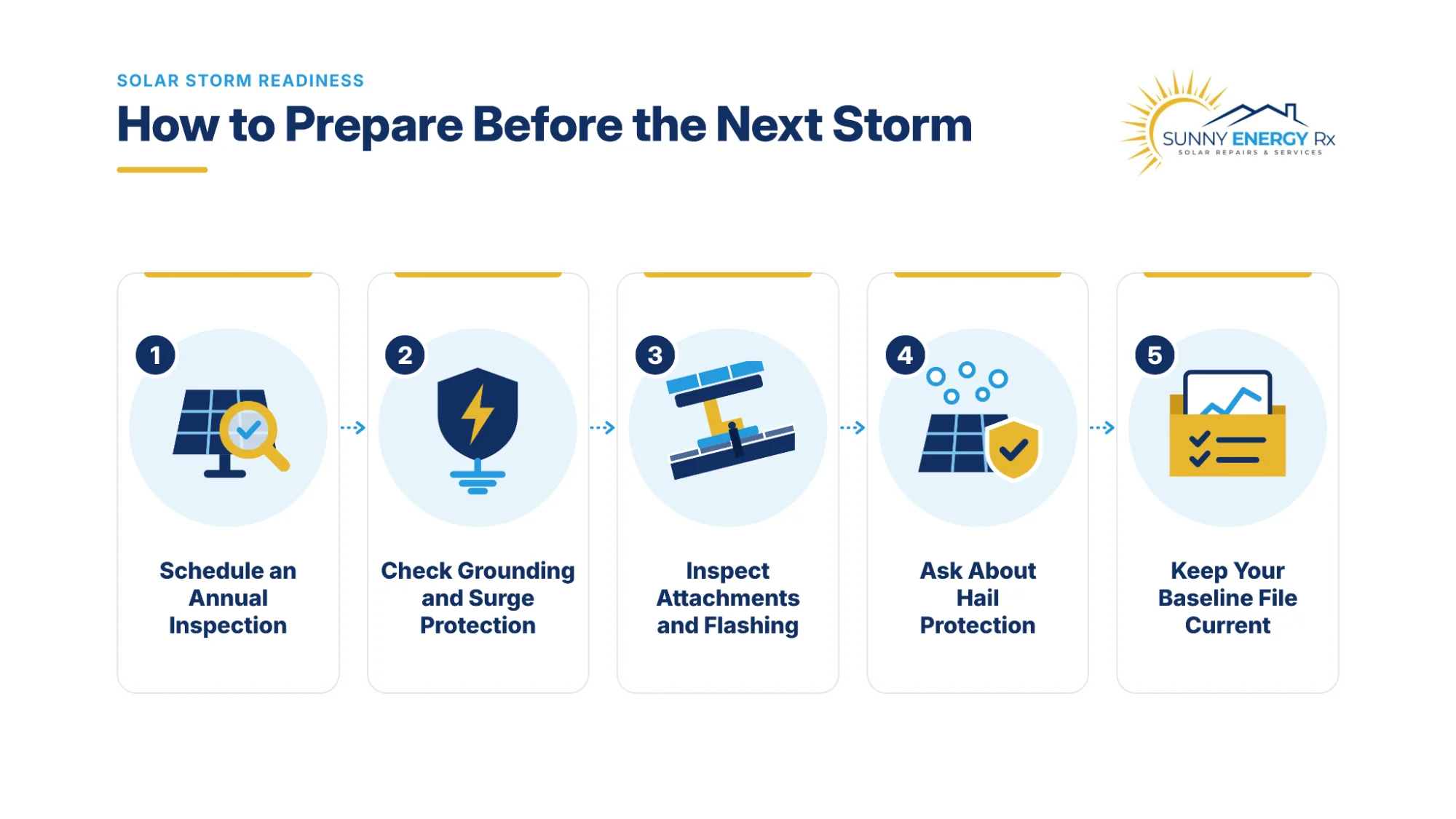
Schedule an annual inspection. A technician can spot loose hardware, worn sealant and wiring issues before wind finds them. Regular solar energy maintenance can also help identify developing issues before the next storm season.
Check grounding and surge protection. Ask whether your system's grounding and surge protective devices are in good shape.
Inspect attachments and flashing, especially on older roofs.
Ask about hail protection. Hail damage can't be prevented outright, but ask a professional about your panels' hail ratings and what your policy covers before hail season.
Keep your baseline file current, so you can tell quickly if something changes.
Of course, even a well-maintained system can take a hit during severe weather, so knowing the warning signs that require an expert eye helps you avoid bigger safety risks.
When to Call a Solar Technician
Call a professional if you see damaged or displaced panels, error codes, a dead system, a tripped breaker that trips again, banging or rattling on the roof, or any drop in production you can't explain after a storm.
Look for a company with NABCEP certification, an Arizona ROC license, brand certifications and a willingness to service systems it didn't install.
Storm hit your system? Schedule a Post-Storm Solar Inspection and Damage Assessment. Call 480-470-1023.
Yes. Although solar panels are tested to withstand hail and generally handle ordinary hailstorms, larger, faster, wind-driven hailstones can cause cracks, chips or internal damage. The risk depends on hail size, impact speed and panel construction. See Section 2.
Often, yes, but its output may decrease depending on the extent of the damage. Cracks can allow moisture to enter, create hot spots and accelerate further degradation. Have a qualified solar technician inspect the panel rather than continuing to operate it unchecked.
It depends on your homeowners insurance policy and how your solar system is classified. Hail, wind and other storm-related damage may be covered, but exclusions, deductibles and coverage limits apply. Contact your insurance carrier to understand your specific protection.
Yes. Strong monsoon gusts can loosen mounting hardware or lift panels, particularly when roof attachments, flashing or underlying roofing materials are compromised. Poor installation can increase the risk. A professional inspection can identify vulnerable mounting points before severe weather arrives. See Section 3.
No. Solar panels do not attract lightning. Lightning strikes are influenced more by a structure's height, location and surrounding conditions than by the presence of solar equipment. However, rooftop solar systems can still experience electrical surges or damage from nearby lightning strikes.
Surge protective devices help reduce the risk of electrical damage by limiting voltage spikes caused by nearby lightning strikes or grid disturbances. However, they cannot guarantee protection against every surge or prevent damage from a direct lightning strike. Ask a licensed professional about suitable protection.
About the author

Sunny Energy RX Team
The Sunny Energy RX Team is a group of NABCEP-certified Arizona solar technicians with 17+ years of experience. The team specializes in repairing, maintaining and monitoring residential systems from nearly all major brands, including orphaned systems.
Published