Your roof isn't just protecting your home. It's the foundation your solar system sits on. Panels are expected to last 25 to 35 years, and many roofs need work sooner, so the two have to be planned around each other. Many Arizona homeowners don't think about this connection until a leak, a failed mount, or a reroof forces the issue.
When panels sit on a roof without proper upkeep, small problems escalate. Loose mounts, worn flashing, roof penetrations, wiring damage, and bird nesting under panels can all lead to roof damage, lost production, and costly repairs.
What You'll Learn in This Guide:
How roof age and condition affect a solar system over its lifespan
How roof direction, pitch, and material affect panel performance and upkeep
Which roof components (decking, flashing, underlayment) to watch around panels
How panels affect the roof underneath them
Who to call for roof work, solar work, or both
Sunny Energy RX supports homeowners with existing solar systems, including those whose original installer is no longer around. We handle solar panel repair, roof-safe maintenance, inspections, and bird-proofing so your system and roof work together.
If you want your solar investment to perform efficiently and protect your roof for years to come, schedule a call with Sunny Energy Rx.
What Does "Solar Panels on a Roof" Actually Mean?
Before diving into roof compatibility and costs, it helps to understand what's actually happening on top of your house. Many homeowners assume solar panels replace the roof. In reality, in the vast majority of residential installations, solar panels are not the roofing material: they're mounted above an existing, fully intact roof.
There are two main ways to install solar on a home: mounting panels above the existing roof or integrating solar products directly into the roofing material.
Roof-Mounted Solar Panels (Most Common)
This is what nearly every Arizona home with solar actually has. Engineered racking systems anchor into the roof structure, and the panels sit a few inches above the surface. This setup:
Allows airflow beneath the panels, reducing heat buildup
Is easier to inspect, clean, and service
Can be temporarily removed and reinstalled during a reroof
Works with nearly all common residential roofing materials (asphalt shingle, tile, metal, flat)
Integrated Solar Roofs (Solar Shingles / BIPV)
An alternative approach like building-integrated photovoltaics (BIPV), often called solar shingles, replaces part of the roofing material itself with the solar product. These systems create a sleeker architectural look but require specialized installation and repair and are far less common in Arizona due to cost.
For most homeowners, traditional roof-mounted solar remains the practical choice: easier to maintain, simpler to service, and far more flexible when your roof eventually needs work.
That distinction matters when you look at how your roof and panels age together.
How Solar Panels Affect Your Roof
Solar panels change how your roof ages, how it's serviced, and what happens when it needs work. Whether your system is new or has been up for years, it helps to understand how panels interact with your roof's structure, lifespan, and maintenance needs.
Installing solar panels in Arizona is not just about sunshine and savings. If you're planning installation or already have panels on your roof, understanding how solar panels impact your roof's structure, lifespan, and long-term maintenance is important.
If you're installing soon: Focus on roof age, structural capacity, and material compatibility before committing to solar.
If you already have solar: Watch for leak risks around mounting points, monitor system performance drops, address bird activity under panels, and know when detach-and-reset becomes necessary.
This guide covers both scenarios, thus protecting your roof and your solar investment for the long haul.
Age and Condition of the Roof
Your panels will generate power for 25 to 35 years minimum. However, your roof typically lasts only 20-25 years. Therefore, timing matters significantly in solar panel repair for your wallet and peace of mind.
A Gilbert homeowner's roof was 12 years old when their system went in. Five years later it needed replacement, and removing and reinstalling the panels cost $8,400 for 24 panels, about $350 per panel.
Metal roofs and newer tile roofs typically last as long as the panels. Older roofs, including older tile roofs in Scottsdale and Tempe, should be inspected regardless.
Here's the financial reality: Solar panel reinstallation costs range from $300 to $1,000 per panel. Moreover, labor costs continue to rise 3 to 5% annually
Follow this solar roof replacement rule in Arizona: If your roof is more than 10 years old, replace it first. Metal roofs and newer tile roofs typically handle the full solar panel lifespan. However, older tile roofs in Scottsdale and Tempe often need inspection regardless.
Orientation and Slope (The "South-Facing" Rule)
Arizona's intense sun makes panel positioning important. Roof direction and slope affect how much a system produces, so it helps to know what to expect from your roof.
Best Roof Directions for Arizona Production
South-facing roofs capture the most sunlight throughout the year. However, west-facing installations also perform well for afternoon energy needs.
A Mesa homeowner with solar roof panels had concerns initially. Their roof faced southwest instead of due south. However, it caused only a 5% production decrease. The system still generates excellent returns on its investment annually.
Here are optimal solar panels and roof direction considerations:
Roof Direction | Estimated Production Potential | Recommendation |
South-facing | ~100% | Ideal orientation for maximum solar energy production |
Southwest / Southeast | ~90–95% | Excellent performance with minimal efficiency loss |
East / West | ~75–85% | Still financially viable for many Arizona homeowners |
North-facing | Low | Generally not recommended in Arizona’s climate |
Roof Pitch: What 'Good' Looks Like
Roof pitch for solar panels also affects your system performance significantly. Thus, the ideal slope ranges from 15 to 40 degrees for Arizona installations. Furthermore, flat roofs require tilt racking systems for solar roof panels to optimize energy capture.
A Peoria homeowner with a completely flat roof had tilt racks set at 20-degree angles. The system produces 18% more energy than a flat mount would.
Roof Material Compatibility
Most Arizona homes feature composition shingles for affordability and reliability in solar roofing applications. However, the material beneath your panels directly affects how long both your roof and solar system remain leak-free and structurally sound.
Metal Roofs:
Solar panels on metal roof installations offer the easiest mounting process. Moreover, metal roofs last 40 to 70 years, outliving your solar roof panels completely.
Durability: 40 to 70-year lifespan exceeds panel warranties, eliminating future solar panel removal needs
Mounting: Clamp systems avoid roof penetrations entirely
Maintenance: Virtually zero issues over system lifetime
Tile Roofs:
Tile roofs dominate Scottsdale, Paradise Valley, and upscale Phoenix neighborhoods. Tile needs careful handling and specialized mounting. A Fountain Hills homeowner's original installer cracked 17 tiles during panel installation. Experienced crews matter for any work on a tile roof, whether it's mounting, repairs, or panel removal.
Fragility: Individual tiles crack easily under pressure
Stand-offs: Required to distribute weight and prevent breakage
Labor: Work on tile takes 30-50% longer than on shingle roofs
Service: Tile roofs usually need specialized labor for repairs and panel removal
If roof-safe solar panel inspections, detach-and-reset services matter to you, contact Sunny Energy RX today to protect your solar panel and roof investment.
Composition Shingles:
Most Arizona homes feature composition shingles for affordability and reliability. Solar panel roof mounting kit systems work perfectly with this material. However, penetrations must be sealed properly to prevent leaks.
For example, in Surprise, improper flashing techniques during solar installation can lead to roof leaks within just two years. Thus, causing water damage indoors that could have been prevented with proper servicing or installation methods.
Here is a small table that gives you the summary of the lifespan of each roof type:
Roof Type | Average Lifespan |
Asphalt Shingle | 20–30 Years |
Concrete Tile | 40–50 Years |
Clay Tile | 50+ Years |
Metal Roof | 40–70 Years |
Foam Roof | 15–25 Years |
Longest-Lasting Roofs: Metal roofs top the list thanks to their 40–70 year lifespan and minimal penetrations. Concrete and clay tile are close behind for the same reasons, long lifespan and strong durability in Arizona's climate.
Roofs That Need Extra Inspection: Older asphalt shingle and foam roofs should be inspected carefully before installation. If a roof is nearing the end of its life or shows structural issues, replacement may be more cost-effective than installing solar first.
Easiest to Service: Metal roofs are the simplest to maintain, with asphalt shingle close behind. Tile roofs, while long-lasting, usually require specialized labor for repairs or panel removal.
Understanding how solar panels interact with your roof is only the first step; before installation, you also need to determine whether the roof is structurally sound, durable, and ready to support the system for years to come.
How to Check If Your Arizona Roof is Ready for Solar Panels?
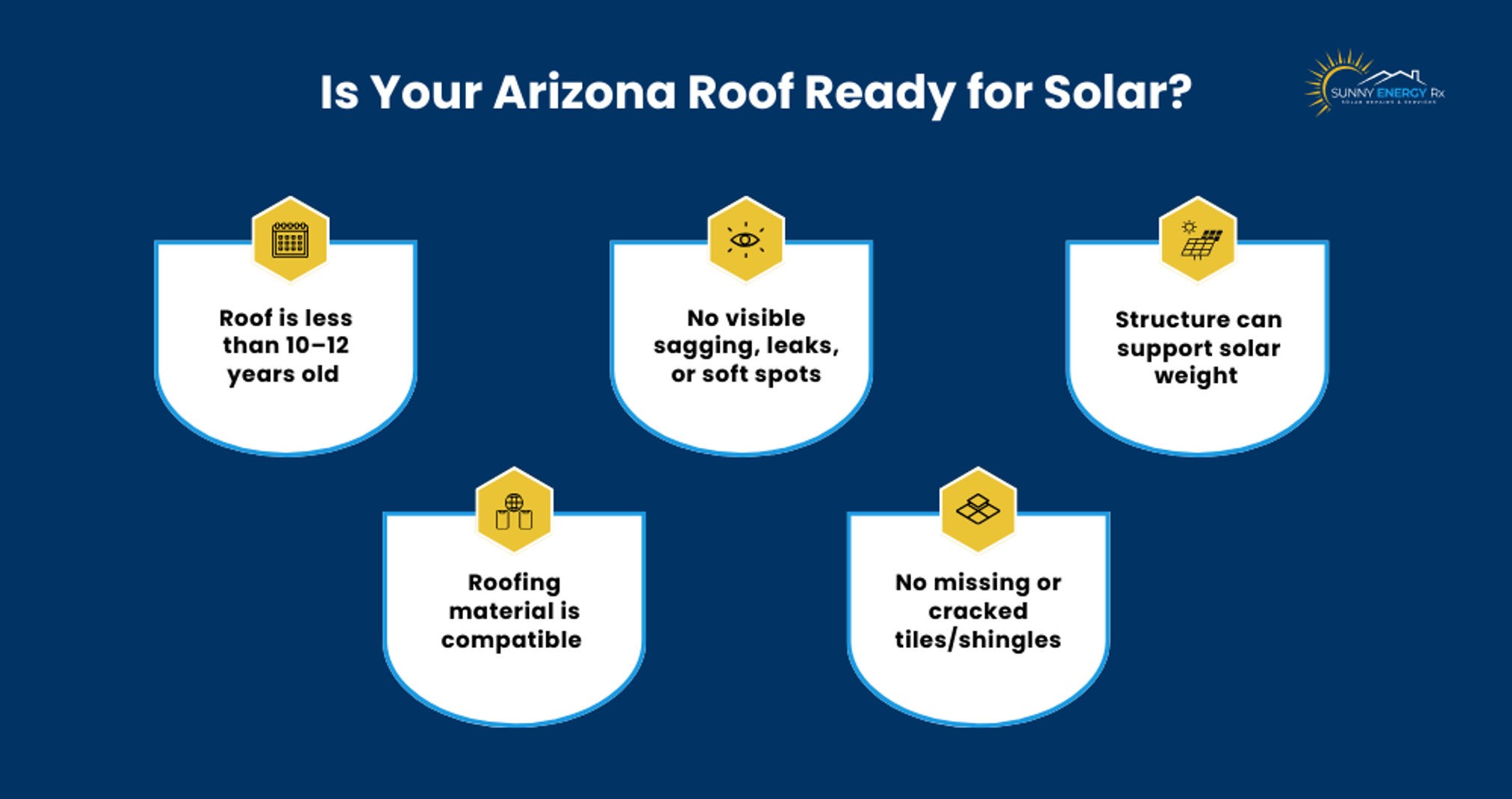
Your roof has to support the panels and stay watertight under them. Whether your system is new or has been up for years, these checks show whether the roof can carry it for another 15 to 20 years or has hidden problems forming.
Let's discuss how Arizona homeowners can quickly assess whether their roof is truly ready for a safe, long-term solar installation.
Get a Professional Roof and Mounting Inspection
A visual glance isn't enough. Professional solar panel inspections can assess the roof's condition and identify issues that may affect solar installation, including:
Wood decking condition: Check for rot or water damage
Why it matters: Compromised decking can't support mounting hardware safely and may collapse under panel weight over time.Rafter strength: Verify adequate load-bearing capacity throughout
Why it matters: Rafters carry the combined weight of panels, racking, and snow/wind loads, weak rafters risk structural failure.Flashing integrity: Inspect all penetrations and valley areas
Why it matters: Failed flashing is the #1 cause of roof leaks after solar installation, even on new roofs.Underlayment condition: Ensure moisture barriers remain intact
Why it matters: Damaged underlayment allows water infiltration that rots decking from beneath, often undetected until panels are removed.
A Glendale customer was confident their roof looked fine, until an inspection revealed significant water damage underneath. They replaced three sections before installation began, avoiding a more serious problem later.
Roof Health Checklist for Homes with Solar
Before scheduling any installation, run through this checklist:
☐ Is the roof in good structural condition, with no rot, sagging, or active leaks?
☐ Does the roof have at least 10–15 years of useful life remaining?
☐ Is the roofing material suitable for solar mounting?
☐ Have you planned for future maintenance and eventual reroof coordination?
If you can't answer "yes" confidently to the first three, that's your signal to get a professional roof assessment before signing a solar contract.
Solar panels' roof weight averages 2 to 4 pounds per square foot. Most Arizona roofs handle this easily when properly constructed. However, older homes sometimes require reinforcement before solar roof panel installation begins.
If you already have solar, an inspection from Sunny Energy RX can assess mounting integrity, flashing condition, and help you plan for detach-and-reset before emergency repairs become necessary.
Once you know your roof is structurally sound, the next question is whether it has enough useful life left to justify installing solar on it or whether reroofing first makes more financial sense.
The Reroofing Decision: Bundle or Wait?
When installing solar on an older roof, homeowners have two choices: replace the roof before installing the panels or install solar now and deal with the roof replacement later. Replacing the roof before solar installation is often called reroofing with solar, and it can help avoid the added cost and hassle of removing and reinstalling the panels later.
The right choice depends on your roof's age, condition, and expected remaining life. Here is a simple framework to help Arizona homeowners decide whether to replace the roof before solar or install the panels first.
Roof Age | Remaining Life | Recommendation | Reason |
0-5 years | 15+ years | Install solar now | Roof outlasts panel warranty easily |
5-10 years | 10-15 years | Evaluate the condition carefully | May work with healthy roofs |
10-15 years | 5-10 years | Consider coordinating reroof + solar work | Reduce detach and reset costs |
15+ years | <5 years | Replace the roof first, definitely | Financial penalty otherwise guaranteed |
Tile Roof Condition - Inspect closely before deciding. Arizona tile roofs can last decades, but cracked tiles, failed underlayment, or prior solar penetrations often require repairs or full underlayment replacement before reinstalling panels.
For example, in Litchfield Park, a 13-year-old roof might appear structurally sound but still have less than 10 years of reliable life remaining. In cases like this, bundling roof replacement with solar installation typically saves Arizona homeowners thousands compared to replacing the roof later.
Free roof replacement with solar panels programs sometimes exist through financing. However, verify the actual costs hidden in higher interest rates.
Now, let us see why homeowners should coordinate roof work with panels.
Why Coordinating Roof Work and Solar Pays Off
Cost-Effective Installation
Bundling roof replacement with solar roof panels installation eliminates redundant costs. You pay for scaffolding, labor mobilization, and permits once instead of twice. Therefore, total project costs decrease by $3,000 to $8,000 typically.
Let's say in San Tan Valley, a homeowner compares bundling roof replacement with solar installation versus hiring separate contractors. The bundled approach for solar panels and roof typically saves money by eliminating duplicate scaffolding, labor mobilization, and permit fees. Hence, the financial advantage is substantial and immediate for planning.
Enhanced Protection
Your panels act as a shield against Arizona's brutal sun. Solar energy roof systems reduce direct UV exposure on shingles. Therefore, the covered roof sections last 5 to 10 years longer. However, uncovered areas age at normal rates, creating lifespan differences.
A Maricopa customer may notice this effect after ten years. Their roof sections under panels might be brand new still. However, exposed areas may show significant weather damage and aging already. Hence, proper solar panel maintenance provides unexpected long-term roof protection benefits beyond energy.
Protection benefits include:
UV reduction: Panels block 100% of direct sunlight
Temperature reduction: Roof surface stays 10-15°F cooler underneath
Hail protection: Panels absorb impact from smaller hailstones
Weather shielding: Rain and wind effects decrease significantly
Roof color and ventilation matter here too. Darker materials absorb more heat, while lighter, more reflective roofing combined with proper attic ventilation can help manage heat buildup.
Long-Term Value
A Prescott homeowner installed panels on an older roof that failed several years later, creating additional removal and reinstallation expenses. Synchronizing roof and solar timelines can help reduce the possibility of this type of disruption, potentially providing:
Better coordination between roof and solar warranties
Fewer unexpected mid-project expenses
Easier future maintenance planning
Less disruption to solar production during reroofing
Beyond deciding when to install solar, homeowners also need to consider how the solar system itself will be integrated with the roof.
to know more about solar panel removal and reinstallation, read our guide. And to know more about solar roof cost, read our blog.
Common Solar Roof Panel Issues That Require Repair in Arizona
Even the best-designed systems face occasional issues inevitably. Real-world problems do happen despite quality installations. Solar panel repair is sometimes completely unavoidable, but how repairs are performed determines whether you're fixing panels or creating expensive solar panels and roof repair.
Common issues requiring professional repair:
High winds rattle mounting hardware and weaken connections. Careless re-tightening can strip bolts and crush roof seals, creating leak pathways.
Extreme heat or pests chew through wires. Improper repairs drill new conduit paths instead of using existing routes, adding unnecessary roof penetrations.
Installation of foot traffic or hail can break fragile glass. Solar panel replacement requires lifting surrounding panels carefully to preserve flashing integrity.
Electronics fail in 120°F+ attic temperatures. Ground-level inverter repairs protect roofs; rooftop microinverter replacements require proper tile-walking technique.
Pigeons love shade underneath panels. Bird proofing solar panel installation must not create new penetration points or damage existing roof seals.
Because these issues can affect both your solar system and the roof beneath it, getting the right service at each stage can help prevent minor problems from becoming costly repairs. Here’s how Sunny Energy RX supports homeowners in keeping both systems working together.
How Sunny Energy RX Supports Your Solar Roof Throughout Its Lifecycle
Understanding how solar and roofing work together is only the first step. Over the life of your system, your roof will age, weather will take its toll, and components will need attention. Here's how we help at every stage:
When the roof needs replacing: We handle the full detach and reset, shutdown, array mapping and labeling, panel and racking removal, secure staging while your roofer works, then reinstallation to manufacturer specifications with torque checks. We coordinate around your roofing crew's schedule so the solar side does not stall the job.
When flashing or mounting hardware is the suspect: Loose rails, worn attachments, and disturbed flashing can contribute to roof problems. We inspect these points during removal or check them separately if you've noticed staining, leaks, or movement.
When production drops: Dust, a failing inverter, a dead string, or a bad connector can all affect production. We run remote diagnostics and on-site inspections to identify the problem, then repair or replace the failed component when appropriate.
When birds get underneath: We clear nests without harming the birds and can install critter guards around the array perimeter, ideally while panels are already removed during a reroof.
When equipment is still under warranty: Many solar systems still have manufacturer warranties on panels and inverters. We document faults and assist with the warranty process when applicable.
When your installer is gone: We service systems regardless of who originally installed them and can help diagnose orphaned systems, restore monitoring, and address repair or maintenance needs.
Conclusion
Your roof and solar panels aren't two separate projects. They are a single, long-term system expected to perform together for 25 years or more. When the roof is healthy and the panels are maintained and serviced correctly, homeowners in Arizona can protect both their home and their energy savings for decades. When that coordination is overlooked, even small issues can turn into expensive disruptions that reduce system performance and shorten lifespan.
The real challenge isn't installation day, but everything that comes after. Roofs age, installers disappear, and warranties expire or get confusing. Consequently, there's no clear answer about who should help or how to fix problems without risking further damage to your roof or voiding your solar warranty.
That's exactly why Sunny Energy RX exists.
We were built specifically to support existing solar systems, specifically for homeowners whose original installer is no longer around. Our NABCEP-certified experts understand how Arizona's heat, dust, monsoons, and bird activity affect both roofs and solar equipment over time.
We focus exclusively on solar repair, maintenance, monitoring, and roof-safe removal and reinstallation, so your system stays productive and warranty-protected for the long run.
Ready to protect both your roof and your solar investment? Schedule a consultation with Sunny Energy RX. We serve homeowners statewide and specialize in keeping solar systems reliable long after installation day.
Summary on Solar Panels and Roof in Arizona
Solar panels and roof systems must work together for 25 to 35 years, making roof condition critical before installation to avoid expensive removal costs later.
Older asphalt roofs should be inspected regularly, since a reroof means panels must be removed and reinstalled.
Southwest- and Southeast-facing roofs still reach 90–95% of maximum output.
Solar panels on metal roof installations offer the easiest mounting with 40 to 70 year durability, while tile roofs require specialized techniques to prevent breakage.
Coordinating roof and solar work avoids paying for scaffolding, mobilization, and permits twice.
Solar panel removal for roof repairs requires certified solar technicians, not general roofers, to protect electrical systems and maintain equipment warranties.
Solar panels' roof weight averages 2 to 4 pounds per square foot, which most Arizona roofs handle easily with proper structural assessment beforehand.
Yes, proper solar panel rooftop installation increases home value. However, leased systems complicate sales due to transfer requirements.
Solar panel removal is possible but requires professional roof patching. Some homeowners remove outdated technology for newer systems. Others remove panels during a complete roof replacement with solar panel projects.
Yes, trapped debris and moisture encourage mold growth. Bird droppings and leaves accumulate under panels. Therefore, regular cleaning and bird-proofing solar panels in Arizona prevent mold and maintain efficiency.
Aesthetics concern some homeowners in certain neighborhoods. Panels must be removed and reinstalled when the roof is replaced, and the system needs ongoing upkeep. Many homeowners find the long-term savings outweigh these tradeoffs.
Professional structural assessments determine the solar panels' roof load capacity. Most Arizona roofs handle 2 to 4 pounds per square foot easily. Solar panel roof requirements include adequate decking and rafter strength.
Panels withstand high winds and hail impacts per testing standards. They actually protect the solar roof underneath from storm damage. However, severe damage requires professional solar panel removal for repairs underneath.
Equipment warranties cover panels and inverters for 25 years. Workmanship warranties cover installation for 5 to 10 years, typically. However, bankrupt installers void workmanship coverage. However, Solar panels' roof mount systems need ongoing maintenance.
Solar roofing installation takes 1 to 3 days for most residential systems. Tile roofs require additional time for careful handling. However, permitting and utility interconnection take weeks. Solar panels on roof installations proceed quickly once approved.
About the author
Sunny Energy RX Team
The Sunny Energy RX Team is a group of NABCEP-certified Arizona solar technicians with 17+ years of experience. The team specializes in repairing, maintaining and monitoring residential systems from nearly all major brands, including orphaned systems.
Published · Updated