Your roof may need replacing long before your solar panels reach the end of their useful life. In Arizona, years of intense sun, extreme heat, and seasonal storms take a toll on roofing materials. Shingles become brittle, tiles crack or shift, and flashing and sealants deteriorate. When that happens, homeowners often face an unexpected question: What happens to the solar panels sitting on top of the roof? That is where solar detach and reset, or replacement, comes in.
Solar panel removal and reinstallation is more involved than simply lifting panels off and putting them back. The system must be safely shut down, electrical connections disconnected, panels and mounting hardware removed, and the roof repaired. Once the roofing work is complete, the solar equipment must be reinstalled, penetrations properly sealed, wiring reconnected, and system production checked.
Getting the sequence wrong can lead to cracked panels, roof leaks, damaged wiring, warranty complications, or a system that stays offline long after the roofing crew has finished. Coordination between your roofer and solar contractor is essential, as is knowing who is responsible for each part of the job.
The situation can become even more complicated when your original solar installer has gone out of business. Without the original service provider, homeowners may struggle to find someone willing to remove and reinstall the equipment, leaving their systems offline and production savings on hold.
This guide explains when solar panel removal and reinstallation is needed for roof repairs or replacement, who should handle it, and what the process involves. You'll also learn how to prevent common problems, identify leaks or equipment damage, check system performance after reinstallation, understand warranty responsibilities, and navigate Arizona permit and utility requirements.
What Happens, What Can Go Wrong, and Who Should Do What
Every roof job over solar comes down to three questions. What happens, step by step, between shutdown and restart? Where does the job tend to go wrong? And which trade is responsible at each point? The sections below answer each one. Before you read them, here are the three steps that matter most.
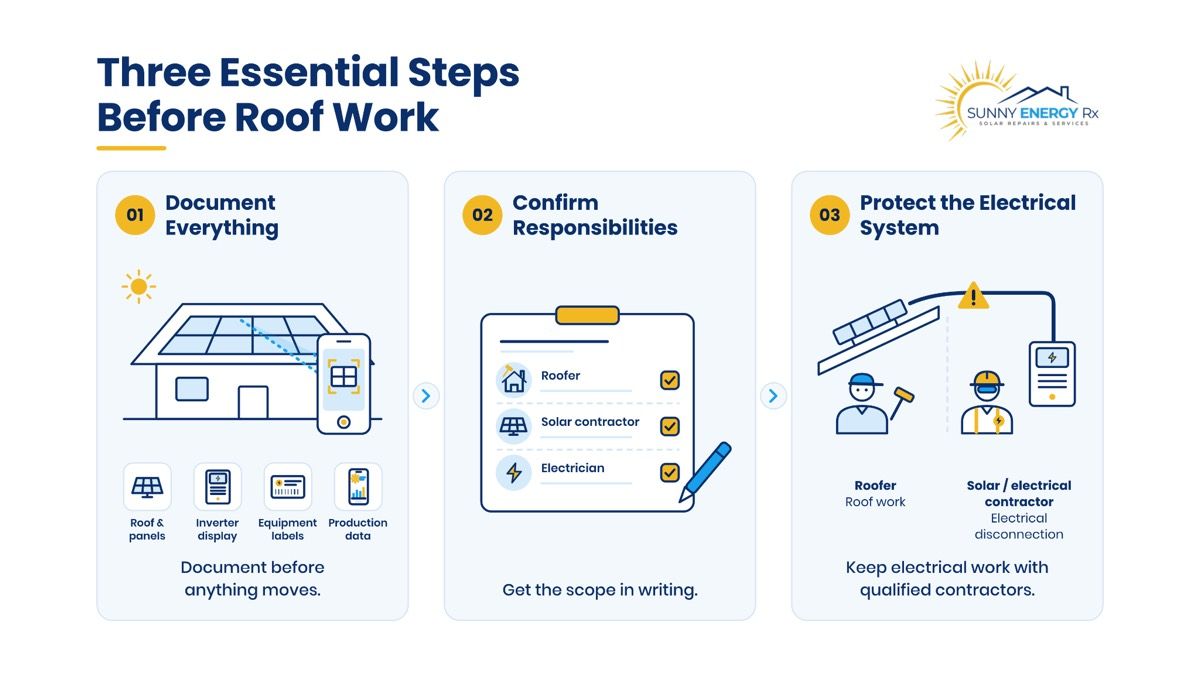
Document before anything moves. Photograph the array, the inverter display, the roof, and the equipment labels. Save a production baseline from your monitoring app.
Get the scope in writing. Ask who removes the panels, who reinstalls them, who does the electrical work, and who is responsible for damage.
Don’t let a roofer disconnect the electrical. Panel removal involves live DC wiring. Only a licensed solar or electrical contractor should do it. If the system is already down, damaged, or near a fire or water event, stop and call a technician.
Those three steps apply to every job, but what you do next depends on what is happening on your roof right now.
Situation Map: Find Your Situation
Not every solar panel removal and reinstallation job looks the same. Some owners are planning a re-roof, some are dealing with a leak or a dead system, and some inherited the panels with the house.
Find the row below that sounds most like your situation, read the “First move this week” column for what to do right away, then go to the section in the last column for the full explanation. Rows marked ⚠️ or 🚩 involve possible water, exposed wiring, or fire damage, so start with those sections if they apply.
# | What you’re seeing | What it usually means | First move this week |
1 | Re-roof planned, solar on the roof | Panels must be detached and reset before roofing starts | Get a written removal and reinstall scope and quote, with a restart date |
2 | Roofer says “we don’t touch solar” | A solar contractor is needed, with coordination | Book the solar contractor first, then give the roofer the dates |
3 | Not sure what happens to the panels while they’re off | A multi-step process from shutdown to production check | Ask for the sequence in writing, including where panels are stored and who tests the system |
4 ⚠️ | Ceiling stain, leak, or broken tiles under or near panels | Failed flashing or sealant, or roof layers not closed correctly | Photograph from the ground or inside; call a roofer and a solar technician |
5 ⚠️ | Cracked panel or loose, hanging wiring after the work | Handling damage, hail, or disturbed connections | Photograph; compare to your before photos; leave the system off if wiring is exposed |
6 | System off or producing less after reinstall (including a utility “not producing” notice) | A panel or string not reconnected, a breaker or disconnect left off, or the inverter didn’t restart | Check the display and app once if safe; compare to baseline; request a production check |
7 🚩 | Storm, fire, or water damage with panels on the roof | A safety and insurance event | Do not restart; stay off the roof; get a licensed technician to inspect |
8 | Installer is gone and the roofer wants the panels off | Workmanship warranty and service contact lost; manufacturer warranties usually remain | Contact the manufacturers; find a contractor who services systems it didn’t install |
9 | Unsure whether you need a permit or must notify APS, SRP, or TEP | Requirements vary by city, county, and utility | Ask each contractor in writing who pulls permits and who notifies the utility |
10 | Just bought a house, roof needs work, solar unknown | Unknown equipment and no records | Photograph the labels and identify the system first; check whether it’s owned or leased |
Not all tasks are to be done by you. Let us take a look at who does what.
Explainer: Who Does What
Solar Panel Removal and Reinstallation involves several trades, each with a different responsibility. Knowing who handles each part of the job helps prevent miscommunication, delays, and disputes over damage or repairs. Here is how responsibilities are typically divided between the roofer, solar contractor, electrician, and homeowner.
Task | Roofer | Solar contractor | Electrician | Owner |
Panel removal | Not unless qualified and licensed for solar | Leads | Supports if licensed for it | Approves scope, documents before |
Wiring disconnect | No | Leads | Yes, if licensed for it | Never |
Roof work | Leads | Coordinates access and timing | Not involved | Approves schedule |
Racking and flashing reinstall | Roofs around the mounts | Leads attachment and sealing of penetrations | Not involved | Confirms in writing who seals what |
Inverter restart | No | Leads | Supports | Confirms it runs |
Production check | Not involved | Leads | Not involved | Compares to baseline |
Permits | Roofing permit where required | Solar permit where required | Electrical permit where required | Confirms who pulls each one |
Who can remove solar panels from a roof? Can my roofer do it?
A roofer can physically lift a panel, but that does not make it safe or appropriate. Panels sit on live wiring that produces voltage whenever there is light. Disconnecting and reconnecting that wiring belongs to a licensed solar or electrical contractor, and a roofer’s helper without that license is not a substitute.
Who is responsible if a panel breaks?
It depends on your contracts. Whoever handled the panel when it broke is usually the starting point, but terms vary between roofing, solar, and manufacturer agreements. Get responsibility for damage in writing before work begins, and use your before photos to document the condition.
Now that you understand who is responsible for each part of the project, let's look at when removing the panels is actually necessary.
1. DO I NEED SOLAR DETACH AND RESET FOR ROOF WORK?
“Do my solar panels have to come off before the roof work starts?”
Quick Answer: Usually yes, if the work happens under or around the array, which is why roofers often call it a solar detach and reset. Re-roofing, tile replacement, and repairs beneath the panels need the panels and racking detached first. Small repairs away from the array may not. A licensed solar contractor should confirm in writing which applies to your roof. |
What You’re Seeing
“My roofer gave me a quote and said the solar has to come off first.”
“The roof is 18 years old, and the panels are only 9.”
“I have a leak, but I don’t know whether it’s the roof or the solar.”
What’s Actually Happening
Roofing materials go under the panels. Shingles, underlayment, tile, and flashing cannot be replaced while rails and panels are bolted over them, so the array has to be detached, set aside, and reattached afterward. If only a section of the roof is being repaired, the panels over that section come off, or the panels may stay if the repair is far enough away. That decision belongs to a qualified solar contractor, not a guess.
In Arizona, the pressure is usually timing. Sun-baked shingles go brittle and roofs often age out before the solar system does. Summer is peak re-roof season, and monsoon storms can compress the schedule and open the roof to rain. A system left uncovered or half-removed during a storm is a bigger risk than one that is scheduled well.
Time off the roof varies with the roof size, the type of roofing, and how many trades are involved. A well-coordinated job can take days, while a poorly coordinated one can take months, which is where owners lose production without realizing it. Ask for a target date for restart, not just a date for removal.
The Fix
Owner-safe steps first. Photograph the array, the roof, the inverter display, and every equipment label. Save a production baseline from your monitoring app.
Ask your roofer for their scope in writing, including whether they expect the panels to be removed.
Ask a licensed solar contractor for a removal and reinstallation scope and quote, including who seals penetrations and who tests the system afterward.
Confirm who pulls permits and notifies the utility (see Section 9).
Technician hand-off. The solar contractor shuts down the system, disconnects the wiring, removes the panels and racking, and later reinstalls and tests. No owner DIY electrical work.
The downtime depends on your roof size, roofing material, repair complexity, and coordination between the roofer and solar contractor. Straightforward projects may take only a few days, while scheduling delays can extend the process to weeks. Ask both contractors for a written timeline and target restart date.
Solar panel removal for roof repair is not always required. You may be able to leave panels in place if the repair area is sufficiently far from the solar array. However, work beneath or immediately around the panels generally requires removal to prevent damage. Have a qualified solar contractor assess the roof before work begins.
In many cases, yes, particularly when replacing tiles directly beneath the solar array. Tile roofs require careful lifting and handling to avoid cracking surrounding tiles or disturbing mounting hardware. A qualified solar contractor should manage panel detachment and reinstallation.
The roofer and solar contractor should assess the repair area together and determine whether panel removal is necessary. Their responsibilities, scheduling, and reinstallation arrangements should be agreed upon in writing before work begins. This helps prevent delays, unexpected costs, and disputes.
How Sunny Energy RX handles this: We give you a written solar panel removal and reinstallation scope, with a start date, before any panel moves.
Once you know whether the panels need to come off, the next question is who should handle the work.
2. WHO SHOULD REMOVE AND REINSTALL MY PANELS?
“My roofer says they don’t touch solar. Who do I call first?”
Quick Answer: A licensed solar contractor should detach and reset the panels, working around the roofer’s schedule. Roofers handle the roof. Electricians handle the wiring when needed. You should not do electrical work yourself. Book the solar contractor first, then the roofer. |
What You’re Seeing
“The roofer said they don’t touch solar and told me to call my installer.”
“My installer went out of business.”
“The roofer said his guys can just lift them off.”
What’s Actually Happening
Three trades are involved, and each one covers a different part of the job. The roofer works on the roof surface. The solar contractor handles the array: shutdown, disconnects, panels, racking, flashing at the mounts, testing. An electrician covers electrical work beyond the array if needed. When nobody owns the full sequence, panels get lifted off by crews without the right license and then wait on the roof until someone figures out who reinstalls them.
In Arizona, contractors must be licensed through the Registrar of Contractors (ROC) for the work they perform. Check that the company holds an active license in the right classification and look it up on the ROC’s license search before you sign. A roofer’s helper without solar or electrical credentials is not enough, even if they can physically lift a panel.
When a roofer says “we don’t touch solar,” that is often the right call, not a refusal. It means the work needs the right trade. The fix is sequencing: the solar contractor detaches first, the roofer works, the solar contractor reinstalls and tests. Many roofers will work with a solar crew if someone sets the dates.
The Fix
Owner-safe steps first. Ask your roofer for their start window and how many days they need with the roof clear.
Look up each contractor’s license on the ROC website and ask for proof of insurance.
Book the solar contractor first, then give the roofer the confirmed detach and reinstall dates.
Put responsibility in writing: who removes, who reinstalls, who seals penetrations, who tests.
Technician hand-off. The solar contractor handles all disconnects and reconnections, plus testing. Do not let anyone else open the wiring.
A roofer may be able to handle certain physical aspects of panel removal, but disconnecting or reconnecting electrical wiring requires appropriate qualifications and licensing. Use a licensed solar or electrical contractor to manage the electrical work safely.
No. Many owners search for how to remove solar panels from a roof, but doing it yourself is dangerous because panels generate electricity whenever exposed to light, and their wiring can carry hazardous voltage. Improper handling can cause electric shock, equipment damage, or roof leaks. Always hire a qualified professional.
Contact your solar contractor first to arrange panel detachment and reinstallation around the roofing schedule. Once the dates and responsibilities are agreed upon, coordinate with your roofer to confirm the start date and avoid unnecessary project delays.
You can hire a qualified solar contractor to service, remove, and reinstall a system installed by another company. Look for experience with your inverter and mounting equipment. See Section 8 to learn how to find a contractor for an orphaned solar system.
How Sunny Energy RX handles this: We hold an active Arizona ROC license, and we coordinate directly with your roofer so the dates line up.
With the right contractor in place, it helps to understand the steps involved from initial shutdown to final system testing.
3. WHAT HAPPENS DURING SOLAR PANEL REMOVAL AND REINSTALLATION?
“What are they actually going to do to my panels?”
Quick Answer: The technician shuts the system down, disconnects the wiring, and removes the panels and rails. After roof work, they reattach, reseal every penetration, reconnect, test, and confirm production. This describes the process, not a DIY guide on how to remove solar panels from a roof. Licensed contractors perform every step. |
What You’re Seeing
“They told me the panels will be off for a couple of weeks. What happens in that time?”
“Where do my panels go while the roof is done?”
“How do I know it was done right?”
What’s Actually Happening
Here is the general sequence for a solar detach and reset. Your contractor’s scope may differ.
Shutdown. The system is turned off at the inverter, the solar breaker, and the AC disconnect, so the array is isolated from the house and the grid.
Disconnects. Because panels make DC voltage whenever there is light, the contractor works safely around live wiring and disconnects the strings.
Panel and rail removal. Panels come off first, then rails and mounts. Wiring is routed and protected so it isn’t crushed, kinked, or left hanging.
Storage. Panels are stored flat or on edge, padded, off the roof, and away from foot traffic. Storage matters because stacked or exposed panels crack.
Roof work. The roofer completes the roof while the area is clear.
Reattachment. Mounts, rails, and panels go back on in the original layout or an agreed layout.
Resealing. Every penetration is flashed and sealed to the roof material.
Reconnection and testing. The strings are reconnected, the system is bonded and grounded, the inverter is restarted, and the contractor confirms production against your baseline.
Tile vs. shingle. On shingle roofs the main concern is rewrapping flashing at each mount. Tile roofs are heavier and more fragile, so tiles need to be lifted and replaced carefully, and Arizona’s heat can make aged tile and underlayment harder to work with. Ask your contractor how they handle your roof type.
The Fix
Owner-safe steps first. Ask for the sequence above in writing, with a testing step at the end.
Photograph the array and the roof from the ground before removal. Do not climb up.
Ask where panels will be stored and who is responsible for them while they’re off.
Technician hand-off. The solar contractor handles every step from shutdown through the production check.
The solar wiring should be properly disconnected, routed, and secured by a qualified technician before the panels are removed. All exposed connections must be protected from moisture, debris, and accidental contact. Loose or exposed wiring should never be left unattended on the roof.
Removed panels should be stored off the roof in a secure, designated area, either flat or on edge as recommended by the manufacturer. They should have adequate padding and protection from foot traffic, falling debris, and accidental impact.
Yes. Every roof penetration created by a solar mounting point must be properly inspected, flashed, and sealed during reinstallation. This helps prevent water intrusion and roof leaks. Ask your solar contractor to check the flashing and seals before completing the installation.
Ask your solar contractor to inspect the mounting hardware, wiring connections, and roof penetrations after reinstallation. They should also perform a system production check, compare results with your previous output baseline, and provide written findings confirming the work completed.
How Sunny Energy RX handles this: We finish every solar removal and reinstall with a production check against your baseline, and we put the findings in writing.
Even when the process is handled professionally, problems can arise. Here is what to look for after the work is complete.
4. LEAKS, DAMAGED PANELS OR EXPOSED WIRING AFTER THE WORK
“I see water or damage after the roof work. What do I do?”
Quick Answer: Photograph everything from the ground, compare it to your before photos, and call the right trade: the roofer for the roof, a solar technician for the array. If wiring is exposed or water reached electrical components, do not touch or restart anything. Call a technician immediately. |
⚠️ Stop and call. If you see exposed or dangling wiring, scorch marks, or water near the inverter, breaker panel, or conduit, leave the system off, keep people and pets away, and call a licensed solar technician now. If you see smoke or smell burning, leave the house and call 911.
What You’re Seeing
“There’s a brown stain on the ceiling after the first rain.”
“One of the panels has a crack across the corner.”
“A wire is hanging loose near the edge of the roof.”
“The roofer says it’s a solar problem. The solar company says it’s a roof problem.”
What’s Actually Happening
Two things can go wrong, and they often get mixed up. The first is water: a penetration that wasn’t flashed or sealed properly, flashing that was disturbed during roofing, or roof layers that were opened and not closed correctly. The second is physical damage: panels cracked during lifting or storage, wiring crushed or pulled during removal, or connectors left loose on reinstall.
Arizona makes both worse. Heat-stiffened wiring doesn’t flex when it’s disturbed. UV-aged connectors and sealant crack instead of bending. Monsoon storms can find a half-sealed penetration within days, and the stain on the ceiling may not show up until weeks later. Hail can add its own damage, so before-and-after photos matter for telling old damage from new.
The argument over whose fault it is is usually the slowest part. The fastest way to end it is documentation. Photos with dates, matched against your before set, show what changed and when.
The Fix
Owner-safe steps first. From the ground or inside the house, photograph the damage, the ceiling stain, the roof edge, and the inverter display. Do not climb on the roof.
Put the photos beside your before photos and note the differences, with dates.
Leave the system off if you see exposed wiring, scorching, or water near electrical equipment. Do not reset anything.
Contact the roofer about the roof surface and flashing, and the solar contractor about the array and wiring. Send both the same photos at the same time.
Technician hand-off. A solar technician inspects panels, wiring, connectors, and bonding, and a roofer checks the roof surface and sealing. Ask for written findings from each.
Responsibility depends on your contracts, the cause of the damage, and which contractor handled the panel. Compare the damage with your before-work photos, report it promptly, and ask both contractors to explain their responsibility in writing.
Identifying the source may require both a roofer and a solar technician. The roofer should inspect the roofing materials, while the solar technician checks mounting points and penetrations. Ask both contractors to document their findings.
If water is reaching electrical equipment, the inverter, or exposed wiring, keep your distance and contact a qualified solar technician immediately. Do not touch wet equipment, open enclosures, or attempt electrical repairs yourself.
No. Solar wiring can carry dangerous voltage whenever panels receive sunlight, even when the system appears switched off. Never attempt to reconnect, move, or secure loose wires yourself. Have a qualified solar technician inspect and repair the connection.
How Sunny Energy RX handles this: We send written findings on the array, with photos, so the roofer and the solar company are working from the same facts.
Not all problems are immediately visible. Sometimes, the first sign of trouble is a system that fails to restart or produces less electricity.
5. THE SYSTEM IS OFF OR PRODUCING LESS AFTER REINSTALL
“My system isn’t working right since the roof work. What now?”
Quick Answer: Check the inverter display, the solar breaker, the AC disconnect, and your monitoring app, then compare production to your baseline. You may reset once if there is no heat, smell, or scorching. A second trip means leave it off and call a technician. Don’t wait weeks. |
What You’re Seeing
“The inverter display is blank, or it’s showing an error code.”
“The monitoring app says zero, and it’s sunny.”
“My bill went up and I didn’t notice until now.”
“The utility sent a notice that my system isn’t producing.”
What’s Actually Happening
The most common causes are quiet ones. A panel or string was never reconnected. A breaker or the AC disconnect was left off. A connector loosened during handling. The inverter was disturbed and didn’t restart. Roof work can also change the shading, for example a vent, a replaced section, or a new tree trimming pattern, which changes output even when everything is connected.
In Arizona, the stakes of a quiet failure are higher because production is high. A system left off in June is a lot of lost energy before anyone notices. Heat also stresses connections and inverters, so a loose connection or a marginal component can fail only on hot afternoons.
The utility flag. If APS, SRP, or TEP sends a notice that your system isn’t producing, check the system first, then check your bill. This guide makes no claim about net-metering policy.
The Fix
Check the inverter. Write down any error code and compare the monitoring app to your usual output.
Confirm the switches. If it’s safe to reach them, make sure the solar breaker and AC disconnect are on.
Reset once, only if safe. Skip it if there’s heat, a burning smell, or scorching. If the fault returns or trips again, leave it off.
Photograph the display and app, with date and time visible.
Call a technician. Start with the contractor who did the reinstall, or any qualified tech. Ask for a production check and written findings, not just a restart.
A system that stops producing after a re-roof may have a disconnected wire, an inactive breaker, or an inverter that needs to restart. A qualified solar technician can inspect the connections, check for error codes, and identify the cause.
You can attempt a single reset if there are no signs of overheating, burning smells, scorching, or visible damage and the manufacturer's instructions allow it. If the inverter fails again or displays an error, leave it alone and contact a technician.
It generally means your utility meter or monitoring data shows little or no solar generation. This could indicate an equipment or connection issue following roof work. Check your inverter display and monitoring app before contacting your utility.
Compare your current production with the baseline you saved before the roofing work. You can also check the same month from the previous year in your monitoring app. Allow for seasonal sunlight, weather, and temperature differences when comparing results.
Yes. New roof vents, repositioned equipment, or changes to nearby structures can introduce shading that affects solar production. Even partial shading can reduce output, depending on your system design. Ask your solar technician to check for new obstructions during the production inspection.
How Sunny Energy RX handles this: We check every string against your baseline and tell you in writing what we found.
A drop in production may call for troubleshooting, but visible damage or exposure to water or fire requires a different response.
6. SAFETY: STORM, FIRE, WATER OR DAMAGED WIRING
“There’s been storm, fire, or water damage with my panels on the roof. Is it safe?”
Quick Answer: Don’t assume it is. Do not restart anything near fire or water intrusion. Stay off the roof, keep people away, and get a licensed technician to inspect. Smoke or a burning smell means leave the house and call 911. Your role is to observe and report. |
🚩 Stop and call. Do not restart anything near fire or water intrusion. If there is smoke or a burning smell, leave the house and call 911. Do not touch panels, wiring, the inverter, or the roof. Call a licensed solar technician once everyone is safe.
What You’re Seeing
“A branch went through part of the array during the storm.”
“There was a fire on the roof, and the panels are still up there.”
“Water is coming through the ceiling near the inverter wall.”
“The wires are hanging off the roof.”
What’s Actually Happening
Panels can produce voltage whenever there is light, even when damaged. Damaged panels, cracked glass, and exposed wiring can be dangerous, and water or fire can compromise insulation, connectors, and the inverter. A system that looks fine may not be safe to restart.
Arizona monsoon storms bring wind, hail, and flooding rain, and wildfire smoke and ash can affect parts of the state. Heat-brittle roofing may fail first and take the mounts with it. Roof damage also changes what the system needs next: repair or removal before any restart.
This is a safety and insurance event, not a performance problem. The usual fix steps for a system that’s off do not apply here.
The Fix
Safety first, observe only. Get everyone clear of any danger. If it’s safe, photograph the damage from the ground.
Don’t restart anything. No restarting the system, resetting the inverter, or flipping breakers near the damage.
Stay hands-off. Don’t climb up, and don’t touch or move the panels or wiring.
Notify your insurer and keep records. Save photos, dates, the names of people you speak with, and any written reports.
Bring in the pros. A licensed solar technician should inspect, make the system safe, and document findings before any restart. A roofer handles the roof.
Insurance. This guide describes documentation only: photos, dates, inspection reports, and written findings. It does not predict what any policy covers.
Have a qualified solar technician inspect the system before turning it back on, especially if the storm caused visible damage, water intrusion, or exposed wiring. Keep the system off until the technician confirms it is safe to operate.
Yes. Solar panels can continue generating electricity whenever exposed to sunlight, even when the system is switched off. Cracked glass, exposed wiring, or damaged connectors can create electrical and physical hazards. Keep your distance and arrange a professional inspection.
Keep dated photos of the damage, the roof and solar equipment, along with inspection reports from your roofer and solar technician. Record contractor communications, repair estimates, and relevant invoices. Contact your insurer to understand coverage and documentation requirements before authorizing repairs.
Leave the house immediately if you notice a burning smell coming from your solar equipment or electrical system. Call 911 and do not touch the inverter, wiring, or breakers. Do not re-enter the property until emergency responders confirm it is safe.
How Sunny Energy RX handles this: We inspect and document first. Nothing gets restarted until it’s safe.
After addressing immediate safety concerns, it is also important to understand how the work or any resulting damage may affect your existing warranties.
7. WARRANTY CONSIDERATIONS
“If something breaks during roof work, whose warranty covers it?”
Quick Answer: It depends on the contract. The roofer’s workmanship warranty usually covers the roof, the solar contractor’s workmanship warranty covers their removal and reinstall work, and the manufacturer’s warranty covers the equipment itself. Terms vary, so read each one before work begins. |
What You’re Seeing
“Does the roofer’s warranty still apply with panels on the roof?”
“Will moving my panels void the manufacturer’s warranty?”
“Both companies say it’s the other one’s problem.”
What’s Actually Happening
Three kinds of coverage overlap. Workmanship warranties cover how the work was done. Manufacturer warranties cover the equipment, such as panels, inverters, and batteries. Roof warranties cover roofing materials and installation. Each has its own conditions, and some manufacturers set requirements for how panels are handled or reinstalled. Responsibility for damage during removal depends on who did the work and what each contract says.
In Arizona, heat and UV age materials faster, so a warranty’s age and its exclusions matter. Check the dates and the fine print on each document.
The Fix
Collect your paperwork. Gather every warranty and contract you have: roof, solar, panels, inverter, and battery.
Ask about coverage in writing. Have each company state in writing how removing and reinstalling the system affects their warranty.
Photograph everything beforehand. Take photos before any work starts so you can compare for damage afterward.
Get written confirmation from the installer. Ask the solar contractor to confirm in writing that the reinstall will follow the manufacturer’s requirements.
Not necessarily. Solar panel removal and reinstallation does not automatically void a warranty, but some manufacturers have specific requirements for panel handling, disconnection, and reinstallation. Using an unqualified contractor or failing to follow these instructions could affect warranty coverage. Ask your solar contractor to confirm the manufacturer's requirements before work begins.
Responsibility depends on which contractor handled the panels, how the damage occurred, and what your agreements specify. Before work begins, clarify who covers accidental damage during removal, storage, and reinstallation. Get these responsibilities documented in writing.
They generally cover different parts of your property. A roofing warranty covers roofing materials and workmanship, while solar warranties cover equipment defects and, where applicable, installation workmanship. Review both policies to understand exclusions and how they apply after a re-roof.
Start with your home purchase documents, original installer emails, and solar equipment records. You can also check the manufacturer's website using your panel and inverter serial numbers. Keep copies of equipment warranties, installation agreements, and any previous repair records together.
How Sunny Energy RX handles this: We put our workmanship terms for removal and reinstall in writing, before we start.
Warranty questions can become more complicated when the original installer is no longer in business. In that situation, homeowners need to know where to turn for service.
8. INSTALLER GONE OR BANKRUPT
“My installer is gone and my roof needs work. Who can reinstall my panels?”
Quick Answer: A qualified, licensed solar contractor can usually reinstall a system it didn’t install. Contact the panel or inverter manufacturer, gather your records, and ask whether the company services systems installed by others. Don’t let the system sit off for months. |
What You’re Seeing
“The company that installed my system doesn’t answer.”
“The roofer wants the panels off by next month.”
“I don’t know whose warranty I have now.”
What’s Actually Happening
When an installer disappears, the workmanship warranty and the service contact often disappear with them. The equipment warranties usually still sit with the manufacturers. A qualified contractor can identify the system from its labels, inspect it, and handle the removal and reinstall. The risk is delay. A system left off for months loses production and can be forgotten, and wiring left exposed in Arizona heat does not improve.
The Fix
Record the equipment details. Photograph the labels on the inverter, panels, and battery, and locate your monitoring account.
Check your remaining coverage. Contact the panel and inverter manufacturers to confirm which warranties are still in effect.
Vet prospective contractors. Ask each one whether they service systems they didn’t install, and what they’d need to see before starting.
Let the contractor do the work. They should inspect the system, give you written findings, and handle the removal and reinstall.
Usually, yes. You can hire a different solar contractor to remove and reinstall your panels, even if they didn't handle the original installation. Check that they hold the required licenses and have experience working with your system's equipment and mounting hardware.
Manufacturer warranties often remain valid even if your original installer closes, provided the equipment meets the warranty conditions. However, workmanship warranties may be harder to enforce. Contact the manufacturer to confirm coverage and ask about authorized service options.
Ideally, your system should remain offline only as long as necessary to complete the roofing work and reinstall the panels. Extended downtime means lost solar production and potential wiring exposure. Ask your contractors for a realistic restart date.
Share any information that can help the new contractor understand your system, including equipment labels, inverter and panel serial numbers, monitoring account details, original installation contract, and available permit records. Previous inspection reports and repair history are also useful.
For more, see our solar orphans guide.
How Sunny Energy RX handles this: We service systems we didn’t install, and we start with identifying what’s on your roof.
Finding a contractor is only part of the preparation. Before removal begins, you also need to establish whether permits or utility notifications are required.
9. UTILITY NOTIFICATION AND PERMITS
“Do I have to tell my utility, or get a permit, before the panels come off?”
Quick Answer: It depends on your city, county, and utility. Solar panel removal and reinstallation often involves permits for roofing and electrical work, and utilities may need notice for system changes. Ask your contractor who handles each one, and verify with your city and utility directly. |
What You’re Seeing
“My roofer said they’d pull the roofing permit, but what about the solar?”
“I’m with APS, SRP, or TEP. Do I have to call?”
“Will an inspector need to see the system again?”
What’s Actually Happening
Roofing, electrical, and solar work can each fall under different permit rules, and the answers differ by city and county. Utilities also have interconnection agreements tied to your system. Whether removal and reinstallation triggers notice or inspection depends on the jurisdiction and the utility. This guide makes no net-metering claims.
The Fix
Check local requirements. Call your city or county building department and ask what rules apply to roof work on a home with solar panels.
Review utility rules. Look at your interconnection agreement and the utility’s website, or call the utility directly.
Get permit duties in writing. Ask each contractor to state in writing who will pull which permit and who will notify the utility.
Let the solar contractor handle the paperwork. They should manage the solar and electrical permits and any required inspection.
Permit requirements depend on your city or county and the scope of the roofing and solar work. Some projects may require revised plans or permits for electrical and mounting changes. Check with your local building department before work begins.
You may need to notify your utility if the roofing work involves changes to your solar equipment, electrical connections, or system configuration. Check your interconnection agreement and contact APS, SRP, or TEP to understand any notification or approval requirements.
Responsibility depends on the type of work and local permitting rules. The roofer may handle roofing permits, while the solar contractor may be responsible for solar-related electrical or equipment permits. Confirm responsibilities with both contractors before work starts.
Possibly. Your local building department may require an inspection to verify that the roofing work, solar mounting hardware, or electrical connections meet applicable requirements. Ask your contractor whether an inspection is necessary, who will schedule it, and whether final approval is documented.
How Sunny Energy RX handles this: We confirm permit and utility requirements with you, in writing, before work starts.
These requirements are especially important when you have limited information about the system, as often happens after buying a home with existing solar panels.
10. JUST BOUGHT A HOUSE WITH SOLAR AND THE ROOF NEEDS WORK
“I just bought a house with solar, and the roof needs work. Where do I start?”
Quick Answer: Identify the system first. Photograph the inverter and panel labels, find any records, and learn who owns the monitoring account and whether the system is owned or leased. Then get a removal and reinstall scope before the roofer starts. |
What You’re Seeing
“I don’t know who installed it or what equipment it is.”
“The seller left no paperwork.”
“The inspector said the roof needs replacing.”
What’s Actually Happening
Without records, you can’t tell what you own, who to call, or what is covered. The labels on the inverter and panels give you the make, model, and serial number, which is what a technician and the manufacturer will ask for first. In Arizona, many homes have solar on roofs that are close to the end of their life, so this situation is common.
The Fix
Record the equipment labels. Photograph the labels on the inverter, panels, battery, and meter. Use Explainer A to see who does what.
Request records. Ask the seller, the title company, or the HOA for documentation, and find out who owns the monitoring account.
Check warranty transfer. Contact the manufacturer to ask whether warranties carry over to a new owner.
Confirm ownership. Find out whether the system is owned or leased, since a leasing company may need to be involved before anything is removed.
Bring in a solar contractor. They should inspect the system, identify what’s installed, and quote the removal and reinstall.
Start by checking the equipment labels, monitoring app, original installation paperwork, and home purchase documents. You can also contact your local building department for permit records, which may identify the original installer or electrical contractor who completed the work.
It depends on the manufacturer's warranty terms and your original installation agreement. Some equipment warranties transfer automatically, while others require registration or formal notification. Contact the manufacturer with your panel and inverter serial numbers to confirm coverage.
Contact your solar leasing company before scheduling any panel removal or reinstallation. The lease agreement may specify approved contractors, removal procedures, costs, and warranty responsibilities. Making changes without approval could violate your agreement or affect your coverage.
Monitoring accounts are often registered under the original homeowner's or installer's email address. If you cannot access yours, contact the manufacturer and request an account transfer. You may need proof of ownership, equipment serial numbers, and system details to restore access.
How Sunny Energy RX handles this: We identify the system from your labels first, then scope the work.
Whether you bought the house last week or installed the system years ago, the best protection is a single folder that holds everything about the system and the roof work.
Your Roof-Work Records File
Keep all roof-work and solar-related documents together in one folder, either digitally or on paper. These records help you track the system's condition before and after the project, verify completed work, resolve warranty questions, and provide useful information if you need future repairs or insurance support.
Before and after photos of the array, the roof, and the labels
Production baseline and post-work production
Written scope, contracts, and permits
Make, model, and serial numbers of the inverter and any battery or gateway
Warranty registration and case numbers
Utility notices (APS, SRP, TEP)
Monitoring login and account owner
With your records in one place, you can answer the question owners ask most once the work is scheduled: will the roof job put my warranties at risk?
WILL DETACH AND RESET AFFECT YOUR SOLAR WARRANTIES?
“I need to remove my panels for a roof replacement. Will I still be covered if something goes wrong?”
Quick Answer: Removing and reinstalling solar panels does not automatically void every warranty. However, coverage can be affected if equipment is handled improperly, manufacturer requirements are not followed, or the reinstallation causes damage. Before work begins, review your equipment, solar installation, and roofing warranties, and clarify who is responsible for the new work. |
Three Types of Warranties to Check Before Roof Work
Your solar system and roof have separate layers of protection. Understanding what each warranty covers can help prevent disputes if something goes wrong during removal or reinstallation.
1. Solar Equipment Warranty
Your solar panels, inverter, and battery may each have separate manufacturer warranties covering defects and equipment failures. These warranties generally do not cover every type of damage. Problems caused by improper handling, unauthorized modifications, or incorrect reinstallation may fall outside the coverage.
Before removal, identify your equipment brands and model numbers. Contact the manufacturers to ask whether they have specific requirements for disconnecting, handling, storing, and reinstalling their equipment. Also confirm whether the warranty remains valid when a different contractor performs the work.
2. Solar Installation Workmanship Warranty
Your original solar installation agreement may include a workmanship warranty covering installation-related problems, such as mounting, wiring, and installation defects. However, this coverage is separate from the manufacturer's equipment warranty.
If another contractor removes and reinstalls your panels, the original installer's workmanship warranty may not automatically extend to the new work. The contractor performing the removal and reinstallation should provide written workmanship terms covering the work they perform, including mounting hardware, electrical connections, and related installation tasks.
If your original installer is still operating, ask how the proposed work affects its existing workmanship coverage. If the installer has closed, retain your original agreement and clarify what coverage remains enforceable.
3. Roofing Warranty
Your roofing warranty may have specific conditions concerning solar mounting hardware, flashing, and roof penetrations. Removing panels can involve disturbing these areas, and improper sealing during reinstallation can lead to leaks.
Before work begins, ask your roofer whether the existing roofing warranty covers areas affected by solar equipment removal. Also clarify who is responsible for inspecting, replacing, and resealing flashing and mounting points after the panels go back on.
Do not assume that the roofing warranty automatically covers work performed by a separate solar contractor.
Those records matter most when something goes wrong, and the first question is usually whether a warranty still applies.
What Can Put Your Warranty Coverage at Risk?
Even when a warranty remains active, certain problems during removal and reinstallation can complicate a future claim.
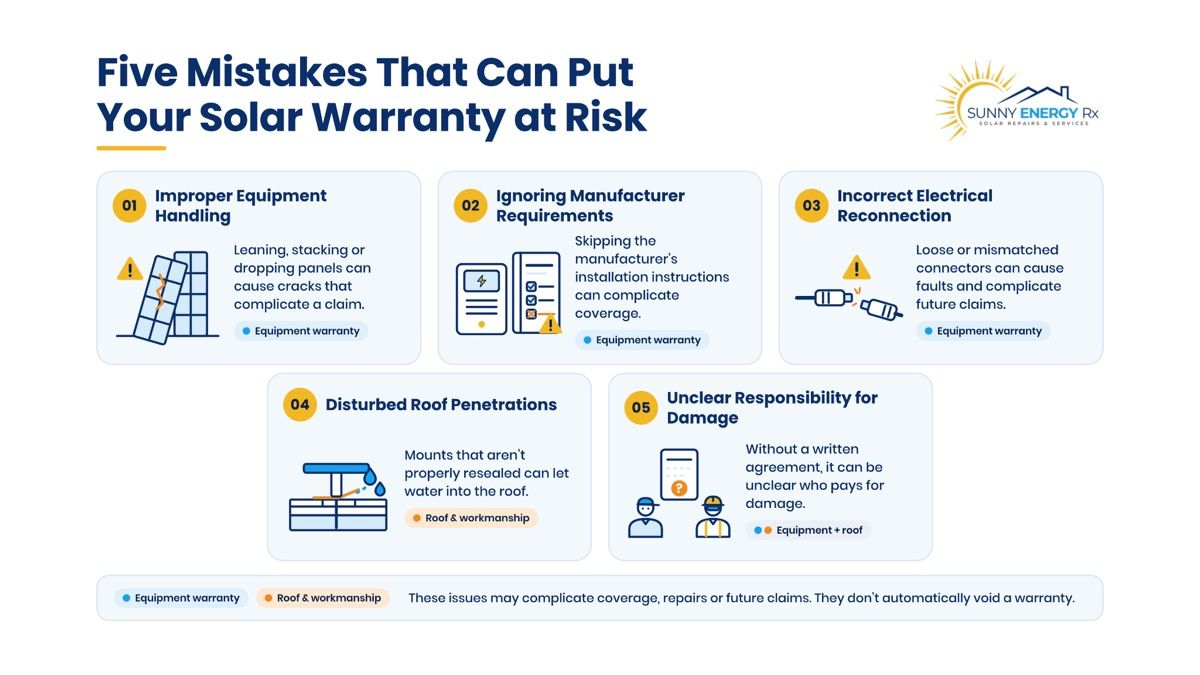
Improper equipment handling: Dropping, stacking, or storing panels incorrectly can cause physical damage or microcracks that may not be immediately visible.
Failure to follow manufacturer requirements: Some manufacturers specify procedures or qualifications for handling and reinstalling their equipment. Failing to follow applicable requirements may affect coverage.
Incorrect electrical reconnection: Loose connections, damaged connectors, or improper wiring during reinstallation can create equipment problems and potential safety hazards.
Disturbed roof penetrations: Improperly restored flashing, mounting hardware, or seals can lead to water intrusion and disputes over roofing responsibility.
Unclear responsibility for damage: If the roofer and solar contractor have not agreed on who handles damage during removal, storage, and reinstallation, resolving a claim can become difficult.
None of these issues are inevitable. Most can be avoided with clear communication between you, the roofer, and the solar contractor. Here is how to do that:
Before Approving the Work
Because many warranty disputes come down to missing paperwork or unclear responsibility, take the following steps before any work begins. These steps protect your coverage, document your system’s condition, and make clear who is responsible for the work.
Collect your original solar installation agreement, panel warranty, inverter warranty, battery warranty, and roofing documents.
Ask the equipment manufacturers whether professional removal and reinstallation affect coverage and whether specific procedures must be followed.
Get written confirmation from the solar contractor explaining the workmanship coverage for the removal and reinstallation.
Clarify who is responsible for accidental damage during panel removal, transportation, temporary storage, and reinstallation.
Establish who will inspect and restore mounting hardware, flashing, and roof penetrations.
Photograph the panels, roof, inverter, and equipment labels before work begins.
Keep the removal and reinstallation invoices, inspection reports, and post-work production records with your warranty documents.
If your system is leased or covered by a third-party ownership agreement, contact the lease provider before scheduling removal. Your agreement may specify approved contractors, required procedures, and responsibility for warranty-related work.
Note: When choosing a solar panel removal company, look for NABCEP certification, an active Arizona ROC license, experience with removal and reinstallation, a record of servicing systems it didn’t install, written findings, and a production check after the work. If a company can’t show these, keep looking.
Looking for solar panel removal near me? For solar panel removal and reinstallation, or a check after roof work, call Sunny Energy RX at 480-470-1023.
The cost to remove and reinstall solar panels depends on array size, roof type, access, and the scope of electrical work. Tile roofs and larger systems usually take more time. Get a written scope and quote from a licensed solar contractor.
It varies with roof size, material, and trade coordination. A planned job may take days, while poor sequencing can stretch it much longer. Ask for a target restart date in writing.
Yes, and they should coordinate closely. The solar contractor removes the panels first, the roofer completes the work, then the solar contractor reinstalls and tests the system. Because each trade depends on the other, someone, ideally you or a project manager, should set firm dates so neither crew delays the other.
Sometimes. If your panels are old, damaged, or underperforming, replacing them while they’re already off the roof can make sense, since you avoid paying for a second removal later. Newer panels are also more efficient, so compare the upgrade cost against your remaining warranty and expected output.
Yes, you won’t generate any solar power while the panels are off, so you’ll buy more electricity from the grid. How that affects your bill or net metering credits depends on your utility and plan, so check with them beforehand and ask the installer for an expected timeline.
About the author

Sunny Energy RX Team
The Sunny Energy RX Team is a group of NABCEP-certified Arizona solar technicians with 17+ years of experience. The team specializes in repairing, maintaining and monitoring residential systems from nearly all major brands, including orphaned systems.
Published · Updated