If you’re searching “how to clean solar panels,” "solar panel cleaning service near me,” or “best way to clean solar panels,” you’re not alone. In Arizona, cleaning matters more than most states because desert dust, construction grit, seasonal pollen, bird activity, and monsoon splash can build up quickly—quietly dragging down production even when panels still look “mostly fine” from the ground.
That’s where a solar panel cleaning service makes a real difference: pros use panel-safe, soft-contact methods, manage water quality to reduce spotting, and clean rooftop systems with the right safety practices—so you get better results without risking scratches, seal damage, or warranty issues.
Sunny Energy RX is built specifically for homeowners who need reliable solar ownership support—especially solar orphans, including customers impacted by installer shutdowns such as Titan Solar and SunPower, where ongoing service, cleaning, and system care are often left unsupported.
We’re a solar service specialist (not a sales company), so our cleaning work is approached with a warranty-safe mindset and an experienced eye for issues like bird activity, monitoring alerts, and unexpected performance drops—helping homeowners keep their systems running properly even when their original provider is no longer available.
This blog covers:
What solar panel cleaning services include (residential + commercial)
The best way to clean solar panels without damaging glass, coatings, seals, or warranties
Tools and materials needed to clean solar panels (and what not to use)
How often to clean solar panels in Arizona (inspection and maintenance guide)
Solar panel cleaning cost ranges and what affects pricing
How to choose the right solar panel cleaning company (and when DIY makes sense)
Want a roof-safe, panel-safe clean that protects long-term efficiency?
Book a Sunny Energy RX solar panel cleaning service anywhere in Arizona and keep your system producing the way it should.
Monitoring First: Catch Performance Drops Before Dirt Is Obvious
Professional solar panel cleaning services remove dust, dirt, pollen, bird droppings, and debris that block sunlight from reaching the photovoltaic cells. Even a light “haze” on the glass can reduce light transmission, which means your system may produce less clean solar power than it should—especially in dusty or high-pollen areas.
A proper cleaning isn’t just about appearance—it’s about restoring performance safely. Pros use panel-safe methods (soft-contact tools, proper rinsing, and residue control) to avoid scratches, streaking, or buildup that can keep attracting new dirt, helping protect long-term output and efficiency.
A quality provider typically includes:
A safe rinse and wash using non-abrasive tools
Panel-safe water practices (often purified / deionized water to reduce spotting)
Light debris removal (leaves, seed pods, pigeon mess)
A basic visual check for obvious issues (cracked glass, loose wiring, hot-spot clues, lifted edges)
Many solar-service specialists also pair solar system cleaning with a quick performance review, checking your monitoring app, confirming inverter status, and comparing recent production trends to spot obvious issues early. From there, cleaning approaches can look a little different depending on whether the system is on a home or a larger commercial site:
Residential vs commercial cleaning contexts
Solar panel cleaning looks similar on the surface, but the priorities change depending on the site. Residential solar panel cleaning is usually about safe access and careful technique on a roof, while commercial cleaning is more about scale, scheduling, and consistency across larger arrays.
Aspect | Residential Solar Panel Cleaning | Commercial Solar Panel Cleaning |
Focus | Roof safety, protecting glass/coatings, preventing micro-scratches and hard-water spotting | Larger systems, operational efficiency, and compliance with facility requirements |
Tools & Techniques | Soft-contact tools, controlled rinsing, extra care around panel edges, wiring, and delicate roof materials (tile, shingles, flat roofs) | Water-fed poles, larger crews, planned service routes for efficiency |
Documentation | Usually minimal; focus is on cleaning quality and safety | Detailed reporting including before/after photos, condition notes, and completion logs for facility tracking |
Scale | Smaller, individual rooftops | Large-scale solar installations, multiple rooftops, or commercial facilities |
Crew Size | Small, specialized team | Larger, coordinated team to manage bigger systems efficiently |
If your monitoring data is showing a drop before the panels look dirty, timing your cleaning strategically can help you recover production sooner and avoid stubborn spotting.
Desert Dust and Weather: How Arizona Impacts Solar Panel Performance
In Arizona, solar panels get dirty faster than most homeowners expect because the environment constantly deposits fine particles on the glass. Between desert winds, nearby construction, seasonal pollen, and monsoon splash-back, grime can build in thin layers that aren’t always obvious from the ground—but still reduce how much sunlight reaches the cells.
Common soiling sources include:
Dust and fine sand (desert winds, construction, farm-adjacent areas)
Pollen (seasonal)
Bird droppings (creates “hard shading” spots)
Monsoon residue (mud splatter + streaking)
Mineral deposits (hard water + evaporation)
In arid climates, you often don’t get enough natural rainfall to rinse panels clean—soiling builds slowly and quietly. We hear this a lot from homeowners in places like Glendale: “My panels look fine, but my production is down.”
In Arizona, the mismatch between what you can see from the ground and what your system is actually producing is common—because the earliest performance drops often show up in your monitoring data before they look “dirty” at first glance.
Rain may rinse loose particles, yet it often dries into streaks, mineral spotting, or sticky residue that still blocks sunlight—especially in dry climates where buildup can bake onto the glass between storms. That’s why natural weather events may reduce buildup temporarily, but they rarely keep panels reliably production-ready on their own.
Choosing the Right Time to Clean Solar Panels
Timing matters almost as much as technique. Understanding how often solar panels should be cleaned helps you remove buildup before it hardens, improves post-cleaning production gains, and reduces the chance of streaking or spotting from fast evaporation.
Good timing rules:
Timing / Condition | Reason / Benefit | Recommended Months (AZ) |
After major dust events (e.g., haboobs/dust storms) | Resets performance after heavy airborne grit settles. | June – September (monsoon/dust storm season) |
After heavy bird activity | Droppings can cause stubborn, localized shading that reduces output more than light dust. | March – May (spring migration/nesting season) |
Before peak production season (spring clean-up) | Maximizes summer generation when daylight hours are longest. | March – April |
Avoid blazing-hot afternoons | Clean early morning or late afternoon to reduce water evaporation, streaking, spotting, and thermal stress on the glass. | Year-round (daily timing: before 10 AM or after 4 PM) |
Solar Panel Cleaning Companies in Arizona
For homeowners and businesses looking to maintain solar efficiency in Arizona, Sunny Energy RX stands out as a top choice for dependable solar panel cleaning services.
Other highly rated providers across the state include Sunbros Solar Panel Cleaning in the Greater Phoenix area. It is a veteran-owned and family-operated company known for bird mess cleanup and bird netting installation.
Solar Panel Cleaners of Arizona serves Buckeye and the West Valley. The company works with residential, commercial, and industrial clients. It is also known for thorough inspections and treated-water rinsing that help prevent hard water stains.
Phx Solar Gleam N Clean is a firefighter-owned Phoenix business. It offers solar panel cleaning, pigeon proofing, window washing, and power washing.
SunsUp Cleaning Services serves Mesa, Scottsdale, Chandler, Gilbert, and Tempe. It is known for high-quality solar panel cleaning and bird mesh installation for both residential rooftops and large solar fields.
Solar panel cleaning needs can vary across Arizona based on local weather, dust levels, and bird activity. Here's a closer look at the unique challenges homeowners face in different parts of the state.
Solar Panel Cleaning Services Across Arizona
Solar panel cleaning needs can vary across Arizona due to differences in dust levels, bird activity, weather patterns, and local conditions. Whether you're in Phoenix, Scottsdale, Mesa, Chandler, Glendale, Peoria, or Tucson, regular cleaning can help maintain system performance and maximize long-term energy savings.
Solar Panel Cleaning Phoenix
Phoenix's dust storms, construction activity, and bird nesting can quickly reduce solar panel performance. Regular cleaning helps remove buildup, restore energy production, and keep systems operating efficiently, especially after monsoon storms and major dust events.
Solar Panel Cleaning Scottsdale
Scottsdale homeowners often have premium solar systems and tile roofs that require careful maintenance. Professional cleaning helps remove dust, pollen, and hard water residue while protecting panel surfaces and maintaining long-term performance.
Solar Panel Cleaning Mesa
Dust, pollen, and monsoon residue can gradually reduce solar production in Mesa. Routine cleaning helps maximize energy output and gives homeowners an opportunity to identify potential issues before they affect system performance.
Solar Panel Cleaning Chandler
Construction growth and seasonal dust can lead to significant panel soiling in Chandler. Professional cleaning helps remove buildup safely while supporting consistent energy production throughout the year.
Solar Panel Cleaning Glendale
Glendale homeowners frequently deal with dust, debris, and bird activity that can impact solar efficiency. Regular cleaning helps restore production and prevent issues caused by heavy soiling or localized shading.
Solar Panel Cleaning Peoria
Peoria's desert conditions and seasonal winds can leave a layer of dust on solar panels that reduces performance over time. Scheduled cleaning helps maintain efficiency and maximize solar savings.
Solar Panel Cleaning Tucson
Tucson's combination of dust, intense sun exposure, pollen, and monsoon activity can affect solar panel output. Regular cleaning helps homeowners maintain peak energy production and protect their solar investment.
While environmental conditions and service availability can vary across Arizona, one factor remains constant: the cleaning method matters. Using the wrong tools or techniques can do more harm than good, making it essential to understand how proper cleaning helps protect both solar performance and panel longevity.
The Critical Role of Method Choice in Preserving Panel Lifespan
Good solar panel cleaning matters because the right method can restore production without wearing down the glass, coatings, or seals over time. Since panels are a long-term asset, cleaning should improve performance while protecting durability and warranty standing.
However, bad cleaning practices can lead to:
micro-scratches that scatter light
residue films that trap dust
premature wear on seals/frames
warranty disputes if damage is clearly cleaning-related
Manual, automated, and professional approaches
There isn’t one single way that works best for every home or site—your ideal method depends on panel location, how dirty they get, and how much safety/access equipment is required. In general, solar panel cleaning falls into three main approaches:
Manual (DIY or pro): soft brush/sponge and water with a controlled rinse
Automated (more common commercially): robotic cleaners or scheduled wash systems (site-dependent)
Professional service: trained roof safety, purified water methods, inspection habits, and liability coverage
The best solar panel cleaning method depends on site conditions, panel location, and access. Manual cleaning suits small, easy-to-reach systems, automated systems work for larger or commercial setups, and professional services are ideal when safety, long-term care, and warranty compliance are priorities especially for rooftops with limited access, complex layouts, or older/orphaned systems.
Sunny Energy RX provides solar panel cleaning services across Arizona, and we treat cleaning like part of long-term solar ownership support—not a quick “spray and go.” Our team uses panel-safe methods to help reduce spotting and avoid damage to glass, coatings, seals, and wiring, with a service-first mindset that’s especially helpful for orphaned systems where the original installer is no longer around.
DIY recommended cleaning methods to protect solar panels
If you’re asking yourself “what can you use to clean solar panels?” start here:
Cool, clean water (preferably low-mineral)
Soft-contact tools (microfiber, soft brush, soft sponge)
Minimal, mild detergent only if needed, then rinse thoroughly (some manufacturers allow mild detergent; some consumer guidance warns against “washing-up liquid” films—so use sparingly and rinse well).
Soft-contact cleaning is preferred because it lifts grime gently without scratching the glass or protective coatings that help panels perform efficiently. Water quality also matters—hard water can dry into mineral spots (especially in hot weather), so purified or deionized water is often used to reduce spotting and leave a cleaner finish.
One of our Scottsdale clients tried using a popular household glass cleaner to “quick-wipe” their panels during a warm afternoon. Within a week, they noticed hazy patches and dust sticking more aggressively—especially along the lower edge where cleaner residue dried first. When they switched to a panel-friendly rinse (clean water + microfiber/soft brush + thorough rinse), the haze cleared and the panels stayed cleaner longer between washes.
To understand when to hire a professional and when to opt for DIY, read our article “Solar Panel Cleaning Cost: Pricing Factors, Average Cost, Cost Explained for Arizona Homeowners and Businesses”
Step-by-step guide to manually clean solar panels
Below is a safe, no-fuss approach to how to clean your solar panels without specialized equipment. It focuses on gentle rinsing and soft-contact washing to remove dust and grime while minimizing the risk of scratches, residue buildup, or seal damage that can affect long-term performance.
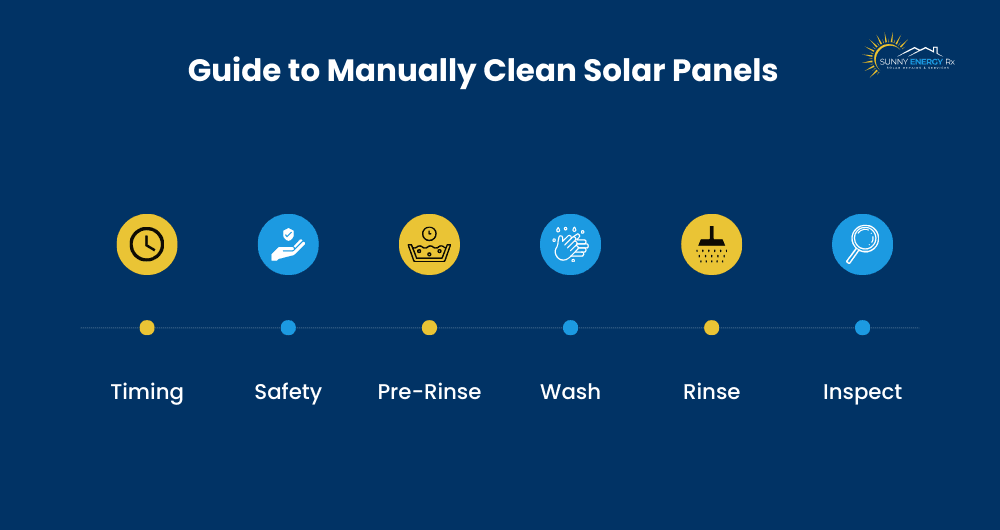
1) Pick the right time
Early morning or late afternoon (panels cool)
Avoid peak heat (rapid evaporation = streaks; thermal stress risk)
2) Prioritize safety
If it’s roof-mounted and steep/tall: strongly consider staying on the ground or hiring pros
Never step or kneel on panels
3) Pre-rinse
Gentle hose rinse to remove loose dust (no jet setting)
4) Wash
Use a soft brush/sponge on an extension pole (ideal)
If using detergent: use a tiny amount of mild, non-abrasive soap—then rinse thoroughly.
5) Rinse
Thoroughly rinse off any soap residue
6) Finish + inspect
Quick visual check: cracked glass, lifted wiring, bird nesting signs
Check your monitoring app the next day for improved performance
These simple steps explain the best way to clean solar panels on the roof, removing buildup effectively while protecting the glass, coatings, and seals for long-term performance.
Safe Solar Panel Cleaning Precautions that Prevent Damage
When cleaning a solar panel yourself, protect two things at the same time: you and the solar equipment. Because panels are often installed at height and connected to electrical components, the right process focuses on reducing fall risk, preventing water intrusion, and avoiding accidental damage to wiring, seals, and glass. Use the checklist below to keep the cleaning controlled and consistent—before, during, and after you touch the array.
Avoid roof work if you’re not trained or properly equipped. If you can’t reach the array safely from the ground with an extension pole, hiring a professional is usually the safer option.
Wear the right traction and protection. Non-slip shoes are the baseline; add gloves and eye protection when brushing debris, rinsing, or working near gritty dust.
Watch the “slip zones.” Wet roof edges, skylights, steep pitches, and loose gravel are common hazard areas—stay clear and never overreach.
Use stable access equipment. If a ladder is involved, it should be properly positioned and secured; never lean a ladder on panels or racking.
Keep water controlled. Use gentle flow and aim away from edges and junction areas to reduce the chance of pushing water where it doesn’t belong.
Follow system guidance when appropriate. If your manufacturer or system manual recommends a shut-down sequence before maintenance, follow it—especially if you’ll be near wiring, conduits, or the inverter.
Never step on panels. Even if they feel solid, stepping on modules can crack glass, create micro-damage, or stress the mounting system.
Can pressure washers damage solar panels during cleaning?
Yes—pressure washers can cause problems if the spray is strong enough to stress seals, force water into edges, or damage frames and wiring components. High pressure can also increase the chance of microcracks from impact and vibration, especially on older systems.
If someone claims they’ll pressure wash, ask:
What pressure and nozzle pattern?
How do they avoid blasting edges, junction boxes, and wiring?
Do they accept liability for water intrusion or damage?
Safer alternative: stick to low-pressure rinsing (garden-hose level), soft-contact washing, and thorough rinsing. If heavy grime won’t be released with gentle methods, that’s a sign to use professional tools and technique—not more pressure.
With enough knowledge on DIY methods, it is also important to understand how automated cleaning works so that you can choose between the two.
Automated Solar Panel Cleaning Systems : Are They Worth It?
For homeowners tired of scheduling manual cleanings, or commercial sites with arrays too large to clean cost-effectively by hand, automated cleaning systems are a growing alternative to both DIY and one-off professional visits when it comes to solar panel cleaning service in Arizona.
How automated solar panel cleaning systems work
Automated systems fall into two main categories:
Fixed water-fed systems: permanently installed nozzles or sprinkler-style lines built into the racking that rinse panels on a timer or sensor trigger, often using the same purified/deionized water principles as manual professional cleaning
Robotic cleaners: brush-equipped units that move across the panel surface on rails or via a semi-autonomous robot, common on large commercial and utility-scale arrays, increasingly available for large residential systems
Both are designed to run on a schedule: daily, weekly, or triggered by a dust sensor without a technician on site each time.
Automated systems vs. professional cleaning vs. DIY
Feature | DIY Manual | Professional Cleaning | Automated System |
Upfront Cost | Lowest (tools only) | None (pay per visit) | Highest (hardware + install) |
Ongoing Cost | Time only | Per-visit fee | Low (mainly water) |
Best For | Small, easy-access systems, light dust | Most residential systems, warranty-sensitive setups | Large residential or commercial arrays, high-dust sites |
Inspection Included? | No | Yes, typically | No — separate inspection still needed |
Warranty Risk | Higher if done incorrectly | Low, when using panel-safe methods | Depends on installer quality and water source |
Is an automated cleaning system right for you?
Automation tends to make the most sense when:
Your array is large (25+ panels) or commercial-scale
You're in a consistently high-dust location with frequent soiling events
You want to reduce recurring service calls over the long term
You're prepared to pair it with a separate annual inspection for anything a sprinkler or robot can't catch
It tends to make less sense when:
You have a smaller residential system with light-to-moderate soiling
You want the "while we're here" inspection benefit that comes with a human technician on the roof
Your system is warranty-sensitive and you want documented, professional service records
Ultimately, whether you choose manual cleaning, an automated system, or a combination of both, regular maintenance is only as effective as the quality of the care. Once routine cleaning is no longer enough or you want the added assurance of a thorough inspection professional technicians offer benefits that DIY methods simply can't match.
When DIY Falls Short and Pros Deliver
For most homeowners, figuring out the best way to clean solar panels on the roof is exactly where calling a pro starts to make sense. DIY cleaning usually relies on a garden hose and a basic brush, which can work for light dust on easy-to-reach arrays. However, professional solar panel cleaning companies typically bring upgrades that improve results and reduce long-term risk.
Common pro upgrades include:
Water-fed pole systems + deionized water for safer reach and fewer streaks/spots
Safer roof access practices (less time exposed to fall risk, better positioning, less contact with fragile edges)
Documentation and “while we’re here” observations like:
loose or exposed wiring/conduit issues
signs of bird nesting under panels
obvious damage (cracked glass, lifted edges, heavy localized soiling patterns)
These small “catch it early” checks are often what separates a basic wash from a service that actually protects long-term production.
A simple rule: DIY is best when it’s easy and safe. Professional cleaning is best when it’s high, steep, stubbornly dirty, or warranty-sensitive.
Sunny Energy RX: A smart choice for solar panel cleaning in Arizona
Arizona’s heat, dust, and bird activity make panel maintenance a different game than “generic” cleaning advice. Sunny Energy RX approaches cleaning like a solar service company—not a window-washing crew—so the goal is always maximum efficiency without risking the system.
What sets Sunny Energy RX apart:
Solar service specialists (not solar sales): We focus on service, diagnostics, and long-term ownership support.
Warranty-safe mindset: Panel-safe tools and methods, with care around edges, seals, and wiring.
NABCEP-certified technicians with 17+ years of Arizona solar experience: You’re getting trained pros who understand rooftop PV systems in real conditions.
Orphaned system support: If your installer is gone, we’re built to help keep your system performing for the long run.
Add-on solutions when cleaning isn’t enough: If we see bird nesting, monitoring issues, or performance drops, we can guide next steps (monitoring, troubleshooting, bird proofing, etc.).
So once you’ve decided whether DIY or pro cleaning makes the most sense, the next step is building a routine that keeps performance high, without overcleaning or missing early warning signs.
Bird Proofing Solar Panels: Why Cleaning Alone Isn't Enough
Panel Cleaning and Inspections: A Frequency Strategy, Not a Fixed Rule
How often solar panels should be cleaned and inspected depends on your environment, panel tilt, and the “dirt events” your home gets hit with—dust storms, nearby construction, heavy pollen weeks, or recurring bird activity.
An inspection-first approach is especially important for homeowners whose original installers—such as Titan Solar or SunPower—are no longer operating. Without an original provider to monitor performance or flag early issues, small problems can go unnoticed and often only become visible after production has already declined.
A good solar panel cleaning service will usually recommend a cadence based on what they see on your roof and what your monitoring data shows, rather than a one-size-fits-all schedule. At least once a year is a smart baseline for solar panel cleaning and inspection (and more often if conditions demand it), especially if:
Your monitoring shows an unexplained production drop that doesn’t match seasonal weather changes
You’re seeing inverter or communication alerts in the app or on the inverter display
You notice bird nesting, droppings, or heavy debris buildup around the array edges or underneath the panels.
A Litchfield Park homeowner told us their roof and panels “looked perfect” from the ground, but our monitoring showed a steady production drop. During the inspection, we found heavy bird activity under the array and a loose connection creating intermittent faults—issues that aren’t obvious visually. Fixing it early prevented bigger electrical damage and avoided a much more expensive repair later.
Because cleaning visits often include a quick performance check, they don’t just keep panels “looking clean”, they help protect the dollars-and-cents value of your system by recovering lost production and catching small issues before they turn expensive.
Return on Investment (ROI) — The Economics of Panel Cleaning
Solar panel cleaning impacts return on investment by restoring energy production that’s lost to soiling, dust, pollen, bird droppings, and mineral residue that block sunlight from reaching the photovoltaic cells. When panels underproduce, homeowners effectively lose part of the energy savings their system was designed to deliver.
In dusty or bird-heavy environments like Arizona, even a modest performance drop can add up over time. Restoring output through proper, warranty-safe cleaning helps systems operate closer to expected production levels, protecting the long-term value of the solar investment.
Short-term savings vs long-term value
From a cost perspective, professional solar panel cleaning is relatively small compared to the lifetime value of a solar system. A single cleaning can recover lost production immediately, while consistent maintenance helps prevent issues that can erode savings over the years—such as uneven soiling, hot spots, or unnoticed performance declines.
Cleaning also supports ROI by reducing the chance of secondary costs. Catching bird activity, wiring concerns, or monitoring issues during a cleaning visit can prevent minor problems from turning into expensive repairs later.
Solar Panel Cleaning ROI Overview
Factor | Without Regular Cleaning | With Professional Cleaning |
Energy production | Gradual decline due to dust, pollen, and bird droppings | Restored output closer to original system expectations |
Monthly solar savings | Reduced bill offset as production drops | Higher bill offset from recovered generation |
Performance visibility | Issues often go unnoticed until losses are significant | Problems spotted early during cleaning and inspection |
Maintenance costs | Higher long-term risk from delayed detection | Lower risk through preventive, inspection-first service |
System lifespan | Greater strain from uneven soiling and hot spots | More stable operation over time |
Return on investment (ROI) | ROI erodes quietly as lost energy accumulates | ROI protected by maintaining consistent output |
Once you understand how cleaning protects ROI by recovering production and preventing avoidable repairs, the next step is looking at what professional cleaning actually costs, and why the value often goes beyond the sticker price.
The True Cost of Professional Panel Cleaning: Value Beyond the Sticker Price
Professional solar panel cleaning costs aren’t one-size-fits-all, because most companies price based on the time, risk, and access involved—not just the number of panels. A small, single-story system with light dust is typically cheaper to service than a steep, two-story roof with heavy bird droppings, stuck-on grime, or tight roof access.
Typical U.S. ranges reported around 2025:
$150–$500 per visit for many residential cleanings
Some sources cite higher averages depending on market/roof complexity (example: an average near the mid-$400s with highs over $1,000 in certain cases).
Per-panel pricing commonly shows up around $10–$25 per panel across multiple market summaries.
Arizona-specific ranges (commonly quoted by local providers and AZ-focused guides):
Often ~$10–$20 per panel or ~$150–$300/year for typical home systems, with more frequent schedules costing more.
Factors affecting professional solar panel cleaning costs
Professional solar panel cleaning pricing is mainly driven by how long the job takes and how challenging it is to access the array safely. Given below are the most common factors that influence the final cost:
Number of panels / total array size
Roof height, pitch, and access constraints
Level/type of soiling (dust vs bird droppings vs mineral deposits)
Whether you bundle cleaning with inspection, monitoring checks, or bird-proofing
Frequency (one-time vs quarterly/biannual plans)
To know more about Solar Panel Cleaning Costs in detail, read our blog “Solar Panel Cleaning Cost: Pricing Factors, Average Cost, Cost Explained for Arizona Homeowners and Businesses”
Cost matters, but so does what happens if cleaning is done the wrong way. That’s why the next step is understanding how warranties split responsibility between homeowner maintenance and manufacturer-covered defects.
Who Cleans Under Warranty? Clarifying Homeowner vs. Manufacturer Duties
Most solar warranties draw a clear line between owner maintenance and manufacturer defects. Homeowners are typically expected to keep panels reasonably clean and address obvious buildup (like heavy debris or bird mess), while manufacturers generally cover failures tied to materials or workmanship.
Here are common cleaning-related issues that typically aren’t covered under warranty:
Damage caused by neglect is usually not covered under warranty.
Damage from abrasive tools/pads is usually not covered.
Damage from harsh chemicals is usually not covered.
Damage from high-pressure washing is usually not covered.
Issues caused by unsafe roof practices are usually not covered under warranty.
How to stay warranty-safe with solar panel cleaning
Best practice is to treat panel cleaning like preventive maintenance, not “scrubbing glass.” The goal is to remove buildup while protecting the module surface, coatings, seals, and electrical components.
Follow manufacturer guidance: Use soft tools, a mild detergent only if allowed, and finish with a thorough rinse.
Avoid warranty-risk methods: Skip abrasive pads, strong chemicals, and high-pressure washing, which can damage glass/coatings or stress seals and frames.
Keep simple records: Take before/after photos and save receipts or service notes (helpful if warranty questions come up later).
Review your terms if unsure: Check the module warranty language and your installer/service agreement—cleaning and maintenance requirements can vary by brand and provider.
How Sunny Energy RX helps protect your warranty during cleaning
Solar warranties usually don’t require “professional cleaning,” but they do assume the system is cared for without causing damage. That’s where Sunny Energy RX fits in: we treat cleaning as warranty-protective maintenance, not just making panels look shiny.
Method selection that avoids warranty triggers: We use soft, non-abrasive tools and manufacturer-approved detergents only when permitted, then rinse thoroughly so residue doesn’t bake on in Arizona heat. We avoid abrasives, harsh chemicals, and high-pressure washing that can stress seals, frames, coatings, and edges.
Pre-clean visual checks to reduce accidental damage: Before cleaning, we look for obvious issues that can turn a “simple wash” into a warranty problem—like lifted seals, cracked glass, exposed wiring, loose connectors, or bird-related damage—so you don’t unknowingly worsen a condition that could be questioned later.
Documentation that supports you if questions come up: We provide before/after photos and simple service notes (date, observed conditions, methods used). If a manufacturer or third party ever asks, you can show your panels were maintained carefully and consistently.
Warranty-aware escalation when cleaning isn’t the real issue: If low production is caused by an inverter/monitoring alert, failed component, or damage (not dirt), we can shift into diagnostics, performance troubleshooting, monitoring & maintenance, or warranty claim assistance—so you’re not stuck guessing or doing “more cleaning” that won’t fix the problem.
Since cleaning quality varies widely from one company to another, asking the right questions up front helps ensure the work is panel-safe, roof-safe, and warranty-safe.
Questions to ask before choosing solar panel cleaning services
When you’re comparing providers, the goal isn’t just to find someone who can wash solar panels—it’s to find a team that knows the best way to clean solar panels without scratching glass, leaving residue, or creating seal/wiring issues. A good company should be able to explain how solar panels are cleaned, what they use, and how they protect your system while delivering reliable results.
Ask these questions before booking a solar panel cleaning service:
What cleaning method do you use—soft-contact or abrasive?
You want soft-contact tools (microfiber/soft brushes), not scouring pads or stiff bristles. This matters for cleaning photovoltaic panels safely and avoiding micro-scratches.What do you clean solar panels with?
Ask specifically what to use to clean solar panels on your home. The safest answer is typically clean water (often purified) and a residue-minimizing approach—especially for solar PV panel cleaning in dusty areas.Do you use purified/deionized water to reduce spotting?
Hard-water rinses can leave mineral spotting that makes panels look streaky and attracts more dust. Purified water is a big upgrade for solar panel washing.Will you avoid high-pressure washing near edges, seals, and wiring?
If you’re researching how to safely clean solar panels this is huge. High pressure can drive water into vulnerable areas and create long-term problems.Are you insured for roof work (and do you have documented safety procedures)?
For cleaning rooftop residential solar panels, insurance and roof-safety practices matter as much as the cleaning itself.Do you provide before/after photos or a short condition note?
This helps verify the job and creates documentation for maintenance history. It’s also useful if you’re tracking performance changes after cleaning solar panels.Can you bundle cleaning with a performance check or bird-proofing?
If your goal is how to keep solar panels clean long-term, bundling matters. Bird activity and nesting are common reasons homeowners have to repeatedly clean solar panels.
If a company can’t clearly explain how to clean solar panels (tools, water quality, pressure approach, and roof safety), that’s usually a sign to keep shopping.
Conclusion: Clean Panels, Protected Performance, Fewer Surprises
Solar panel cleaning isn’t just about making your array look better—it’s about keeping sunlight reaching the cells evenly so your system can produce clean solar power at its best. In Arizona’s dust, heat, pollen, and bird-heavy conditions, solar panel washing often becomes a practical part of ownership, not an occasional “nice-to-have.” The right approach—soft-contact tools, clean water, smart timing, and avoiding harsh chemicals or pressure—helps protect panel coatings, seals, and long-term efficiency.
When panels are easy to reach and lightly soiled, DIY can work using the safe steps in this guide. But for roof-mounted systems, stubborn buildup, hard-water spotting, or warranty-sensitive situations, a professional solar panel cleaning service is usually the smarter path—especially when you want consistent results without risking falls or accidental damage. And if your monitoring still shows underperformance after cleaning, that’s the signal to move from washing to diagnostics.
Need help in Arizona? Sunny Energy RX is built for long-term solar ownership support—especially for homeowners with “orphaned” systems whose installers are gone. If you want a warranty-safe solar panel cleaning service (and a team that can spot performance issues before they become expensive), contact Sunny Energy RX today to schedule service and keep your system producing the way it should.
Summary
Solar panel cleaning services remove dust, dirt, pollen, bird droppings, and debris so more sunlight reaches the PV cells and output stays higher.
In Arizona, panels get dirty faster due to dust/fine sand, construction grit, pollen, monsoon splash, and mineral deposits—rain alone often won’t clean them fully.
The best way to clean solar panels is soft-contact + clean water + correct timing (cool panels), with mild detergent only if needed and a thorough rinse.
Avoid damaging methods/products: abrasive pads, harsh chemicals, many household glass cleaners, and high-pressure washing near edges/seals/wiring.
DIY works best for easy-to-reach panels with light dust; roof-mounted or heavily soiled systems are usually safer and more effective with a professional solar panel cleaning service.
Tools that help: microfiber/soft brushes, extension poles, low-mineral or purified water, gentle rinse—keep water controlled around panel edges.
Cleaning frequency depends on environment, tilt, and “dirt events” (dust storms, pollen spikes, bird activity); use monitoring trends to decide.
Warranties: homeowners typically handle basic upkeep; manufacturers cover defects—not neglect or cleaning-caused damage. Keep methods warranty-safe and save records/photos.
Cost in 2025 varies mainly by panel count, roof access, soiling type, and service frequency; bundling (inspection/monitoring/bird-proofing) can change pricing.
Choosing a company: ask about soft-contact tools, purified water, avoiding pressure washing, roof safety/insurance, before/after photos, and performance check options.
Yes—especially in Arizona. Dust, pollen, and bird droppings reduce sunlight and can lower production before panels look dirty. Professional, panel-safe cleaning restores output, reduces hard-water spotting, and includes a quick visual check to catch issues early for long-term savings.
Most warranties expect homeowners to keep panels reasonably clean and clear debris; manufacturers cover defects in materials or workmanship. If your installer is gone, choose a solar-service specialist who uses warranty-safe methods and provides documentation like photos and service notes.
Typical U.S. residential cleanings often run about $150–$500 per visit, or roughly $10–$25 per panel. In Arizona, pricing depends on roof height, pitch, access, and soiling (dust vs bird droppings vs mineral deposits). Bundling inspection or bird-proofing can change totals.
Yes, if it’s safe to reach. Use cool, low-mineral water, a soft brush or microfiber on an extension pole, gentle rinse, and minimal mild soap only if allowed—then rinse thoroughly. Avoid hot afternoons, ladders on panels, and pressure washers ever.
Soiling builds quietly in Arizona’s dry climate. Over time you may see lower production, reduced bill offset, and stubborn mineral spotting that bakes on. Heavy bird droppings can create hard shading and hot-spot risk, while missed damage goes unnoticed longer.
Sunny Energy RX Team
Published Mar 25, 2026