What the Birds Are Doing to Your System, and How to Get Them Out for Good
Birds under solar panels are usually pigeons, and they love the warm, shaded gap between a rooftop panel and the roof. In Arizona, where the heat pushes birds to look for shelter, that gap can become a nesting site almost year-round. We call it the nesting gap, and it is where most bird-related solar problems start.
The good news is that pigeons under your panels rarely wreck a system overnight. The risk is that the problem builds quietly. Nests rebuild, droppings pile up, and debris collects around wiring and connectors where nobody can see it. Left alone, that can lower output, hide wiring damage and lead to bigger repairs.
Many homeowners first notice the problem from the ground. You might see pigeons walking along the panel edge, hear cooing and scratching on the roof, or spot droppings running down the front of the array. Others find out only when a panel stops reporting in their monitoring app, or when a technician lifts a panel for another job and finds a nest underneath.
This guide explains how solar panel bird proofing works in the right order: remove the birds and nests, clean the area, inspect the equipment, then seal the gap so the birds cannot return. Skipping a step is the most common reason the birds come back, so each stage matters.
Note: Pigeons nest under solar panels because the gap is warm, shaded and safe from predators. Left alone, droppings and nesting debris can foul panels and wiring. The permanent fix is professional solar panel bird removal, a clean-out and inspection, then critter guard mesh fitted around every array edge.
Before you decide what to do about the birds, put safety first. Read the points below before you go near your panels.
Safety First: Read This Before You Touch Anything
Solar panels carry live DC electricity whenever there is daylight, and roofs in Arizona can become dangerously hot. Birds, nests and droppings are not a reason to climb up and investigate yourself.
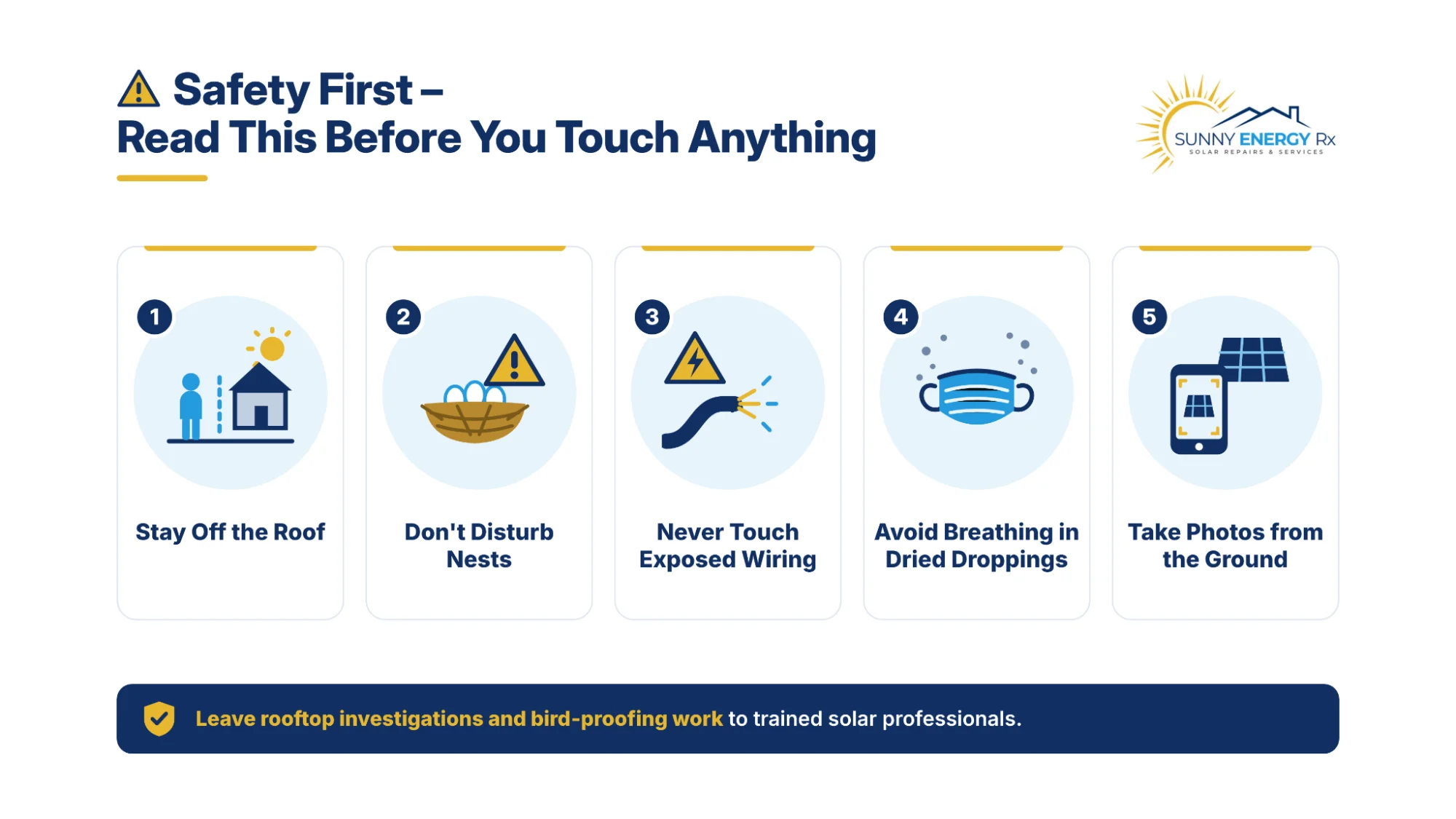
Stay off the roof. Falls, heat exhaustion and slippery droppings make rooftop work risky. Leave it to trained professionals.
Do not poke, spray or block the gap. Sprays and DIY blocking can disturb wiring, trap birds under the panels or hurt protected species.
Never touch exposed or chewed wiring. Treat loose cables, melted insulation, burning smells or buzzing as a hazard. Keep your distance, and call 911 if there is immediate danger.
Avoid breathing in dried droppings. Dust from old droppings can carry germs. Do not sweep or hose it where it can blow around, and keep children and pets away.
Take photos from the ground. A zoomed phone photo of the nesting, droppings and any dangling wiring is enough for a quote. A professional solar panel inspection can help identify hidden wiring damage, loose connections and other problems caused by nesting activity.
With these safety precautions in mind, the next step is to identify the specific bird-related issue you're dealing with. Whether you're seeing the first signs of nesting, dealing with an existing infestation, considering mesh installation, or noticing a drop in solar production, the right solution depends on your situation.
Use the map below to find the section that best matches your problem and understand what to do first.
Bird Proofing Situation Map: Find Your Problem Fast
Solar panel bird proofing in Arizona is not one-size-fits-all, because not every homeowner with pigeons faces the same problem. Some just moved in and are seeing the first birds. Others have old nests, a pile of droppings, a panel reporting zero, or a house purchase in progress.
This map helps you identify your situation and points you to the right section.
Here is the structured comparison table formatted from your second section, along with the formatted diagnostic table from the first section in case you need both cleaned up.
Situation & First-Step Matrix
# | What you’re facing | What it usually means | First move this week |
1 | Pigeons just moved in under my panels | The nesting gap is open and the birds will keep returning | Photograph it and get a quote |
2 | Nests are already there, I need removal first | Nesting debris and droppings have built up | Book a professional removal and clean-out |
3 | I want critter guard or mesh installed | You want a permanent barrier | Ask for a perimeter mesh quote |
4 | I need a quote | Price depends on panel count, arrays, and roof access | Gather photos and panel details |
5 | I want to try DIY first | Roof and wiring risks are higher than they look | Read the DIY section before climbing up |
6 | Will bird proofing void my warranty? | Clamp-on systems are designed to avoid altering panels | Check your manufacturer and installer terms |
7 | Output dropped or a panel shows zero | Birds may be one cause among several | Check the app and photograph any error |
8 | I have Tesla, Enphase, or SolarEdge | Mesh must fit around brand-specific hardware | Tell the technician your equipment |
9 | I’m buying or just bought a house with pigeons | Bird issues should be priced into the deal | Ask for an inspection and quote before closing |
Need help right now? Sunny Energy RX offers a Solar Panel Bird Proofing and Panel Inspection for Arizona homeowners. Call 480-470-1023.
Now that you know where you stand, let’s look at why pigeons choose solar panels in the first place and why it matters.
1. PIGEONS NESTING UNDER PANELS
Pigeons Are Nesting Under My Solar Panels. How Do I Get Rid of Them?
Quick Answer: To get rid of pigeons under solar panels, the birds and nests need to be removed, the area cleaned, and the gap sealed with critter guard mesh. Solar panel bird proofing only works when the gap is sealed as well, because removing the birds alone means new ones simply move in. Have a qualified technician handle it rather than working on the roof yourself. |
If birds on solar panels have just started nesting underneath, it can feel like they appeared overnight. They usually did, because once one pair claims a spot, others follow. Acting early keeps the job smaller.
What You’re Seeing
“Pigeons just found my solar panels and are nesting under them.” “They hang out on my roof all day.” “How do I get rid of them and keep them out?”
What’s Actually Happening
A pigeon pair can raise several broods a year, and they tend to reuse a good nesting site. Chicks spend roughly a month in the nest, so a nest you ignore can become two or three. That is why Arizona bird control for solar roofs is a year-round job: mild winters and shaded roof gaps mean there is rarely a quiet season.
Among solar bird proofing methods, those that do not close the gap, like scarecrows, reflective tape or spikes, tend to slow birds down rather than stop them. Proper solar panel bird proofing focuses on closing the nesting gap so birds cannot return beneath the array.
The Fix
Do not block the gap or spray anything under the panels. You could trap birds or disturb wiring.
Photograph from the ground: where the birds enter, droppings, and how many roof slopes are affected.
Note your panel count and number of arrays for the quote.
Book a professional to remove the birds and nests, clean the area and fit critter guard mesh.
Check production in your app or on your bill afterwards, and ask for before-and-after photos.
Pigeons Rebuild Removing a nest without sealing the gap is a short-term fix. Birds can rebuild within days, so removal and mesh should be planned as one job.
Field Note: A Phoenix homeowner told us pigeons had been getting under their panels and hanging out on the roof, and asked for both nest removal and guards in one visit. Doing both together is the most efficient way, because the technician is already up there and the area is already clean.
Yes. The shaded gap between the panels and the roof is a popular nesting spot because it is sheltered from sun, rain and predators. Once one pair settles in, other birds often follow, so acting early keeps the job smaller.
They can nest repeatedly through the year. A single brood stays for roughly a month, but pairs often rebuild and raise more chicks in the same spot. In Arizona's mild climate, there is rarely a quiet season.
The gap offers shade, shelter from weather and protection from larger predators. It stays comfortable in both heat and cooler weather, and it is hard to reach from the ground, which makes it an ideal, low-risk nesting location.
We do not recommend it. Roof access, heat, live wiring, droppings and the rules around protected species make it better suited to trained professionals. You can safely photograph the problem from the ground and request a written quote.
Yes, if the gap is not sealed. Birds can rebuild within days, because the shelter is still there. That is why nest removal, cleaning and critter guard mesh should be planned together as one coordinated job.
How Sunny Energy RX handles this: We handle removal, clean-out and mesh installation as one coordinated job, so the birds are not just moved on for a few weeks.
Once you know that birds nesting under solar panels need removal before any other solution, the next question is how the nests are actually cleared out and what to do about eggs, chicks and protected species.
2. NEST REMOVAL AND CLEAN-OUT
How Are Pigeon Nests Cleaned Out From Under Solar Panels?
Quick Answer: A technician checks for eggs, chicks and protected species first, then uses protective gear to remove nesting material and droppings from under and around the panels. The area is bagged, sanitized and rinsed, and the panels are cleaned. The wiring is inspected before any mesh goes on. |
A nest clean-out is more than brushing debris away. Done properly, it is a safety job as well as a cleaning one. Professional solar panel cleaning services also help remove accumulated dirt and droppings from affected panel surfaces.
What You’re Seeing
“There’s a dead pigeon under my panels.” “A bird looks stuck.” “Droppings are all over the roof and panels.”
What’s Actually Happening
Nesting debris and droppings build up in layers. Dried droppings can carry germs that are best not breathed in, and a dead or trapped bird can attract pests, which is why solar panel pest control and nest clean-out are usually handled together. Heat can make smells and mess worse in summer.
Because active nests may hold eggs or chicks, removal also needs care and, in some cases, legal checks.
The Fix
The steps below describe what a professional should do. They are not a DIY checklist.
Identify the bird and check for eggs or chicks before touching anything.
Put on protective gear: respirator, gloves, eye protection and disposable clothing.
Access the gap safely from the panel edge, using fall protection on the roof.
Remove nesting material and droppings and bag them for disposal.
Sanitize the area and clean affected roof surfaces.
Clean the panels and check rails and drainage points.
Inspect wiring and connectors for chewing, loose cables or debris, and photograph the results.
Fit critter guard mesh only once the area is clear.
Eggs, Chicks and Protected Species Feral pigeons are generally not protected under federal law, but native birds such as doves can be, and active nests of protected species may not be disturbed. If you are not sure what species is nesting, have it identified before removal, and ask your provider how they handle this. For questions about local wildlife rules, you can contact the Arizona Game and Fish Department.
Field Note: A homeowner contacted us about pigeons that appeared to be stuck under their panels. Our first step was identifying the bird and checking the nest, not rushing to clear it. The order matters for both safety and legal reasons.
Yes. Droppings and debris can stay on the panels, rails, and roof after the birds are gone. A proper clean-out should include removing waste, sanitizing the area, and cleaning the panels, ideally before any mesh is installed. Learn more about solar panel cleaning and bird proofing and why both services matter when dealing with bird infestations.
Dried droppings can carry germs that are best not breathed in. That is why technicians use protective gear such as a respirator, gloves, and eye protection. Avoid sweeping or hosing droppings yourself, and keep children and pets away.
Do not reach under the panels or try to remove it yourself. A dead bird can attract pests and may sit near wiring. A technician can remove it safely, clean the area and check for any hazards.
It depends on the species and whether the nest is active. Feral pigeons are generally not federally protected, but native birds such as doves can be. Have the bird identified first, and ask your provider how they handle protected species.
Yes. Clearing nesting debris often exposes loose, chewed, or displaced cabling that was hidden. That is why a wiring and connector inspection should follow every clean-out, with photos and written findings, before any mesh is fitted.
How Sunny Energy RX handles this: Our team includes NABCEP-certified technicians, and we document the clean-out with before-and-after photos you can keep with your records.
Need help right now? Sunny Energy RX offers a Solar Panel Bird Proofing and Panel Inspection for Arizona homeowners. Call 480-470-1023.
Once the nests are cleared and the area is clean, the next step in solar panel bird proofing is closing the gap so the birds cannot return.
3. CRITTER GUARD AND BIRD MESH
What Is Solar Panel Critter Guard, and How Is It Installed?
Quick Answer: In Arizona, solar critter guard is a mesh barrier fitted around the edge of a solar array to stop birds and small animals from getting underneath. It is usually attached with clips to the panel frame, so it does not require drilling into the roof or panels. It should be installed only after nests and debris are cleared. |
Solar panel bird mesh installation is the part of the job that keeps the problem from coming back. A good solar panel bird proof installation is hard to spot from the ground.
What You’re Seeing
“What is bird mesh?” “Will it be ugly?” “Does it need drilling into my roof?”
What’s Actually Happening
Most bird mesh for solar panels uses a coated or galvanized mesh in a roll or panel form. Clips hold it to the panel’s edge, forming a skirt that closes the gap between the panel and the roof. Done well, it does not block airflow or touch wiring.
Solar panel bird protection varies by materials and by installer. Cheap clips can rust or loosen, and mesh that is cut short leaves gaps birds can use. Material quality, installation scope and roof layout can also affect the final price. See our breakdown of bird proofing solar panels cost to understand the expenses involved.
The Fix
When you request a critter guard quote, ask for the following.
The material and clip type to be used.
A description of how it attaches, and confirmation it does not require drilling into the roof or panels.
A plan for every array edge, including corners, ends and gaps around roof obstacles.
Confirmation of airflow and wiring clearance.
Written workmanship terms and before-and-after photos.
What a Good Install Looks Like The mesh sits tight and straight along the panel edge, with no gaps at corners or ends. Wiring stays clear of the barrier, and the mesh is secured at regular intervals.
Field Note: A Tucson homeowner with two roof slopes and a larger panel count asked for nest removal and critter guard together. The key detail in the quote was that every slope and every array edge was listed separately, so there were no surprises on the day.
It means sealing the gap under your panels, usually with mesh and clips, so birds cannot nest there. A good installation follows the full array edge, closes corners and ends, and leaves wiring and airflow undisturbed beneath the panels.
Clamp-on systems are designed to attach to the panel frame or racking without drilling into the roof or panels. Methods vary by installer and equipment, so ask for the attachment method in writing and confirm it suits your system.
A properly fitted mesh barrier can help keep out other critters as well as birds, since it closes the same gap. Fit quality matters, because small openings at corners or ends can still give animals a way in.
It depends on the number of arrays, panels and roof slopes, plus roof access and any nest removal needed first. Ask for a time estimate in your written quote, and allow extra time if cleaning and inspection are included.
A good installation is low-profile and usually dark, so it blends in with the panel frame. It should sit straight and tight along the edge. Ask to see photos of finished installs before you book.
How Sunny Energy RX handles this: We work on systems from all major brands, and we fit panel-safe mesh designed to close the gap without drilling into your roof.
Once you know how critter guard fits into solar panel bird proofing, the next question most homeowners ask is what it will cost.
4. COST AND QUOTES
How Much Does Solar Panel Bird Proofing Cost?
Quick Answer: The cost of solar panel bird proofing depends mainly on how many panels and arrays you have, how many roof slopes are involved, whether nests need removing, and whether cleaning is included. The best way to get an accurate figure is a written quote based on photos or an on-site inspection. |
The cost of bird proofing solar panels is the first question most homeowners ask, and it is a fair one. The honest answer is that no two roofs are the same, so a flat per-panel number can mislead you.
What You’re Seeing
“How much does solar panel bird proofing cost?” “I have 38 panels on two roof slopes. What would it run?” “Is there a fee just for coming out to look?”
What’s Actually Happening
Solar panel bird proofing is priced by the job, not by the product. A small array with easy access is a very different task from several arrays across steep slopes with heavy nesting. The factors below usually decide the price:
Panel count and number of arrays. More edge to cover means more mesh, clips and labor.
Number of roof slopes. Each slope may need separate setup and safety work.
Roof pitch and access. Steep or tall roofs need more fall protection and time.
Nest removal. Heavy nesting, droppings or a dead bird add clean-out work.
Cleaning. Panel and roof cleaning after removal may be priced separately or bundled.
Inspection and repairs. If chewed wiring or damaged parts turn up, repairs are quoted on top.
Any price you see online may leave out some of these, so compare quotes by what is included, not just the total. Bird proofing is only one part of solar panel maintenance. You can also explore typical solar panel maintenance costs in Arizona to understand other routine service expenses.
The Fix
To get a quote that you can compare fairly, follow these steps.
Count your panels and arrays. Your monitoring app or contract will usually show this.
Note the number of roof slopes the panels sit on.
Take ground-level photos of the arrays, the entry points and any visible nesting or droppings.
Share your equipment brand (Tesla, Enphase, SolarEdge or other) and the system’s age.
Ask for a written scope that separates removal, cleaning, inspection and mesh.
Ask whether an inspection fee applies and whether it is credited toward the work.
Why One Price Rarely Fits A flat figure that does not ask about your arrays, slopes or nesting is a guess. A good quote lists each array and what will be done to it.
Field Note: Two homeowners asked us for quotes in the same week. One had a 38-panel system across two roof slopes, and the other had 45 panels split across five arrays, with only four needing guards. The panel counts were close, but the scope was very different, which is why we quote from the layout and not the headline number.
It varies with panel count, number of arrays, roof slopes, access, nest removal and cleaning. A flat figure rarely fits every roof, so ask for a written, itemized quote based on photos or an on-site inspection.
It depends on the provider. Some include the inspection in the quote, while others charge separately. Ask before you book whether a fee applies, what it covers, and whether it is credited toward the work if you proceed.
Often yes, or it appears as its own line in the quote. Heavy nesting, droppings or a dead bird can add clean-out work. Request a written scope that separates removal, cleaning, inspection and mesh so you can compare quotes fairly.
Ground-level photos of each array, the places where birds enter, and any visible droppings or nesting help most. Also share your panel count, number of roof slopes, equipment brand and system age so the provider can quote accurately.
Sometimes the upfront cost is lower, but poor fitting can fail quickly, trap birds or damage equipment, and roof work carries real safety risks. Compare a written professional quote with your DIY plan before deciding.
How Sunny Energy RX handles this: Our Free Bird-Proofing Quote and Panel Inspection starts with your photos and layout, and our NABCEP-certified team explains what each line of the quote covers.
Since the cost is the main reason homeowners consider doing it themselves, let's look at whether DIY solar panel bird proofing is a good idea.
5. DIY VS PROFESSIONAL
Can I Bird-Proof My Solar Panels Myself?
Quick Answer: DIY bird proofing solar panels is possible with online mesh kits, but it involves roof access, heat, droppings and live wiring. A badly fitted barrier can fail, trap birds or damage equipment. For most homeowners, hiring a qualified technician is safer and more reliable than doing it themselves. |
It is natural to look for a cheaper route to solar panel bird proofing, especially when you can see the problem from your yard. The risks, however, are higher than they look from the ground.
What You’re Seeing
“How do I stop pigeons under solar panels DIY?” “Can I just buy mesh and clip it on?” “What is the cheapest way to bird-proof my panels?”
What’s Actually Happening
A DIY job can go wrong in several ways:
Roof safety. Falls are a serious risk, and Arizona roofs can reach dangerous temperatures in sunlight.
Live wiring. Panels produce electricity whenever there is light, and nests can hide damaged cables.
Health risk. Health risk. Dried droppings can carry germs, and cleaning without protection exposes you to them. The same precautions apply to routine panel cleaning. Read our article on the best way to clean solar panels on the roof to understand why professional cleaning is often the safer approach.
Wrong materials. Cheap clips can rust or loosen, and thin mesh can sag or tear.
Trapped birds. Sealing the gap with birds or chicks inside is both inhumane and a legal risk for protected species.
Warranty risk. Improvised fixes that drill into panels or bend frames may cause problems with your equipment terms.
The Fix
If you are weighing DIY against professional help, work through this checklist.
Do not go onto the roof if you are not trained and equipped for it.
Never reach under the panels or touch cables.
Do the safe parts from the ground: photograph the problem and note panel counts.
Do not seal the gap until you are sure no birds or eggs are inside.
Get at least one written quote, so you can compare the cost of professional work with your DIY plan.
What Not to Try Sprays, foam fillers, loose boards and improvised wire can trap birds, block airflow or touch wiring. They are best avoided entirely.
Field Note: A Mesa homeowner told us they wanted the cheapest way to stop pigeons and had been searching for DIY options. After looking at the roof access and the amount of nesting, they decided the risk was not worth saving on labor. A written quote gave them a clear comparison.
We do not recommend it. Roof falls, extreme heat, live wiring, droppings and protected-species rules all add risk. Safe homeowner steps include photographing the problem from the ground, noting panel counts, and requesting a written quote from a qualified provider.
Cheap options exist, such as DIY mesh kits, but low-quality clips and poor fitting can fail quickly or cause damage, which can cost more later. Compare written quotes against your DIY plan, including the safety risks and the time involved.
It depends on the materials and the fitting. Low-quality clips can rust or loosen, and thin mesh can sag or tear under heat, sun and monsoon winds. Purpose-made, coated or galvanized mesh with proper clips generally lasts longer.
We would avoid it. Hosing can spread dried droppings, push debris into places you cannot see, and create slippery surfaces. It can also put you at risk if you need roof access. Leave cleaning to a technician with protective gear.
We advise against it. Improvised blocking can trap birds or chicks inside, restrict airflow, touch wiring or damage panel frames. It may also create legal issues if protected species are nesting. Have the area cleared and inspected first.
How Sunny Energy RX handles this: Our technicians use protective gear and roof safety equipment, and we carry out the job to manufacturer-friendly standards on systems from all major brands.
If you do decide to bring in a professional, one of the first things you will want to know is how that affects your solar warranty.
6. WARRANTY
Does Bird Proofing Void My Solar Warranty?
Quick Answer: Clamp-on solar panel bird proofing systems that do not drill into or alter the panels are designed to avoid affecting your equipment warranty. However, warranty terms vary, so check your manufacturer and installer paperwork before work starts, and keep records and photos of the installation. |
Warranty is one of the first things to settle before any solar panel bird proofing begins, so it is a smart question to ask before anyone touches your system. The answer depends on how the work is done and on the terms of your particular warranties.
What You’re Seeing
“Will bird proofing void my warranty?” “My installer said not to touch the panels.” “I do not want to cause a problem.”
What’s Actually Happening
Manufacturer warranties generally cover the equipment itself, while a solar panel service warranty from your installer or a service company may include workmanship or roof-penetration coverage. Problems tend to arise when work involves drilling into panels, modifying frames, disturbing roof mounts or interfering with wiring. If bird-proofing work raises concerns about roof penetrations or existing roof warranties, our solar panel roof repair and warranty guide explains how solar equipment and roofing responsibilities can overlap.
A clamp-on critter guard is designed to attach to the panel frame or racking without that kind of modification. Still, we cannot speak for every manufacturer or installer, so it is worth checking your own paperwork.
The Fix
You can protect your coverage with these steps.
Find your warranty documents and note which warranties are held by the manufacturer and which by the installer.
Look for terms about modifications, accessories, and who may work on the system.
Ask your installer or manufacturer in writing whether clip-on mesh is acceptable for your equipment.
Choose a licensed, qualified provider who uses non-drilling attachment methods.
Keep before-and-after photos and a written scope with your records.
Save the invoice and the technician’s details.
If your installer has closed, manufacturer equipment warranties often continue even when the installer is gone, but installer workmanship coverage may not. Confirm which warranties still apply before work starts. If your original installer is no longer operating, read our guide to solar companies going out of business in Arizona to understand what happens to existing service and warranty support.
Field Note: A Tempe homeowner asked us whether bird guards would affect their panel warranty. We explained how the clips attach and suggested they confirm in writing with their manufacturer, then kept the confirmation and installation photos in their records file. That is the cleanest way to settle the question.
Clamp-on systems that do not drill into or alter the panels are designed to avoid affecting your equipment warranty. Terms vary by manufacturer and installer, so check your documents, ask in writing if you are unsure, and keep your records.
If your installer is still active, yes. Ask for their guidance in writing, including whether clip-on mesh is acceptable for your equipment. Their confirmation, together with photos and invoices, gives you a clear record if a warranty question comes up.
Manufacturer equipment warranties often continue after an installer closes, though installer workmanship coverage may not. Contact the manufacturer to ask about its terms, use a licensed provider who documents the work, and keep all records.
Keep your warranty documents, the written quote and scope, the invoice, before-and-after photos and the technician's details. Add any written confirmation from your manufacturer or installer. These help with future service, warranty questions and any sale of the home.
They are designed not to, since they attach to the frame or racking without drilling. Fit quality still matters, so ask which clips are used, how they attach to your equipment, and whether the method is acceptable under your warranty terms.
How Sunny Energy RX Handles Bird Proofing
Our NABCEP-certified technicians handle Solar Panel Bird Proofing from start to finish, even if we didn't install your system. Here's what that covers:
Clear the nests. We safely remove existing nests from under your panels without harming the birds.
Install critter guards. We fit durable critter guards that keep pigeons out from under your panels and keep your panels and roof clean.
Handle defective parts. If we find a defective part along the way, our Warranty Claim Assistance team works with the manufacturer on the paperwork to help keep your repair costs down.
Warranty questions often come up alongside another worry: whether the birds have already hurt your system’s output.
Request your Free Bird-Proofing Quote and Panel Inspection. Call 480-470-1023 or visit sunnyenergyrx.com.
7. COULD THE BIRDS BE WHY MY OUTPUT DROPPED?
One Panel Shows Zero or My Output Dropped. Is It the Pigeons?
Quick Answer: Pigeons can contribute to lower output through droppings, shading and debris around wiring, but they are rarely the only possible cause. Check your app and inverter for error codes, compare production with the same month last year, and book a diagnostic if the drop continues. A technician can tell whether birds are involved. |
It is easy to blame the birds when you see them under your panels and your numbers look off. Sometimes you are right, but often something else is at play, so it pays to check.
What You’re Seeing
“One panel is not reporting at all, and four others produce less.” “My app has not connected to the inverter for a couple of months.” “There are pigeons living under my panels. Could that be the reason?”
What’s Actually Happening
Birds can affect output in a few ways:
Droppings and shading. Heavy droppings on a panel can block light and lower that panel’s output.
Debris near wiring. Nesting material can collect around connectors, microinverters or optimizers.
Chewed cables. Rodents and other critters that follow the birds can damage insulation.
Heat buildup. Packed debris can restrict airflow.
But other causes are just as common, including dust, shading, a tripped breaker, an inverter fault, a failed microinverter or optimizer, and communication problems. If your system is producing less electricity than expected, our guide explains the common reasons solar panels are not producing and what homeowners can safely check.
es are just as common, including dust, shading, a tripped breaker, an inverter fault, a failed microinverter or optimizer, and communication problems.
What “Offline” Usually Means A monitoring app that says offline or not reporting often points to a communication problem, such as Wi-Fi, a gateway or an expired plan. It does not automatically mean your panels stopped producing, so confirm production using your inverter display or utility bill.
The Fix
Work through these steps without opening any electrical equipment.
Check your monitoring app for alerts and note which panels are affected.
Look at the inverter display and photograph any error code.
Compare this month’s production with the same month last year, or check your utility bill.
Check the gateway lights from a safe position, without opening any box, and note whether your Wi-Fi has changed.
Photograph visible droppings and nesting from the ground.
Book a diagnostic if the shortfall lasts beyond a billing cycle, and tell the technician about the birds.
They can be a factor through droppings, shading and debris near wiring, but other causes are common, including dust, tripped breakers, inverter faults and failed components. A diagnostic visit can confirm whether birds are involved before you spend money.
Pigeons mainly cause fouling and debris rather than chewing. Chewed cables are more often linked to rodents and other critters, but nests can hide damaged or loose wiring. A technician can inspect the cabling and connectors safely.
Yes. Heavy droppings can block sunlight and lower the output of the affected panels, and buildup can stain or corrode surfaces over time. Regular production checks help you notice changes early, and a professional clean-out restores clear panels.
They can chew cable insulation and connectors, which may cause faults or safety hazards. Mesh that closes the gap under the array helps keep them out. If you suspect chewing, avoid touching anything and book a qualified inspection.
Typically, a visual check of wiring, connectors, microinverters, or optimizers for chewing, debris, and loose parts, plus a review of any error codes. Ask for findings and photos in writing, with repair recommendations separated from the inspection itself.
Not necessarily. It often means a communication issue, such as Wi-Fi, a gateway, or an expired plan. Confirm production using your inverter display or utility bill, and ask a technician to restore monitoring if it stays offline.
How Sunny Energy RX handles this: With our Panel Inspection and Monitoring Assurance, we first check that your monitoring connection is working, then look into why production is down. If birds are involved, we explain what we found and let you decide the next step.
If your system uses specific hardware, you will also want to know how mesh fits around it. That is the next section.
8. BRAND-SPECIFIC QUESTIONS
Can Bird Proofing Go Around Tesla, Enphase and SolarEdge Panels?
Quick Answer: Yes, in most cases solar panel bird proofing can be fitted around systems from Tesla, Enphase, SolarEdge and other major brands, because the mesh sits at the array edge rather than on the electronics. The technician needs to know your equipment so the mesh keeps clear of microinverters, optimizers, cables, and airflow. |
Different brands put their electronics in different places, and that affects how the mesh should be fitted. Telling your provider what you have helps them plan the job. If you are unsure which manufacturer supplies your equipment, our overview of solar brands in Arizona can help you identify the system you have.
What You’re Seeing
“Can bird proofing be installed around Tesla panels?” “I have Enphase. Will the mesh touch the microinverters?” “My system uses SolarEdge optimizers. Is that a problem?”
What’s Actually Happening
Microinverters, optimizers and cabling are usually mounted on or beneath the panels, so the mesh must be placed so it does not press on them, block airflow or pinch cables. The details differ by brand and by installation, so a technician should check your system before fitting anything.
Below is a general guide to what a technician looks at for each brand. It is not a substitute for a site inspection or for your manufacturer’s guidance.
Tesla: Check the mounting style and where cables and any attached components sit along the array edge, so the mesh does not interfere with them.
Enphase: Microinverters are generally mounted beneath each panel, so the mesh needs to clear them and the trunk cabling. A panel reporting zero can be a sign that debris or a bird has disturbed a connection, so ask for an inspection.
SolarEdge: Power optimizers are generally attached to the panels or racking, and cabling runs between them. The mesh should sit clear of both.
The Fix
Tell your provider your brand and system layout when you request a quote.
Share your equipment documents or photos of the labels, if you have them.
Ask how the mesh will clear electronics and cables and keep airflow.
Ask for confirmation in writing that the method suits your equipment.
Check with your manufacturer or installer if you are unsure about their terms.
Keep photos of the finished install in your records file.
What to Avoid Mesh that presses on electronics, cuts off airflow or relies on drilling into panels. Ask for the method to be explained before work starts.
Field Note: Homeowners with Enphase and SolarEdge systems have contacted us about birds under their panels and a panel or app that was not reporting. The first step was always the same: identify the equipment, inspect under the array, then plan the mesh around what we found.
Usually yes, but the method should be checked against your system's layout. A technician will look at the mounting style and where cables and components sit along the array edge, so the mesh does not interfere with them.
Yes in most cases. Enphase microinverters are generally mounted beneath each panel, so the mesh needs to clear them and the trunk cabling. Ask your provider to inspect the system first and confirm the fitting method.
Yes. Knowing your brand and layout helps them plan the fitting, check for brand-specific considerations and quote accurately. Share equipment photos, labels or documents if you have them, and ask for the method in writing.
It should not. A well-planned install keeps mesh clear of electronics, cables and airflow paths. Ask how clearance will be maintained, and request before-and-after photos that show the mesh sitting at the array edge, not on equipment.
How Sunny Energy RX handles this: We work on systems from all major brands, including Tesla, Enphase and SolarEdge, and we plan every install around the equipment you actually have.
Need help right now? Sunny Energy RX offers a Solar Panel Bird Proofing and Panel Inspection for Arizona homeowners. Call 480-470-1023.
If you are in the middle of buying a home with solar panels, bird problems can add a few extra questions. Here is how to handle them.
9. BUYING A HOUSE WITH PIGEONS ALREADY THERE
I’m Buying a House With Pigeons Under the Solar Panels. Who Deals With It?
Quick Answer: If you are buying a home with pigeons under the solar panels, ask the seller about past bird issues, get an inspection and a written quote before closing, and discuss who pays. Nest removal, cleaning and critter guard can usually be arranged before or after the sale, so it is worth settling the responsibility up front. |
Buying a house with solar already installed is a good thing, but pigeons under the panels, and the solar panel bird proofing they may need, are easy to miss until you move in.
What You’re Seeing
“We are in the process of purchasing this property, not the current owner.” “I just bought a house with solar and pigeons.” “Who should pay for this?”
What’s Actually Happening
Bird nesting can be hidden from the ground, and a seller may not know how long it has been going on. Because the gap fills up over time, a problem found after you move in becomes your cost and your job to fix.
On a purchase, the question of responsibility is a matter for your agreement and your agent, so treat the points below as general guidance, not legal advice.
The Fix
Ask the seller whether they know of bird nesting, past removal or any guards already fitted.
Photograph the arrays from the ground during your walkthrough.
Get a written quote and inspection before closing, so you know the scope.
Raise it with your agent and ask whether it can be addressed in the negotiation or repair terms.
Ask for the solar records you can obtain, such as the equipment list, warranty documents, and any monitoring details.
Book nest removal, cleaning and mesh soon after you take ownership if it has not been done.
Do not delay after closing; nests rebuild and droppings accumulate, so a problem that is small at closing can be bigger a few months later.
Field Note: A buyer contacted us while still purchasing a property, asking for a quote for a bird deterrent system around the panels. Having the scope and price in writing before closing gave them a clear picture for their negotiation.
Either can work. A written quote and inspection before closing help with negotiation, and the work can often be done soon after you take ownership. Nests rebuild quickly, so do not leave it for months.
That depends on your purchase agreement and negotiation. Talk to your agent about whether it can be addressed through repair terms or pricing. This is general information, not legal advice, so check your contract.
Often yes. Ask your agent and a qualified solar provider about inspecting the system, including the area under the panels. A written report and photos give you a clear picture of bird issues and any visible wiring concerns.
Check the equipment labels, the seller's paperwork, and your city or utility records. Your monitoring account and permit file may also list the brand and installer. A technician can identify the system during a visit.
How Sunny Energy RX handles this: Our Free Bird-Proofing Quote and Panel Inspection gives buyers a written scope and photos, backed by NABCEP-certified technicians with 17+ years of Arizona solar experience.
Now that we have covered the individual situations, it helps to understand why bird problems tend to grow unnoticed, and how to stay ahead of them.
Explainer : Critter Guard vs Bird Mesh vs Spikes vs Netting
Birds nesting beneath solar panels can leave homeowners wondering whether spikes, bird netting for solar panels, or bird guards for solar panels are the right solution. Although all three are marketed as bird deterrents, they work differently, and not every option is suited to the narrow gap beneath a solar array. Spikes discourage birds from landing but do not prevent them from entering underneath, while loose solar bird netting can sag, leave openings, or create entanglement risks.
For solar panel protection from birds on most rooftops, perimeter bird mesh (also called critter guard) is the preferred approach because it closes the gap around the panels without drilling into the roof or panel surfaces. The key is choosing a system that is securely attached, maintains airflow, and can withstand Arizona's intense sun, heat, and monsoon winds.
Comparison: Solar Bird-Proofing Methods
Method | How it works | Typical durability | Appearance | Things to watch |
Critter guard / bird mesh (clip-on) | Metal or coated mesh clipped along the panel edge, closing the gap | Long-lasting when fitted properly | Low-profile, usually dark | Needs a clean install and correct clips |
Spikes | Points on surfaces to stop landing | Often poor under panels | Visible | Birds can nest around them, and they do not close the gap |
Loose netting | Net stretched over or around the array | Can sag or tear | Can look untidy | Birds can get trapped or find gaps |
DIY blocking (foam, boards, wire) | Improvised fill | Varies | Varies | Can trap birds, block airflow, or touch wiring |
Cost and warranty impact vary by product and installer, so ask for both in writing.
What to Check Before Installing Bird Mesh
Ask which method is being proposed and why it suits your roof.
Check the attachment method. Choose a perimeter system that attaches to the panel frame or racking rather than drilling into the roof.
Confirm airflow and wiring clearance. The mesh should allow airflow beneath the panels without pinching or interfering with wiring.
Get the terms in writing. Request a clear installation scope and warranty details.
It is a mesh barrier, usually clipped around the edge of an array, that blocks birds and small animals from the space under the panels.
Usually not well, because they do not close the gap.
It can work in specific cases, but loose netting often sags or leaves gaps and can trap birds.
A correctly fitted system should still allow airflow. Ask your installer to confirm this.
How Sunny Energy RX handles this: We service systems from all major brands and fit panel-safe mesh designed to close the gap without drilling into your roof.
Once you've compared the available bird-proofing methods and know what to look for in a proper installation, it's equally important to keep track of the paperwork associated with your solar system.
Having your equipment details, warranty documents, and installation records readily available can help avoid complications during bird-proofing work and make future service visits easier.
Your Solar Records File: Essential Documents for Bird Proofing
Keeping your solar paperwork together helps with warranty questions, service visits and any future sale of the home. For bird proofing, it also gives you a clear before-and-after record.
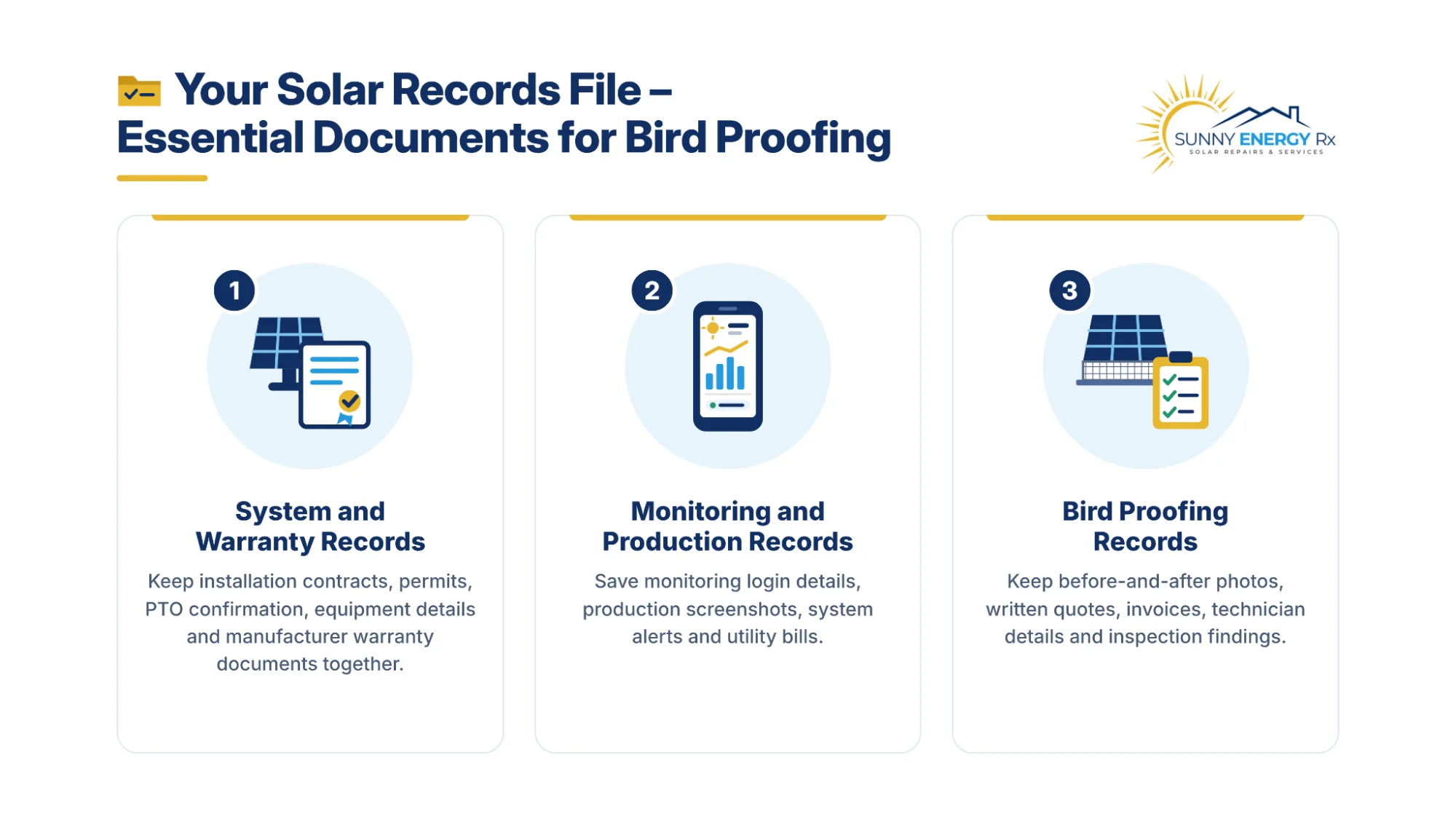
Create a digital folder and, if practical, keep printed copies of your most important documents.
System and Warranty Records
Signed solar installation contract and any change orders
City or county permits and final inspection records
Permission to Operate (PTO) confirmation
Equipment list with panel, inverter, microinverter or optimizer model and serial numbers, where available
Manufacturer warranty documents and registration confirmations
Installer workmanship or roof-penetration documents, if applicable
If your records also include previous roof work involving your solar array, our guide to solar panel removal and reinstallation for roofing projects explains what homeowners should know about coordinating solar and roofing work.
Monitoring and Production Records
Monitoring account login and recovery details
Screenshots of production and any alerts
Utility bills for comparison
Bird Proofing Records
Before photos showing nesting, droppings and entry points
Written quote and scope of work
Invoice and technician details
After photos showing the finished mesh
Written inspection findings
Any written confirmation from your manufacturer or installer about the work
A complete file does not replace good installation, but it gives any technician a clear starting point.
With your records organized, the last step is choosing the right company for the job.
How to Choose a Bird-Proofing Company in Arizona
Solar panel bird proofing involves roof work and solar equipment, so the company you hire matters more than the product it uses. Check these three areas before you book.
NABCEP certification: Look for relevant credentials held by the professionals who will work on or inspect your solar system.
Arizona ROC license: Verify the contractor’s license status and classification through the Arizona Registrar of Contractors.
Solar equipment experience: Ask whether the company works on your brand of panels, microinverters, optimizers and monitoring equipment.
It also helps to understand what qualifications and experience to look for when hiring solar service professionals to work on an existing system.
What Else to Check Before You Approve the Work
Before approving any bird-proofing work, make sure the company can explain exactly what the job involves, how your roof and solar equipment will be protected, and what happens if complications arise. Use the following checklist to evaluate the company's approach and avoid surprises after installation.
Proof of insurance and a clear roof safety approach
A written scope that separates removal, cleaning, inspection and mesh
Panel-safe, non-drilling attachment methods
How the company handles eggs, chicks and protected species
Before-and-after photos as part of the job
A clear explanation of how the work relates to your warranties
Written workmanship terms for the install
Be cautious of unsolicited door-to-door offers, pressure to pay in full upfront, or quotes that do not list your arrays and roof slopes.
Once you have checked credentials and scope, you can look for a team that handles the whole job from removal to mesh.
Need Bird Proofing for Your Solar Panels in Arizona? Reach Out to Sunny Energy RX
Sunny Energy RX provides solar panel bird proofing, nest removal, panel cleaning and critter-damage inspections for Arizona homeowners, on systems from all major brands, including ones we did not install. Our NABCEP-certified technicians bring 17+ years of Arizona solar experience to every visit.
Request your Bird-Proofing Quote and Panel Inspection. Visit sunnyenergyrx.com for more information.
If you still have questions, the answers below cover the ones we hear most often.
Pigeons mainly cause fouling through droppings and nesting debris. Chewed wiring is more often linked to rodents and other critters, but nests can hide damaged or loose cabling. A cleanup and inspection is the best way to find out.
Clamp-on systems that do not drill into or alter the panels are designed to avoid affecting your equipment warranty. Terms vary, so check your manufacturer and installer documents, ask in writing if you are unsure, and keep your installation records.
It depends on your panel count, number of arrays and roof slopes, roof access, how much nesting there is, and whether cleaning and inspection are included. A written, itemized quote based on photos or an inspection is the most reliable way to get a figure.
It depends on the size of the system, the number of arrays and roof access. Ask for an estimate in your written quote, and allow extra time if nest removal and cleaning are included.
Yes. Droppings and debris can stay on the panels, rails and roof after the birds are removed, so a clean-out and panel cleaning should be part of the job.
A properly fitted mesh closes the gap, which removes the nesting spot. Birds may still land on the roof, but they should not be able to get underneath. A check a few weeks after installation helps confirm nothing is getting through.
Yes. Heavy droppings can block light and reduce the output of the affected panels. Regular checks of your production help you notice changes early.
It is a mesh barrier, usually clipped along the edge of the array, that blocks birds and small animals from getting under the panels. It is designed to attach without drilling into the roof or panels, but confirm the method with your provider.
About the author
Sunny Energy RX Team
The Sunny Energy RX Team is a group of NABCEP-certified Arizona solar technicians with 17+ years of experience. The team specializes in repairing, maintaining and monitoring residential systems from nearly all major brands, including orphaned systems.
Published