
Solar panel and roof planning is important for long-term performance in Arizona.Your roof and solar system must work together for 25 to 35 years, and mistakes around roof age, orientation, or service timing often lead to costly removals and repairs. Here, you’ll learn how Arizona conditions affect solar roofs, how to get roof safe solar service, how to avoid hidden costs, and how proper coordination protects both panel output and roof lifespan.
Your roof isn't just protecting your home, but forms the foundation of your entire solar investment. However, many Arizona homeowners don't realize this critical connection until it's too late. Solar panels and roof health are inseparable partners in your energy journey. Therefore, checking roof compatibility must happen before you commit to solar.
When solar panels sit on your roof without proper support, issues can escalate quickly. Loose mounts, roof penetrations, wiring problems, and bird nesting under panels can all lead to roof damage, energy loss, and costly repairs if left unaddressed.
What You'll Learn in This Guide:
How to determine if your roof is ready for solar panels (and when to replace it first)
The true cost of bundling roof replacement with solar installation vs. doing them separately
Why south-facing solar panel roofs produce more energy and how other orientations perform
What happens during solar panel removal for roof repairs (and who should handle it)
How to find reliable solar service providers who won't abandon you after installation
At Sunny Energy Rx, we step in where installers disappear, leaving solar orphans in Arizona. We specialize in solar panel repair, roof-safe maintenance, inspections, and bird-proofing, thus ensuring your Arizona solar system and roof work together.
If you want your solar investment to perform efficiently and protect your roof for years to come, schedule a call with Sunny Energy Rx.
How to Check If Your Arizona Roof is Ready for Solar Panels?
Before installing solar panels, your roof needs to be strong enough to support them and protected enough to last just as long. And if you already have panels installed, these same factors determine whether your roof can safely support them for another 15–20 years or they have hidden issues already forming. Let's discuss how Arizona homeowners can quickly assess whether their roof is truly ready for a safe, long-term solar installation.
Get a Professional Solar Roofing Integrity Check
Solar panel inspection isn’t as simple as just taking a close look at your solar panels and roof. Therefore, professional roof inspections become essential before solar roof panel installation begins. For existing systems, regular inspections catch mounting issues, flashing failures, and hidden leaks before they turn into expensive repairs. It is important to ensure your roof supports significant additional weight for decades.
Pre-Installation & Existing System Roof Checklist:
Wood decking condition: Check for rot or water damage
Why it matters: Compromised decking can't support mounting hardware safely and may collapse under panel weight over time.Rafter strength: Verify adequate load-bearing capacity throughout
Why it matters: Rafters carry the combined weight of panels, racking, and snow/wind loads, weak rafters risk structural failure.Flashing integrity: Inspect all penetrations and valley areas
Why it matters: Failed flashing is the #1 cause of roof leaks after solar installation, even on new roofs.Underlayment condition: Ensure moisture barriers remain intact
Why it matters: Damaged underlayment allows water infiltration that rots decking from beneath, often undetected until panels are removed.
For example, in Glendale, a roof that looks perfect visually can hide severe water damage underneath. Without a professional inspection, homeowners might install panels over compromised decking. However, they face catastrophic failures and costly emergency repairs years later. In cases like this, identifying and replacing damaged sections before installation prevents thousands in future expenses.
Solar panels' roof weight averages 2 to 4 pounds per square foot. Most Arizona roofs handle this easily when properly constructed. However, older homes sometimes require reinforcement before solar roof panel installation begins.
A professional solar panel consultation helps you determine the right solar system for your home and identify any roof modifications needed to ensure a safe, long-lasting solar installation.
If you already have solar, an inspection from Sunny Energy RX can assess mounting integrity, flashing condition, and help you plan for detach-and-reset before emergency repairs become necessary.
The Reroofing Decision: Bundle or Wait?
Timing your roof replacement with solar panels saves substantial money. However, many homeowners struggle with this critical financial decision.
Here is a simple decision framework to help Arizona homeowners decide if they need to change their roof before solar installation or wait.
Roof Age | Remaining Life | Recommendation | Reason |
0-5 years | 15+ years | Install solar now | Roof outlasts panel warranty easily |
5-10 years | 10-15 years | Evaluate the condition carefully | May work with healthy roofs |
10-15 years | 5-10 years | Consider coordinating reroof + solar work | Reduce detach and reset costs |
15+ years | <5 years | Replace the roof first, definitely | Financial penalty otherwise guaranteed |
Tile Roof Condition - Inspect closely before deciding. Arizona tile roofs can last decades, but cracked tiles, failed underlayment, or prior solar penetrations often require repairs or full underlayment replacement before reinstalling panels.
For example, in Litchfield Park, a 13-year-old roof might appear structurally sound but still have less than 10 years of reliable life remaining. In cases like this, bundling roof replacement with solar installation typically saves Arizona homeowners thousands compared to replacing the roof later.
Free roof replacement with solar panels programs sometimes exist through financing. However, verify the actual costs hidden in higher interest rates.
Check Solar Eligibility
Online tools can give Arizona homeowners a starting point, but they often miss roof-specific details that only an on-site inspection can uncover.
Google's Project Sunroof and similar platforms analyze your roof using satellite imagery. However, on-site inspections provide the definitive answer for installation.
Evaluation factors include:
Shading from trees, chimneys, or neighboring buildings
Available roof space for solar roof panel mounting systems
Electrical panel capacity and upgrade requirements, if needed
HOA restrictions or city permit requirements for installation
Why satellite tools fall short:
Satellite imagery can't detect roof age, material condition, structural issues, or microclimates like afternoon shade patterns. These factors directly affect system performance, installation costs, and long-term viability, but only a trained eye can catch them. Online tools are helpful for estimates, but roof-specific decisions in Arizona should always be confirmed with an on-site inspection.
What Your Roof Must Handle in Arizona - Before or After Solar Installation?
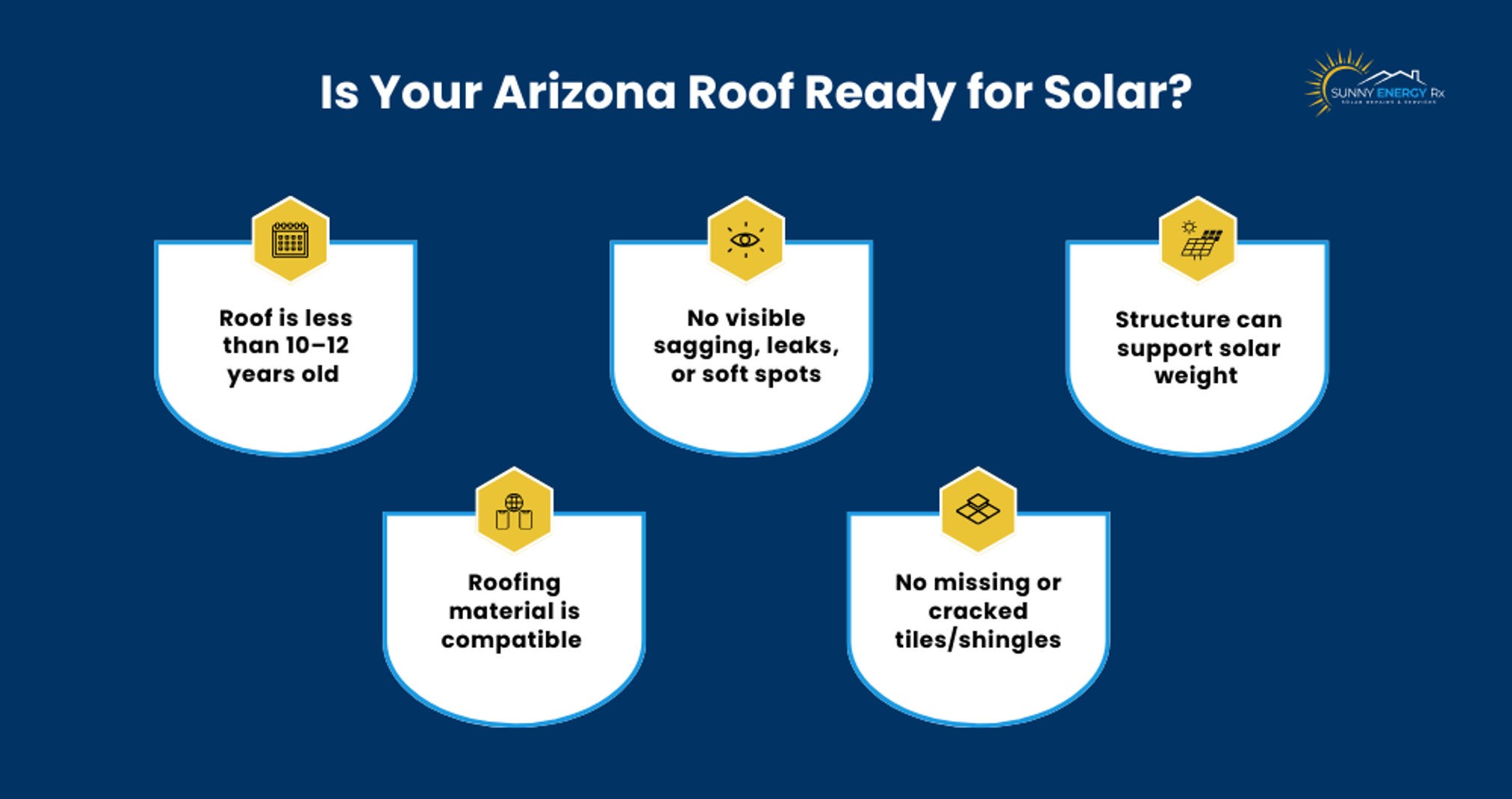
Installing solar panels in Arizona is not just about sunshine and savings. If you're planning installation or already have panels on your roof, understanding how solar panels impact your roof's structure, lifespan, and long-term maintenance is important.
If you're installing soon: Focus on roof age, structural capacity, and material compatibility before committing to solar.
If you already have solar: Watch for leak risks around mounting points, monitor system performance drops, address bird activity under panels, and know when detach-and-reset becomes necessary.
This guide covers both scenarios, thus protecting your roof and your solar investment for the long haul.
Age and Condition of the Roof
Your panels will generate power for 25 to 35 years minimum. However, your roof typically lasts only 20-25 years. Therefore, timing matters significantly in solar panel repair for your wallet and peace of mind.
A Gilbert homeowner learned this lesson the expensive way last year when they faced costly solar panel removal. Their roof was 12 years old during solar panel roof installation. Five years later, roof replacement became necessary. The solar panel removal and reinstallation cost them $8,400 for 24 panels, approximately $350 per panel, which falls within the typical range. Hence, the math is simple and unforgiving for poor planning.
Here's the financial reality: Solar panel reinstallation costs range from $300 to $1,000 per panel. Moreover, labor costs continue to rise 3 to 5% annually
Follow this solar roof replacement rule in Arizona: If your roof is more than 10 years old, replace it first. Metal roofs and newer tile roofs typically handle the full solar panel lifespan. However, older tile roofs in Scottsdale and Tempe often need inspection regardless.
Orientation and Slope (The "South-Facing" Rule)
Arizona's intense sun demands optimal panel positioning for maximum energy production. If you're planning a new system or evaluating an existing one, understanding how roof direction and slope affect performance helps you set realistic expectations.
Best Roof Directions for Arizona Production
South-facing roofs capture the most sunlight throughout the year. However, west-facing installations also perform well for afternoon energy needs.
A Mesa homeowner with solar roof panels had concerns initially. Their roof faced southwest instead of due south. However, it caused only a 5% production decrease. The system still generates excellent returns on its investment annually.
Here are optimal solar panels and roof direction considerations:
Roof Direction | Estimated Production Potential | Recommendation |
South-facing | ~100% | Ideal orientation for maximum solar energy production |
Southwest / Southeast | ~90–95% | Excellent performance with minimal efficiency loss |
East / West | ~75–85% | Still financially viable for many Arizona homeowners |
North-facing | Low | Generally not recommended in Arizona’s climate |
Roof Pitch: What 'Good' Looks Like
Roof pitch for solar panels also affects your system performance significantly. Thus, the ideal slope ranges from 15 to 40 degrees for Arizona installations. Furthermore, flat roofs require tilt racking systems for solar roof panels to optimize energy capture.
A Peoria homeowner installing solar roof panels had a completely flat commercial-style roof. Therefore, we installed tilt racks at 20-degree angles. Their system now produces 18% more energy than a flat installation.
Roof Material Compatibility
Most Arizona homes feature composition shingles for affordability and reliability in solar roofing applications. However, the material beneath your panels directly affects how long both your roof and solar system remain leak-free and structurally sound.
Metal Roofs:
Solar panels on metal roof installations offer the easiest mounting process. Moreover, metal roofs last 40 to 70 years, outliving your solar roof panels completely.
Durability: 40 to 70-year lifespan exceeds panel warranties, eliminating future solar panel removal needs
Installation: Clamp systems avoid roof penetrations entirely
Cost: Minimal additional expenses for proper mounting
Maintenance: Virtually zero issues over system lifetime
Tile Roofs:
Tile roofs dominate Scottsdale, Paradise Valley, and upscale Phoenix neighborhoods. However, tile requires delicate handling and specialized mounting techniques. A Fountain Hills customer nearly faced disaster last year. Their original installer cracked 17 tiles during panel installation. Therefore, choosing experienced installers prevents expensive tile replacement costs.
Fragility: Individual tiles crack easily under pressure
Stand-offs: Required to distribute weight and prevent breakage
Labor: Installation takes 30-50% longer than shingle roofs
Expertise: Sunny Energy RX specializes in tile roof installations
If roof-safe solar panel inspections, detach-and-reset services matter to you, contact Sunny Energy RX today to protect your solar panel and roof investment.
Composition Shingles:
Most Arizona homes feature composition shingles for affordability and reliability. Solar panel roof mounting kit systems work perfectly with this material. However, penetrations must be sealed properly to prevent leaks.
For example, in Surprise, improper flashing techniques during solar installation can lead to roof leaks within just two years. Thus, causing water damage indoors that could have been prevented with proper servicing or installation methods.
Here is a small table that gives you the summary of the lifespan of each roof type:
Roof Type | Average Lifespan |
Asphalt Shingle | 20–30 Years |
Concrete Tile | 40–50 Years |
Clay Tile | 50+ Years |
Metal Roof | 40–70 Years |
Foam Roof | 15–25 Years |
Best Roofs for Solar Panels
Metal roofs are often considered the best roof for solar panels because they last 40–70 years and typically require fewer roof penetrations. Concrete and clay tile roofs are also excellent choices due to their long lifespan and durability in Arizona's climate.
Roofs That May Need Extra Inspection
Older asphalt shingle and foam roofs should be inspected carefully before solar installation. If the roof is nearing the end of its lifespan or has structural issues, replacement may be more cost-effective than installing solar first.
Which Roofs Are Easiest to Service?
Metal roofs are generally the easiest to maintain and service. Asphalt shingle roofs are also straightforward for repairs. Tile roofs last longer but usually require specialized labor when repairs or solar panel removal are needed.
Choosing the right roofing materials for solar helps protect your investment, reduce future maintenance costs, and ensure your roof lasts as long as your solar system.
Understanding your roof type and its long-term maintenance requirements can help you make smarter solar decisions. However, for many Arizona homeowners, the biggest opportunity lies in coordinating roofing and solar projects together, which can lead to significant cost savings and long-term benefits.
Benefits of Installing Solar and Roofing Together in Arizona
Cost-Effective Installation
Bundling roof replacement with solar roof panels installation eliminates redundant costs. You pay for scaffolding, labor mobilization, and permits once instead of twice. Therefore, total project costs decrease by $3,000 to $8,000 typically.
Let's say in San Tan Valley, a homeowner compares bundling roof replacement with solar installation versus hiring separate contractors. The bundled approach for solar panels and roof typically saves money by eliminating duplicate scaffolding, labor mobilization, and permit fees. Hence, the financial advantage is substantial and immediate for planning.
Enhanced Protection
Your panels act as a shield against Arizona's brutal sun. Solar energy roof systems reduce direct UV exposure on shingles. Therefore, the covered roof sections last 5 to 10 years longer. However, uncovered areas age at normal rates, creating lifespan differences.
A Maricopa customer may notice this effect after ten years. Their roof sections under panels might be brand new still. However, exposed areas may show significant weather damage and aging already. Hence, proper solar panel maintenance provides unexpected long-term roof protection benefits beyond energy.
Protection benefits include:
UV reduction: Panels block 100% of direct sunlight
Temperature reduction: Roof surface stays 10-15°F cooler underneath
Hail protection: Panels absorb impact from smaller hailstones
Weather shielding: Rain and wind effects decrease significantly
Roof color and ventilation also play a major role in Arizona heat performance. Darker roofing materials absorb more heat, which can increase attic temperatures and place additional stress on both roofing materials and solar components. Lighter-colored or reflective roofing, combined with proper attic ventilation, helps reduce heat buildup under solar panels. In Arizona’s extreme summer conditions, this combination can extend roof life, improve overall system performance, and reduce heat-related wear on mounting hardware and roof penetrations.
Long-Term Value
Maximizing ROI requires synchronizing your roof and solar panels. A Prescott homeowner installing panels on a 15-year-old roof will face failure of roof sooner than later.Thus, causing extra money for solar panel removal and reinstallation. This can destroy solar investment returns for five additional years.
Synchronized warranties provide:
Peace of mind: Both systems are covered for decades
Financial predictability: No surprise expenses mid-investment period
Resale value: Buyers prefer complete, protected systems significantly
Operational efficiency: Maximum production without interruption for repairs
Solar Roofing vs. Mounted Panels: What's the Difference?
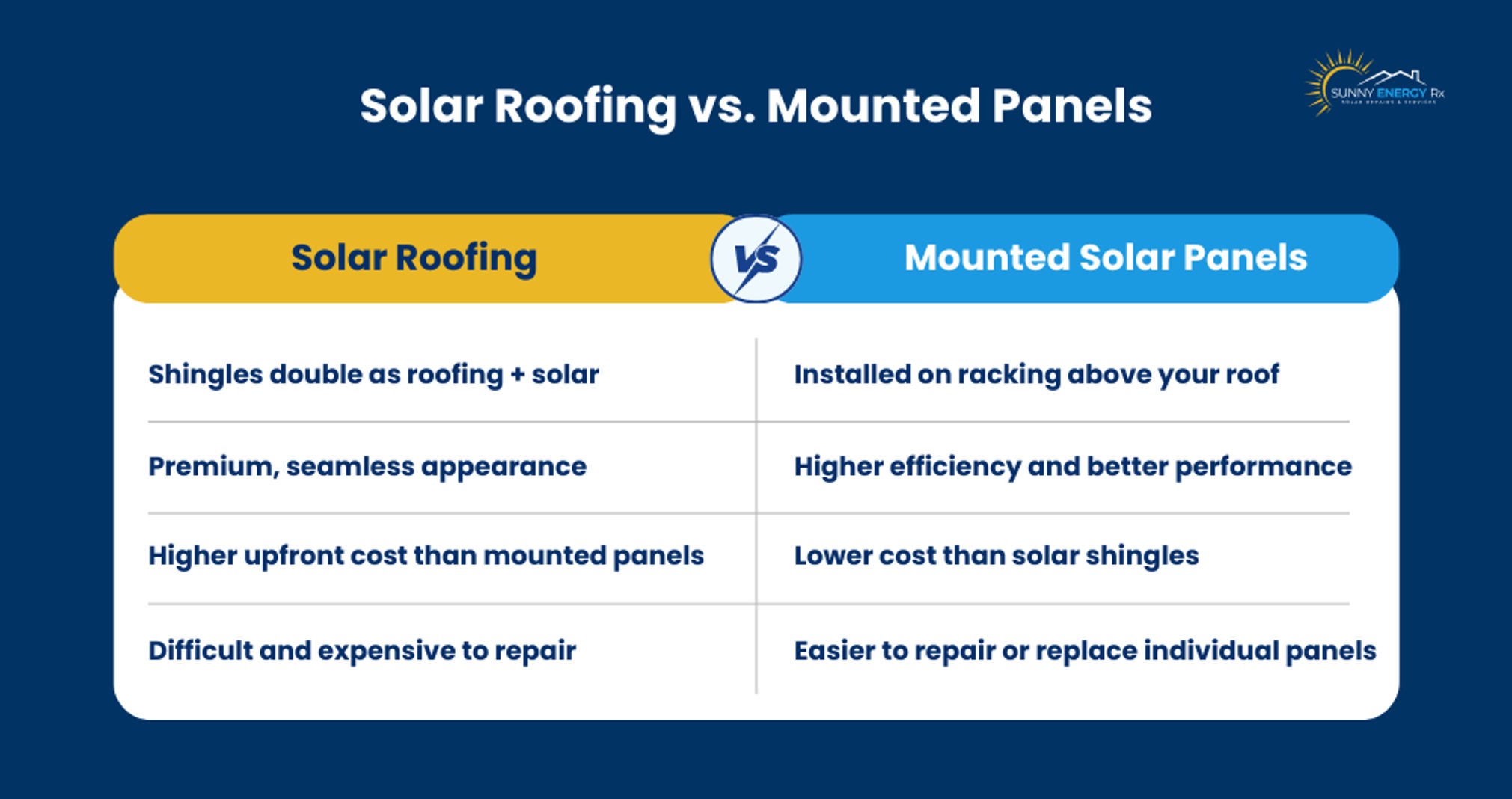
Solar roofing and mounted solar panels both generate clean energy, but they integrate with your roof in very different ways. Understanding how each system interacts with your roof helps you choose the option that best fits your home, budget, and long-term maintenance needs.
Solar Roof Panels (Mounted Systems)
Traditional solar panels on roof installations use racking systems. These elevated panels above your existing roof surface are securely attached. Therefore, the roof and solar panels remain separate, serviceable components.
Advantages of mounted systems:
Efficiency: 18 to 22% conversion rates are standard currently
Cost: $2.50 to $3.50 per watt for complete installations
Repairs: Individual panels replace easily when problems occur
Flexibility: System sizing adjusts to your needs exactly
A Tempe homeowner compared both options thoroughly before deciding. Mounted panels cost $28,000 for their 10kW system. Therefore, they chose traditional panels over solar roof shingles alternatives. Their decision saved $42,000 while providing superior performance metrics.
Solar Roofing (BIPV / Solar Roof Shingles)
Solar roof shingles integrate directly into your roof structure permanently. These building-integrated photovoltaics (BIPV) replace traditional roofing materials completely. However, they cost significantly more than mounted systems.
Tesla Solar Roof dominates this market currently in Arizona. A Paradise Valley installation we inspected cost $85,000 total. Traditional panels would have cost $32,000 for identical production. Hence, aesthetics always come with a substantial financial premium.
Solar roof shingles: roof considerations:
Aesthetics: Sleek, integrated appearance without visible panels
Cost: 2-3x more expensive than traditional solar roof panels
Efficiency: 14-18% conversion rates, lower than mounted panels
Repairs: Entire sections need replacement for single failures
Solar roof tiles work best for new construction projects. Retrofit installations often encounter complications with existing roof structures. Let's say in Goodyear, a new build incorporates solar tiles for the roof beautifully. While the aesthetic integration is seamless, homeowners should expect to pay 2-3x more than traditional mounted panels.
How Much Does a Solar Roof Cost in Arizona?
Solar roof costs in Arizona can vary widely depending on the type of system, roof design, and local incentives. Understanding this can help homeowners budget smarter and avoid unexpected expenses.
What Are the Installation Costs for Solar Roofs vs Solar Panels in Arizona?
Solar roof cost varies dramatically based on your chosen technology. Traditional mounted systems remain the most affordable option. However, integrated solar roofing system costs continue dropping as technology improves.
Cost Comparison Table:
System Type | Cost Per Watt | Roof Replacement |
Mounted Panels | $2.50 to $3.50 | Not included |
Solar Roof Shingles | $5.00 to $7.00 | Included |
Solar Panel Roof Shingles | $4.50 to $6.50 | Included |
A Waddell customer requested quotes for both system types recently. Their solar panel roof cost for mounted panels totaled $26,500. However, integrated solar roof panels pricing reached $58,000 for identical production. Therefore, they selected traditional panels and invested savings elsewhere.
Solar panel roof price factors include:
System size: Larger systems reduce per-watt costs slightly
Roof complexity: Tile and multi-plane roofs increase labor costs
Equipment quality: Premium panels and inverters cost more
Permitting: City fees range from $300 to $1,200 typically
Important: If your roof has less than 10 to 15 years of life remaining, hidden costs like solar panel removal and reinstallation often outweigh any short-term savings. In Arizona, replacing an aging roof after solar is installed frequently means paying twice for labor, once to remove the panels and again to reinstall them.
This is why roof age should always be evaluated before choosing a solar system or roofing approach.
The Hidden Costs of Poor Planning
The real expense hits when you ignore roof age. Solar panel removal for roof repairs costs $3,000 to $6,000 minimum. However, large systems easily exceed $10,000 for complete removal.
For example, a typical 28-panel system in Casa Grande that requires emergency solar panel removal after just seven years can cost homeowners $8,400 for removal and $6,200 for reinstallation, totaling $14,600, or roughly $520 per panel. When roof replacement becomes urgent due to extensive leak damage, that's $14,600 in avoidable expenses that could have funded the initial roof replacement instead.
Solar roof racking system removal requires careful handling and storage. Damaged equipment during removal isn't typically covered by warranties. Hence, choosing experienced solar service professionals like Sunny Energy RX protects investments.
How Solar Panel Removal and Reinstallation Works for Roof Repairs in Arizona?
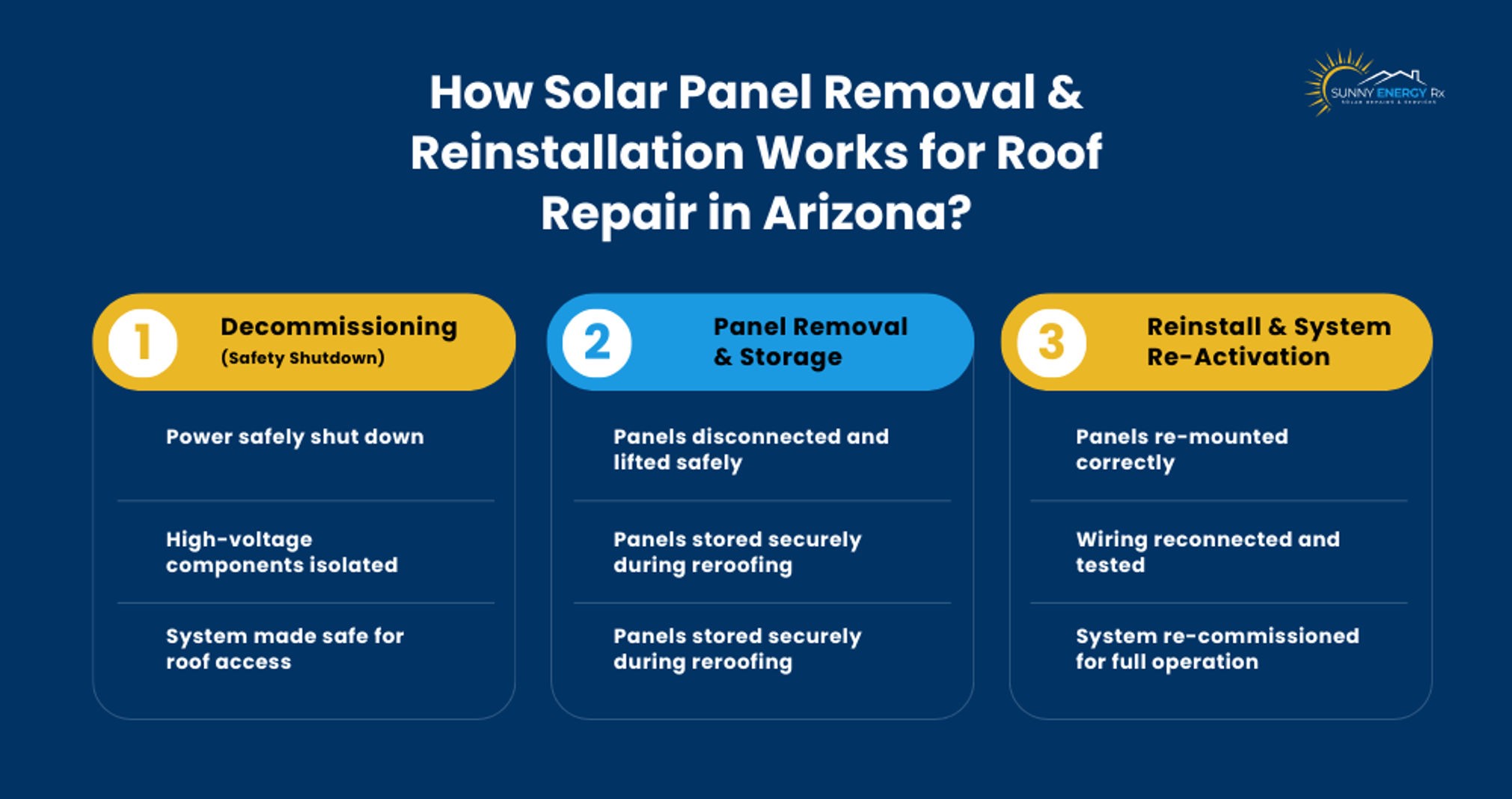
What Is the Solar Panel Remove and Reinstall Process for Roof Repairs?
Solar panel removal follows strict safety protocols to protect people. A Prescott Valley customer attempted DIY removal last year. They damaged their solar inverter and voided their equipment warranty. Therefore, professional service prevents expensive mistakes and safety hazards.
Professional removal process:
Decommissioning:
Shut down the entire system properly per the manufacturer's specs
Lock out electrical connections to prevent accidental energization
Document existing system configuration and performance baseline data
Photograph all connections for accurate reinstallation later guaranteed
Removal and Storage:
Carefully disconnect all electrical connections following NEC codes
Remove panels systematically and label each one clearly
Inspect mounting hardware for damage or corrosion issues
Store panels in a climate-controlled environment securely, always
Protect inverters and electrical equipment from weather exposure
Reinstallation After Roof Work:
Inspect the new roof surface for proper installation quality
Install new flashing and mounting hardware per codes
Reconnect the system exactly as originally configured throughout
Test all electrical connections before final system activation
Verify production matches or exceeds pre-removal performance levels
Here’s what that process looked like for a Sierra Vista homeowner: A Sierra Vista homeowner hired Sunny Energy RX to remove their solar panels before roof repairs. We completed the removal of their 22-panel system in one day and safely stored the equipment in our secure facility while roofing work was completed over the following two weeks.
Once the roof was ready, reinstallation took another day. The system was fully tested and returned to normal operation, with production matching pre-removal performance.
Beyond the technical steps, homeowners often want to know what the experience actually feels like.
What to Expect During Solar Panel Removal & Reinstallation
When solar panels need to be removed for roof repairs, homeowners often worry about downtime, storage, and coordination. Here’s what typically happens with a professional solar service team in Arizona:
Typical Timeline
Removal: 1 day for most residential systems
Storage period: Matches your roofer’s schedule (usually 1–7 days)
Reinstallation & testing: 1 day once roofing work is complete
Panel Storage & Protection: Panels are carefully removed, labeled, and stored safely off the roof to prevent microcracks, frame damage, or connector issues caused by heat and improper handling.
Documentation & Warranty Protection: System shutdown, disconnection, and reinstallation are documented step by step, helping preserve manufacturer warranties and providing proof of professional handling if issues arise later.
Coordination With Your Roofer: A solar service specialist coordinates directly with your roofing contractor so:
Roofing work is completed without solar obstructions
Panels are reinstalled only after the roof is fully ready
No rushed or unsafe reinstallations occur
This coordinated approach prevents delays, protects your roof, and ensures your system returns to full production safely.
Why Should a Solar Specialist Remove Panels Instead of a Roofer?
Roofers excel at roofing but lack electrical expertise completely. By hiring a solar service provider in Arizona, you can be worry-free instead of wondering if solar panels void the roof warranty.
Let's say in Youngtown, a homeowner hires their roofer to remove solar panels to save money. If the roofer disconnects the inverter incorrectly, it can cause permanent internal damage, resulting in expensive solar inverter repair and voided warranty claims. Hence, specialized knowledge prevents costly mistakes and safety incidents.
Who Does What During Solar Panel Removal & Roof Replacement:
Roofer | Solar Specialist |
Remove and replace shingles, tile, or underlayment | Shut down the solar system safely per manufacturer protocols |
Install new flashing around roof penetrations | Disconnect and label DC strings to prevent accidental energization |
Ensure roof structure and waterproofing are sound | Protect inverter and electrical equipment from weather exposure |
Complete roof work without solar obstructions | Remove, store, and reinstall panels to exact specifications |
Ensure roof is strong to endure the weather | Verify system production matches or exceeds pre-removal performance |
Roofing and solar companies in Arizona should coordinate but maintain expertise. Solar service companies like Sunny Energy RX partner with experts on solar and roofing throughout the Arizona region.
How to Find the Best Roofing and Solar Companies in Arizona?
Thousands of Arizona homeowners face abandonment by their installers. These "Solar Orphans" in Arizona have functioning systems but zero support. Therefore, finding maintenance-focused roofing and companies in Arizona becomes critical for long-term success.
Let's say in El Mirage, a homeowner's original solar installer disappears completely without any forwarding information. When their inverter displays error codes, finding someone willing to service an "orphaned" system becomes nearly impossible. This is exactly why Sunny Energy RX exists. We diagnose and repair systems regardless of who installed them. We've become the "second home" for hundreds of orphaned solar systems across Arizona.
What to Look for When Hiring a Roofer and Solar Service Team
Before scheduling roof work, make sure both teams can clearly answer:
Who is responsible for solar panel removal and reinstallation?
How will the solar system be shut down, protected, and documented?
How will the roofer and solar technician coordinate timelines?
Will new flashing and mounts be used during reinstallation?
Will system performance be tested and verified before sign-off?
If either contractor cannot explain this process clearly, coordination problems and costly mistakes are likely.
Warning signs of unreliable installers:
Focus exclusively on sales volume over service quality
Minimal local presence or temporary office locations only
Pressure tactics demanding immediate decisions without proper evaluation
No clear service or maintenance plans after installation
Poor online reviews specifically about post-installation support issues
In addition to this, Arizona's Registrar of Contractors (ROC) licenses protect consumers from fraud. However, many solar companies operate without proper licensing currently. A Sahuarita resident hired an unlicensed contractor last year. When problems arose, they had zero legal recourse. Therefore, always verify ROC licensing before signing any contracts.
Verification checklist:
ROC License: Search azroc.gov for active contractor licenses
Electrical License: Verify C-11 classification for solar installations
Insurance: Request certificates of liability and workers' compensation
References: Contact previous customers about their service experience, specifically
Reviews: Read Google, Yelp, and BBB reviews carefully
Focus on service and repair reviews, not sales experiences. A company might sell excellently but provide terrible service. A Phoenix customer learned this distinction too late, unfortunately. Their installer earned five-star sales reviews but one-star service reviews. Therefore, post-installation support matters more than sales experience ultimately.
Conclusion
Your roof and solar panels aren't two separate projects. They are a single, long-term system expected to perform together for 25 years or more. When the roof is healthy and solar panels are installed, maintained, and serviced correctly, homeowners in Arizona can protect both their home and their energy savings for decades. When that coordination is overlooked, even small issues can turn into expensive disruptions that reduce system performance and shorten lifespan.
The real challenge isn't installation day, but everything that comes after. Roofs age, installers disappear, and warranties expire or get confusing. Consequently, there's no clear answer about who should help or how to fix problems without risking further damage to your roof or voiding your solar warranty.
That's exactly why Sunny Energy RX exists.
We were built specifically to support existing solar systems, specifically for homeowners whose original installer is no longer around. Our NABCEP-certified experts understand how Arizona's heat, dust, monsoons, and bird activity affect both roofs and solar equipment over time.
We focus exclusively on solar repair, maintenance, monitoring, and roof-safe removal and reinstallation, so your system stays productive and warranty-protected for the long run.
Ready to protect both your roof and your solar investment? Schedule a consultation with Sunny Energy RX. We serve homeowners statewide and specialize in keeping solar systems reliable long after installation day.
Summary on Solar Panels and Roof in Arizona
Solar panels and roof systems must work together for 25 to 35 years, making roof condition critical before installation to avoid expensive removal costs later.
Replace asphalt roofs over 10 years old before solar panel roof installation to prevent paying $300 to $1,000 per panel for detachment and reset services.
South-facing solar panels' roof direction produces maximum energy in Arizona, while west-facing installations still achieve 90-95% production efficiency throughout the year.
Solar panels on metal roof installations offer the easiest mounting with 40 to 70 year durability, while tile roofs require specialized techniques to prevent breakage.
Bundling roof replacement with solar panels saves $3,000 to $8,000 by eliminating duplicate labor, scaffolding, and permitting costs for homeowners.
Solar roof cost varies, as traditional mounted panels cost $2.50 to $3.50 per watt,while solar roof shingles cost $5.00 to $7.00 per watt installed.
Solar panel removal for roof repairs requires certified solar technicians, not general roofers, to protect electrical systems and maintain equipment warranties.
Solar panels' roof weight averages 2 to 4 pounds per square foot, which most Arizona roofs handle easily with proper structural assessment beforehand.
Roofing and solar companies must coordinate properly: roofers handle roofing work while licensed solar technicians manage electrical components to prevent damage and maintain coverage.
Yes, solar panels on roofs provide excellent returns. Their energy savings and increased home value justify investment. Furthermore, adequate sun exposure and structural integrity in Arizona make it the right form of renewable energy.
Yes, proper solar panel rooftop installation increases home value. However, leased systems complicate sales due to transfer requirements.
Solar panel removal is possible but requires professional roof patching. Some homeowners remove outdated technology for newer systems. Others remove panels during a complete roof replacement with solar panel projects.
Yes, trapped debris and moisture encourage mold growth. Bird droppings and leaves accumulate under panels. Therefore, regular cleaning and bird-proofing solar panels in Arizona prevent mold and maintain efficiency.
Upfront solar panel roof prices deter some homeowners. Aesthetics concern others in certain neighborhoods. Solar panel removal becomes necessary for roof replacements. However, long-term savings outweigh these considerations.
Professional structural assessments determine the solar panels' roof load capacity. Most Arizona roofs handle 2 to 4 pounds per square foot easily. Solar panel roof requirements include adequate decking and rafter strength.
Panels withstand high winds and hail impacts per testing standards. They actually protect the solar roof underneath from storm damage. However, severe damage requires professional solar panel removal for repairs underneath.
Equipment warranties cover panels and inverters for 25 years. Workmanship warranties cover installation for 5 to 10 years, typically. However, bankrupt installers void workmanship coverage. However, Solar panels' roof mount systems need ongoing maintenance.
Solar roofing installation takes 1 to 3 days for most residential systems. Tile roofs require additional time for careful handling. However, permitting and utility interconnection take weeks. Solar panels on roof installations proceed quickly once approved.
Sunny Energy RX Team
Published Dec 18, 2025