.webp)
The relationship between roofing and solar has become one of the most important intersections in modern residential construction. In Arizona, where abundant sunshine and rising utility costs have made rooftop solar one of the fastest-growing home improvements, a roof is no longer just a protective barrier against the elements—it is also the foundation that supports a home's long-term energy production.
However, combining solar and roofing is not always straightforward. Many homeowners discover that their roof and solar system have different life expectancies. A roof may need replacement while the solar panels still have years of productive life remaining. Others install solar without first evaluating the condition of their roof, only to face the unexpected expense of removing and reinstalling the system a few years later. For roofing contractors, existing solar arrays can create scheduling challenges, safety concerns, and additional liability if the system is not handled properly.
Arizona's unique climate adds another layer of complexity. Extreme heat, monsoon storms, dust accumulation, and aging tile roofs can all affect both roofing materials and solar equipment. When roofing and solar projects are poorly coordinated, homeowners may experience project delays, warranty concerns, unexpected costs, and prolonged periods without solar production.
Fortunately, these challenges can be avoided with proper planning and collaboration. A thorough roof assessment before going solar, choosing the right roofing and solar professionals, and working with experienced Solar Removal and Reinstallation (R&R) specialists can significantly reduce risk and protect both investments. When roofers and solar professionals coordinate from the start, homeowners benefit from a durable, watertight roof and a properly functioning solar energy system.
This comprehensive guide explains the different types of solar and roofing companies, how to determine whether a roof is truly solar-ready, and why effective collaboration between Arizona roofing contractors and solar specialists is essential for a smooth, cost-effective project.
Types of Solar and Roofing Companies and Their Roles
When planning a solar project, it's important to know who is responsible for each part of the work. Some companies specialize only in solar installation, others focus solely on roofing, and some offer both services under one roof. Understanding the role of each type of company can help homeowners choose the right partner and avoid costly issues later, especially when a roof replacement and solar installation need to happen together.
Rooftop Solar Company
A dedicated rooftop solar company, or rooftop solar power company, focuses on the electrical and energy aspects of the project. These solar roof companies typically handle:
Solar system design and engineering
Permitting and utility interconnection
Electrical wiring and equipment placement
Installing solar panel arrays and solar array roof mounts
Monitoring system performance after installation
For homeowners, this means the rooftop solar company is responsible for making sure the system produces energy efficiently and meets local code requirements. For roofing contractors, it means the solar installer usually treats the roof as the mounting surface and depends on the roof being structurally sound and ready for attachment.
Top rooftop solar companies understand roof conditions, but they usually do not perform major roof repairs or replacements unless they are part of a broader roofing and solar company or an all-in-one roofing and solar provider.
Roofing Contractors
Traditional roofing contractors focus on the roof itself, which is especially important in Arizona’s harsh climate. Their job is to protect the home from heat, wind, monsoon storms, and long-term wear. Roofing and solar contractors who understand both trades know that a solar installation is only as good as the roof beneath it.
Roofing contractors typically handle:
Roof inspections and structural evaluations
Leak repairs and waterproofing
Replacing shingles, tile, underlayment, or decking
Installing new roofing systems
Confirming whether the roof can support solar panels
For homeowners asking, “Is my roof good for solar?” a qualified roofer can help determine whether the roof meets the requirements for solar panels before any solar work begins. For contractors, this step is critical because a roof that is too old, damaged, or poorly designed can create problems later for both the homeowner and the solar installer.
All-In-One Providers
Many homeowners prefer working with an all-in-one solar and roofing provider or a single roof and solar company that can manage both the roof replacement and the solar installation under one plan. These solar and roofing companies can simplify scheduling, reduce delays, and help avoid communication issues between separate crews.
A reliable roof and solar company or solar roofing co should have the proper roofing and electrical credentials required in Arizona. In many cases, the best roof and solar companies are those that can coordinate both trades while keeping the homeowner informed at every step.
For roofing contractors, partnering with a trusted solar roofing contractor can also make projects more efficient. When both teams understand roofing and solar from the start, the result is usually a cleaner installation and fewer callbacks.
Understanding who does what is only the first step. Even the best solar and roofing companies cannot install a high-performing system on a structurally unsound roof, nearing the end of its lifespan, or poorly suited for solar production.
Technical Baseline: Is Your Roof Good for Solar?
One of the first questions Arizona homeowners ask when considering solar and roofing projects is, "Is my roof good for solar?" Before any panels are installed, a professional assessment is necessary to determine whether your roof meets the solar panel roof requirements and can safely support a solar energy system for the next 25 years or more.
To ascertain this, a qualified roof and solar company or solar roofing contractor will evaluate your roof's age, structural integrity, orientation, and material before recommending a system design. Understanding these technical requirements can help homeowners avoid costly surprises and ensure their investment performs as expected.
1. What Roof Material is Best for Solar Panels?
While systems can be engineered for almost any surface, certain solar roof materials offer distinct advantages in installation cost and longevity:
Standing Seam Metal Roofing
Standing seam metal roofing is widely considered the best roof for solar panels and is often recommended by leading solar roof companies. Installers can use specialized solar array roof mounts and clamps that attach directly to the raised seams without penetrating the roof surface.
This installation method offers several advantages:
Eliminates the need for drilling holes into the roof deck
Reduces the risk of future leaks
Simplifies maintenance and panel removal
Provides excellent durability in Arizona's harsh climate
For homeowners planning both a roof replacement and solar installation, standing seam metal is often regarded as the best solar roof option.
Asphalt Shingle Roofs
Asphalt shingles are the most common form of residential solar roofing in Arizona and throughout the United States. Understanding how to install solar panels on shingle roof systems is standard practice for experienced roofing and solar contractors.
The installation process typically involves:
Locating the roof rafters
Securing mounting hardware directly into the structural framing
Installing heavy-duty flashing to prevent water intrusion
Attaching rails and the final solar panel array roof system
Because asphalt roofs are affordable and compatible with most mounting systems, they remain one of the most practical solar roof options for homeowners.
Concrete and Clay Tile Roofs
Concrete and clay tile roofs are extremely popular in Arizona because of their durability and heat resistance. However, they require more specialized installation techniques.
Installing solar on tile roofs generally involves:
Removing individual tiles
Attaching mounting hardware to the roof deck
Installing flashing and waterproofing materials
Cutting or replacing tiles around each mount
The additional labor makes tile installations more complex and expensive than shingle or metal systems. Nevertheless, many solar and roofing companies specialize in tile roof installations and can design systems that preserve both aesthetics and structural integrity.
2. The Ideal Roof Pitch and Slope
The roof pitch for solar panels impacts how directly sunlight strikes the cells. For Arizona homeowners, the best roof pitch for solar panels generally falls between 25 and 35 degrees, which is approximately a 5:12 to 7:12 roof pitch. This range allows solar modules to receive strong sun exposure while also promoting natural rainwater cleaning.
The best roof slope for solar panels is one that closely matches the area's latitude and maximizes annual energy production.
However, not every home has the ideal slope. Fortunately, experienced solar and roofing professionals can work with:
Flat roofs by installing tilt-up racking systems
Steep roofs by using low-profile mounting equipment
Complex roof designs by distributing panels across multiple sections
Even if your home does not have the perfect roof slope for solar panels, modern mounting technology allows most properties to support efficient solar production.
3. Direction and Orientation
Roof orientation is another critical factor when determining whether your property is suitable for solar.
South-facing roofs receive the most consistent, intense sunlight throughout the day. However, installing solar panels on east-facing or west-facing roof surfaces remains highly viable. These orientations typically generate only 15–20% less energy than a perfectly south-facing roof.
In many cases, that difference can be offset by adding one or two extra panels to the rooftop solar array.
Questions to Ask Your Roofer Before Going Solar
Before installing solar panels, ask your roofer:
✅ Does my roof have at least 10–15 years of useful life remaining?
✅ Is the roof structure strong enough to support a solar system?
✅ Is my current roofing material suitable for solar installation?
✅ Are there any leaks, damaged decking, or repairs needed first?
✅ Does my roof's orientation and shading make it a good candidate for solar?
✅ Is there enough usable roof space for the number of panels I need?
✅ Should I replace my roof before installing solar to avoid future removal and reinstallation costs?
Once you've determined that your roof is a good candidate for solar, it's also important to think long term. At some point, your roof may need replacement, raising an entirely different question: who handles the solar panels already on your home?
Solar Installers vs. Solar R&R Specialists
If your home already has solar panels and needs a new roof, you'll likely need the system temporarily removed and reinstalled. While many top rooftop solar companies excel at designing and installing new systems, they may not specialize in the complex process of Solar Removal and Reinstallation (R&R).
This has created a growing niche within the solar and roofing industry: dedicated Solar R&R specialists. These companies focus exclusively on safely removing existing solar equipment, coordinating with roofers, and reinstalling the system once the roofing work is complete.
Feature/Task | Primary Solar Installer | Dedicated Solar R&R Specialist |
Primary Goal | Selling new hardware and expanding energy capacity. | Protecting existing solar assets during roof replacement projects. |
System Deconstruction | May delay removals because installation crews are focused on new projects. | Provides rapid, scheduled system removals that align with roofing timelines. |
Component Storage | Limited storage options for removed equipment. | Labels, inventories, and securely stores panels, inverters, and racking components. |
System Restoration | May recommend replacing components or redesigning the system. | Reinstalls existing equipment and verifies system performance after reroofing. |
Coordination with Roofers | Typically secondary to new installations. | Works directly with roofing and solar contractors to minimize project delays. |
Recognizing the differences between traditional solar installers and dedicated R&R specialists is only part of the story. The next question is how these specialists actually work with roofing contractors to complete a roof replacement without damaging the existing solar system.
How Roofers and Solar Companies Work Together During a Roof Replacement
When a home already has solar panels, replacing the roof becomes a two-trade project. Roofers cannot simply remove shingles around the array because solar panels, racking, and high-voltage wiring must be handled carefully to avoid equipment damage, safety risks, and warranty issues.
For this reason, experienced solar and roofing companies follow a coordinated workflow that keeps both the roof and solar system protected.
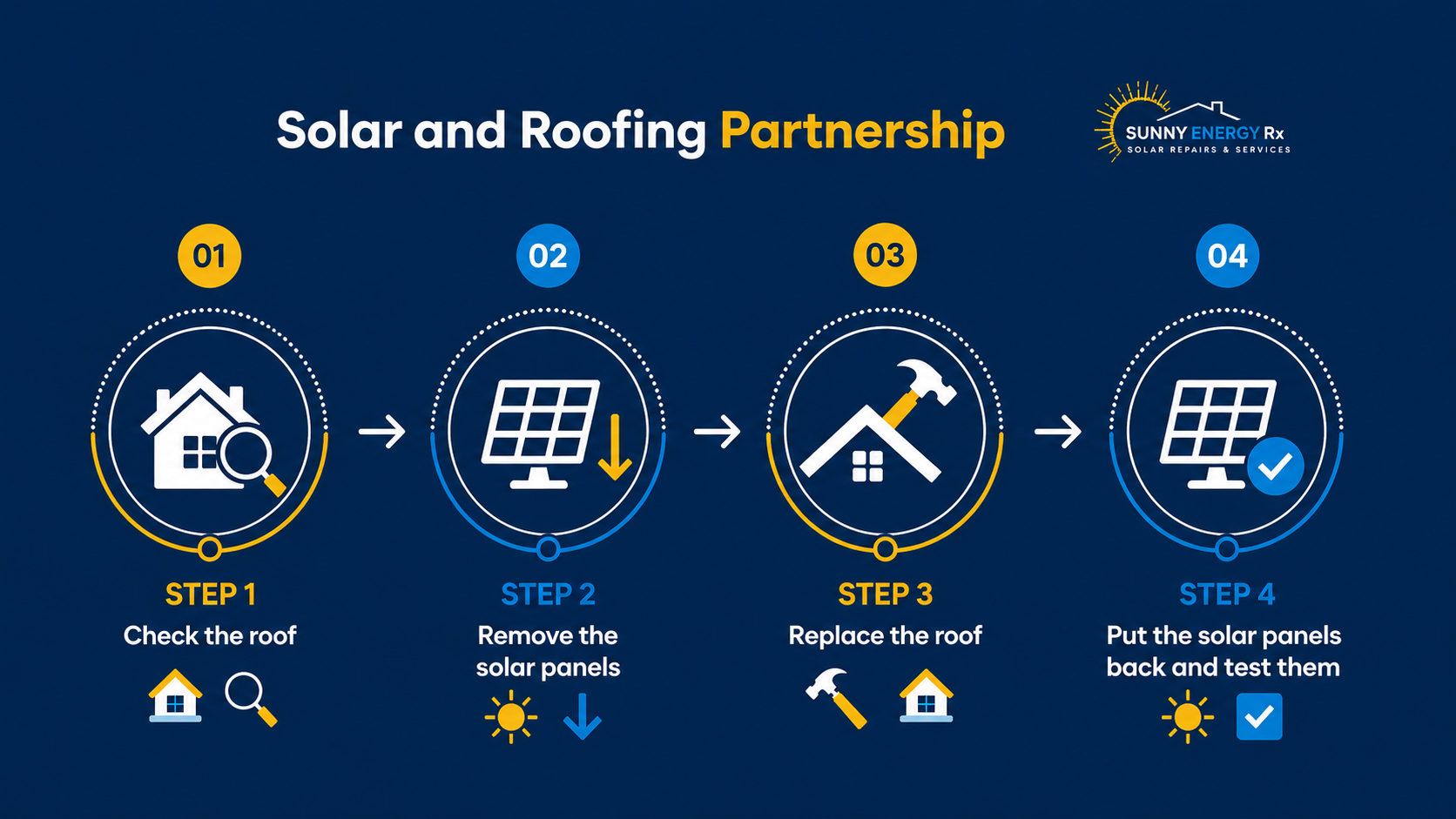
1. Roof Assessment and Planning
Before any work begins, the roofing contractor and solar R&R specialist inspect the roof to:
Evaluate the roof's condition and remaining lifespan.
Identify any structural issues or repairs needed.
Plan the safest approach for removing and reinstalling the solar system.
This initial assessment helps prevent surprises and ensures the project is completed efficiently.
2. Safe Solar Removal
Before roofing work begins, a Solar Removal & Reinstallation (R&R) specialist:
De-energizes the solar system.
Disconnect panels and electrical components.
Removes the modules, racking, and mounting hardware as needed.
Labels and stores equipment safely away from the construction area.
This step protects the existing system and gives the roofing crew unrestricted access to the roof.
3. Roof Replacement
With the solar equipment removed, the roofing contractor can:
Replace underlayment, shingles, or tiles properly.
Repair any damaged decking or structural issues.
Install a uniform, watertight roofing system without working around solar equipment.
This approach is far safer and typically results in a better-quality roof than trying to work around an existing array.
4. Precision Solar Reinstallation
After the new roof passes inspection, the solar crew returns to:
Reinstall the mounting system using new flashing and sealants.
Reattach the solar panels and electrical components.
Test and recommission the system.
Verify that the system is producing power correctly.
This partnership between roofing and solar contractors ensures that homeowners receive both a high-quality roof and a properly functioning solar system without compromising either investment.
While this workflow sounds straightforward, its success depends heavily on having the right solar partner. For Arizona roofing contractors, finding a reliable, non-competing solar service provider can make the difference between a smooth project and costly delays.
Seamless Solar Support for Arizona Roofers
In Arizona’s demanding climate, regional roofing companies need a solar partner they can rely on to keep projects moving on schedule without sales conflict.
Sunny Energy RX operates strictly as a service-and-support partner, never a competitor. With more than 17 years of deep regional expertise in the Arizona solar landscape, our NAPCEB-certified team provides a dedicated, contractor-first workflow designed to support local roofers across Phoenix, Tucson, Mesa, Scottsdale, and Chandler.
How Sunny Energy RX Supports Roofing Contractors
When a roofer is replacing or repairing a roof with an existing solar system, Sunny Energy RX handles the solar side of the project from start to finish. Our team can:
De-energize and safely disconnect the solar system before roofing begins
Remove panels, racking, wiring, and related components as needed
Label, document, and protect equipment during the roofing phase
Coordinate timing with the roofing contractor to reduce project delays
Reinstall the system after the new roof is complete
Use proper flashing, mounting, and sealant practices during reinstallation
Test and verify system performance before closeout
Assist with manufacturer warranty considerations when applicable
This allows the roofer to focus on building a watertight, high-quality roof without working around live electrical equipment or mounted solar arrays.
A Solar Partner, Not a Roofing Competitor
Sunny Energy RX is not a roofing company and does not replace the roofer’s role in the project. Instead, we act as the solar technical partner that makes roof replacement possible when solar panels are already installed.
For roofing contractors, that means:
No sales conflict with the homeowner
No pressure to replace working solar equipment unnecessarily
No confusion over who is responsible for the solar system
Cleaner project coordination between trades
Fewer callbacks related to solar removal, wiring, mounting, or monitoring issues
This partnership is especially important in Arizona, where extreme heat, monsoon storms, tile roofs, dust, and aging rooftop systems can make solar detach and reinstall work more sensitive than a standard removal.
Need your roof repaired without risking your solar investment? Schedule your solar detach and reset with Sunny Energy RX today and get your system back online quickly, safely, and warranty-ready.
Conclusion
As solar adoption continues to grow across Arizona, the relationship between solar and roofing has become more important than ever. A successful project isn't just about installing panels or replacing shingles; it's about ensuring both systems work together safely and efficiently for decades to come.
For homeowners, that means understanding whether your roof is truly ready for solar, choosing the right professionals, and planning for future roof replacements. For roofing contractors, it means having a trusted solar partner who can safely manage existing systems without disrupting project timelines or creating unnecessary liability.
Whether you're installing a new solar array, replacing an aging roof, or coordinating a solar removal and reinstallation project, the key is collaboration. When roofing and solar professionals work together, homeowners benefit from a durable roof, a reliable energy system, and the peace of mind that both investments are protected for the long term.
Summary
Solar and roofing projects involve multiple specialists, including solar installers, roofers, and all-in-one providers.
A successful solar installation starts with a structurally sound roof that can support the system for decades.
The best roof materials for solar are standing seam metal, asphalt shingles, and properly prepared tile roofs.
Roof pitch, slope, orientation, and available space all affect solar performance and system design.
Homeowners should ask their roofer about the roof condition, remaining lifespan, and whether replacement is needed before installing solar.
Roofs and solar panels often have different lifespans, making future Solar Removal and Reinstallation (R&R) services an important consideration.
Dedicated Solar R&R specialists focus on safely removing, storing, and reinstalling existing solar systems during roof replacements.
Replacing a roof on a solar-equipped home requires close coordination between roofing and solar professionals.
The typical workflow includes solar removal, roof replacement, and precision reinstallation and testing.
For Arizona roofers, partnering with an experienced solar service company helps reduce delays, minimize liability, and protect the homeowner's solar investment.
Effective collaboration between roofing and solar professionals results in a durable roof, a reliable energy system, and long-term peace of mind for homeowners.
Most Solar Removal and Reinstallation (R&R) projects take anywhere from a few days to a couple of weeks, depending on the size of the system, the complexity of the roof, and the roofing contractor's schedule.
Not necessarily. However, improper removal or reinstallation can affect equipment warranties and workmanship guarantees. It's important to work with qualified solar professionals who follow manufacturer guidelines.
In many cases, yes. A reroofing project can be a good opportunity to expand your system, but additional panels may require new permits, utility approvals, and compatibility checks with your existing equipment.
If your roof is nearing the end of its lifespan, replacing it before going solar is often the most cost-effective decision. Doing so can help you avoid paying for a future solar removal and reinstallation project.
Coverage varies by policy and by the reason for the roof replacement. If the damage is caused by a covered event, such as a storm or fire, some insurance policies may cover part or all of the solar removal and reinstallation costs. Always check with your insurance provider before starting work.
Sunny Energy RX Team
Published Jul 16, 2026